
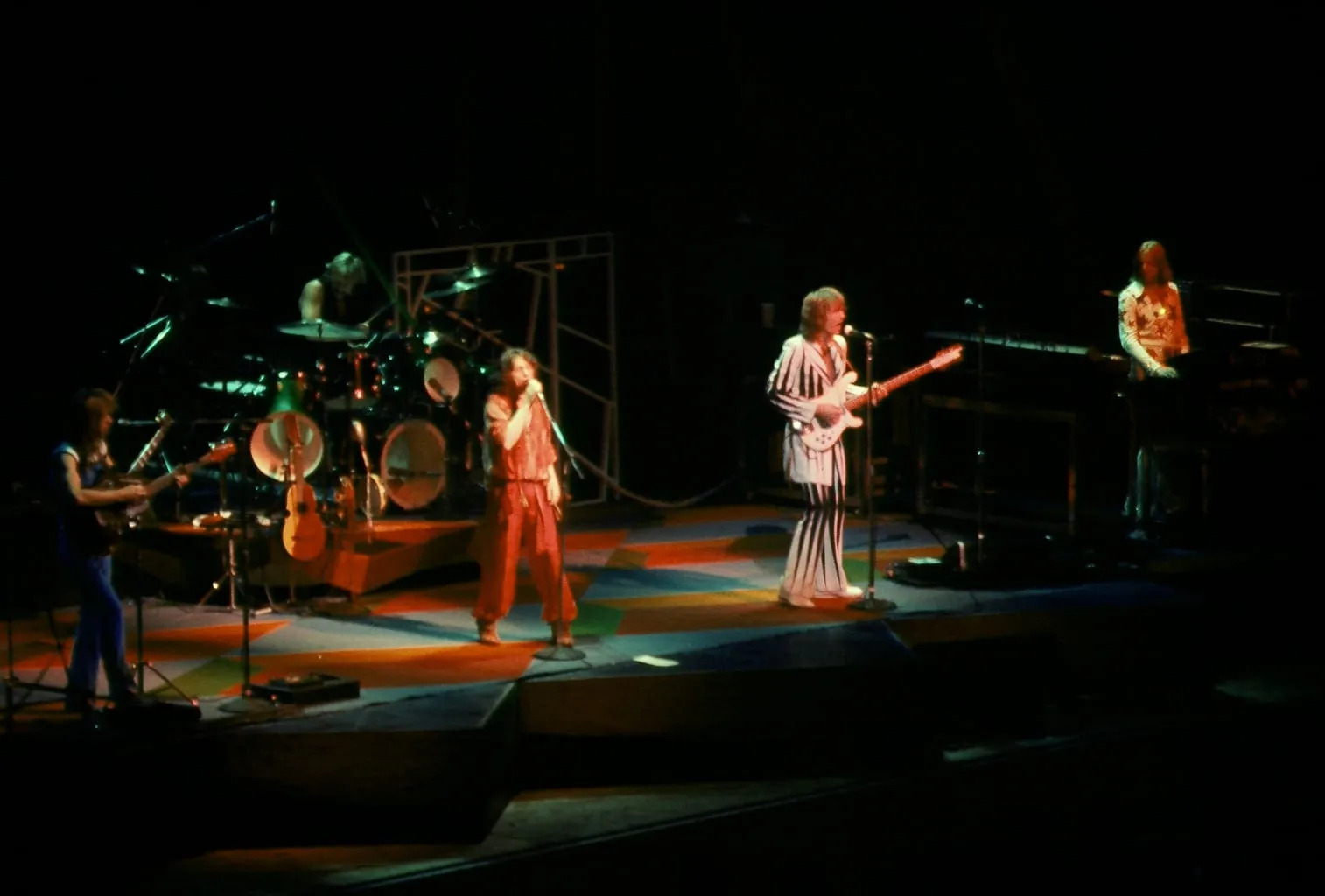
Photo by Rick Dikeman , licensed under CC BY-SA 3.0 · Wikimedia Commons
Rank #27
Yes
Symphonic prog architects whose long suites defined the genre's ambition.
From Wikipedia
Yes are an English progressive rock band formed in London in 1968. Comprising 20 full-time musicians over their career, their most notable members include lead singer Jon Anderson, bassist Chris Squire, guitarists Steve Howe and Trevor Rabin, drummers Bill Bruford and Alan White, and keyboardists Tony Kaye and Rick Wakeman. The band have explored several musical styles and are often regarded as progressive rock pioneers. Since February 2023, the band's line-up consists of Howe, keyboardist Geoff Downes, bassist Billy Sherwood, singer Jon Davison, and drummer Jay Schellen.
Members
- Bill Bruford
- Chris Squire
- Jon Anderson
- Rick Wakeman
- Steve Howe
Studio Albums
- 1969 Yes
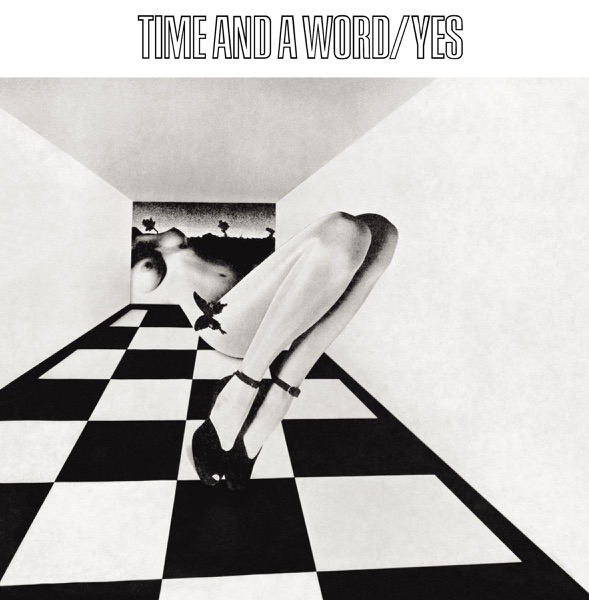
- 1970 Time and a Word
- 1971 The Yes Album
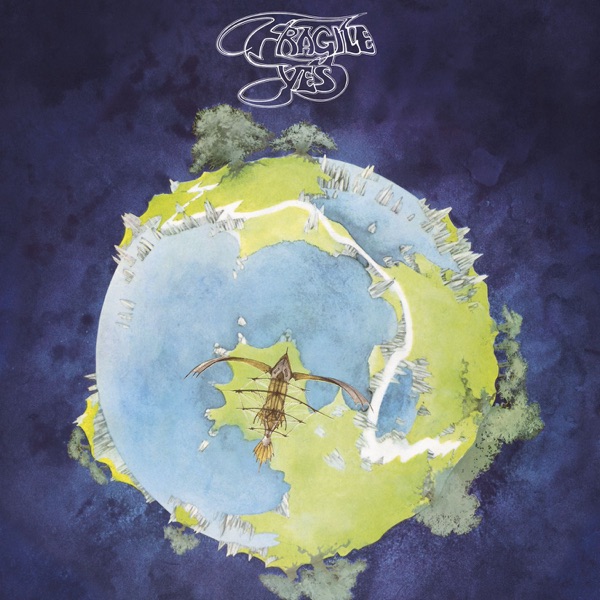
- 1971 Fragile
- 1972 Close to the Edge
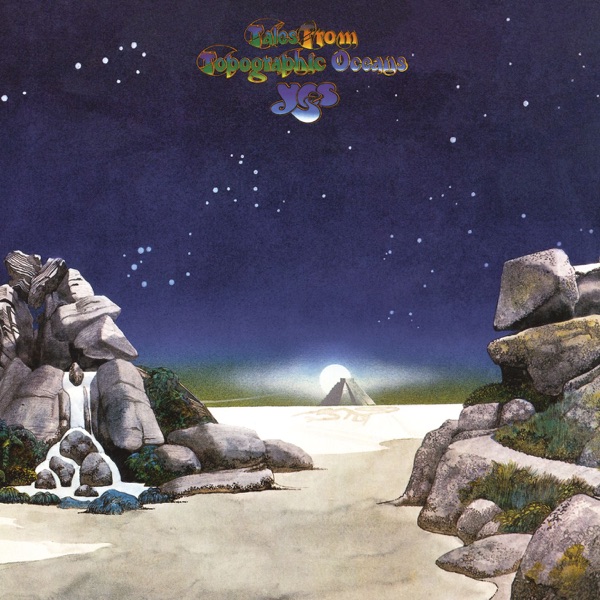
- 1973 Tales From Topographic Oceans
- 1974 Relayer
- 1977 Going for the One
- 1978 Tormato
- 1980 Drama
- 1983 90125
- 1987 Big Generator
- 1991 Union
- 1994 Talk
- 1997 Open Your Eyes
- 1999 The Ladder
- 2001 Magnification
- 2011 Fly From Here
- 2014 Heaven & Earth
- 2018 Fly From Here: Return Trip
- 2021 The Quest
- 2023 Mirror to the Sky
- 2026 Aurora
Source: MusicBrainz
Deep Dive
Overview
Yes are an English progressive rock band formed in London in 1968 who became architects of symphonic prog, a subgenre defined by extended compositional forms, classical instrumentation, and conceptual ambition. Across five decades, the band has cycled through approximately 20 full-time musicians, yet maintained a core identity built on virtuosity and compositional invention. Their work in the early 1970s established templates for long-form rock suites that influenced generations of progressive and art rock acts.
Formation Story
Yes crystallized in London in 1968 from the collision of several musical currents. The initial lineup drew from existing bands and solo musicians in the British rock scene, uniting around a shared fascination with extending rock music beyond the three-minute single format. By the time of their debut, the group had settled on a core of musicians who would define their classic period: Jon Anderson on lead vocals, Chris Squire on bass, Steve Howe on guitar, and keyboard and percussion players who rotated as the band’s sonic palette expanded. This formation emerged during a cultural moment when rock musicians increasingly looked toward classical and orchestral structures, seeking to legitimize rock as art music.
Breakthrough Moment
Yes’s initial albums, Yes (1969) and Time and a Word (1970), established their potential but remained within conventional rock frameworks. The breakthrough came with The Yes Album (1971), which introduced extended instrumental passages and multi-part song structures that showcased each member’s technical prowess. The album signaled a decisive turn toward prog ambition. That same year, Fragile deepened this direction, featuring multi-movement pieces that exemplified the band’s approach to composition. By 1972, with Close to the Edge, Yes had achieved both commercial success and critical recognition as serious musicians. The title track, a three-part suite spanning over 20 minutes, became the defining statement of their early vision.
Peak Era
From 1971 to 1974, Yes entered their most creatively fertile and commercially dominant period. Close to the Edge (1972) and Tales From Topographic Oceans (1973) represented the apotheosis of their symphonic ambitions, with songs structured as extended suites featuring intricate instrumental passages, layered vocal harmonies, and conceptual thematic development. Rick Wakeman’s keyboard arrangements had become increasingly central to the band’s sound, bringing orchestral textures to rock instrumentation. In 1974, Relayer continued this trajectory with demanding, non-linear song structures. By the mid-1970s, Yes occupied a unique position in rock: they commanded stadium audiences while maintaining uncompromising compositional approaches that privileged technical complexity and thematic coherence over radio accessibility.
Musical Style
Yes defined their sound through a precise fusion of rock and classical elements. The band’s instrumental approach centered on technical virtuosity across all positions: Chris Squire’s bass work moved beyond rhythm section convention, operating as a quasi-lead instrument with melodic agency; Steve Howe’s guitar playing combined rock phrasing with classical fingerstyle technique; drum work (initially Bill Bruford, later Alan White) employed polyrhythmic complexity borrowed from jazz and progressive classical percussion; and the keyboard chair—occupied most famously by Rick Wakeman but also Tony Kaye—functioned as an orchestral instrument capable of rendering strings, brass, and organ textures within a rock ensemble. Jon Anderson’s vocals, high-pitched and often layered with themselves, provided a distinct timbral signature. Lyrically, the band favored abstract, philosophical, and occasionally mystical themes rather than narrative rock conventions. This combination of technical facility, conceptual sophistication, and orchestral ambition became the defining template for symphonic prog.
Major Albums
Close to the Edge (1972)
The band’s masterwork, built around a 20-minute title suite that remains the quintessential prog composition: three distinct movements, contrasting tempos, and instrumental passages showcasing each member’s individual facility within a unified conceptual framework.
Fragile (1971)
An album-length exploration of multi-part composition featuring intricate vocal arrangements, virtuosic instrumental passages, and production techniques that placed keyboards and bass prominently in the mix.
The Yes Album (1971)
Their first full commitment to extended compositional forms, establishing the long-suite approach that would become their signature and demonstrating that rock could accommodate classical structural principles without sacrificing energy.
Tales From Topographic Oceans (1973)
A double album structured as four lengthy suites, each building abstract thematic material and showcasing the band’s ensemble interplay at maximum complexity.
Relayer (1974)
The final album of their first great period, demonstrating that the band could continue evolving within the symphonic framework without repeating themselves, with even more rhythmically intricate and harmonically adventurous compositions.
90125 (1983)
A commercial resurgence featuring a more accessible production and song structures, demonstrating the band’s willingness to adapt their approach while retaining technical sophistication.
Signature Songs
- “Owner of a Lonely Heart” — The closest Yes came to a conventional pop-rock single, achieving mainstream radio play while retaining the band’s harmonic complexity.
- “Roundabout” — A multi-part suite from Fragile that became one of their most recognizable pieces, balancing accessibility with genuine compositional ambition.
- “Heart of the Sunrise” — From Fragile, a showcase for Chris Squire’s bass playing and the band’s ability to balance aggression with sophisticated arrangement.
- “And You and I” — A three-movement composition from Close to the Edge demonstrating how yes could develop themes across extended instrumental passages.
- “Close to the Edge” — The title track from their masterwork, the apotheosis of their symphonic approach, a 20-minute suite that remains the archetypal progressive rock composition.
- “Starship Trooper” — From The Yes Album, a three-part suite that established their long-form approach and showcased the band’s ensemble interplay.
Influence on Rock
Yes fundamentally altered what rock music could be structurally and conceptually. By validating extended compositions, sophisticated harmonic language, and classical instrumental textures within rock contexts, they created a template that influenced not only subsequent progressive rock acts but also metal, fusion, and alternative rock musicians. Bands from Genesis to King Crimson to Dream Theater either emerged parallel to Yes or explicitly built upon the compositional and production vocabularies that Yes had pioneered. The band’s influence extended beyond direct imitation to a broader cultural validation of ambition in rock: the notion that rock music need not be confined to verse-chorus structures or three-minute formats became established partly through Yes’s sustained commercial success with extended, complex compositions.
Legacy
Yes maintained continuous activity through the 1980s, 1990s, and 2000s, despite periodic lineup changes and shifting commercial fortunes. Albums like 90125 (1983) achieved commercial success by adapting their approach to then-current production standards, while later works such as The Ladder (1999) and Magnification (2001) continued their commitment to complex composition. The band’s catalog achieved new reach through reissues, with vinyl reissues of Close to the Edge, Fragile, and The Yes Album introducing their work to successive generations of rock listeners. Into the 2020s, Yes continued recording and touring, releasing The Quest (2021) and Mirror to the Sky (2023), demonstrating remarkable longevity. Their position in progressive rock history remains secure: they remain one of the few prog acts to achieve both sustained commercial success and enduring critical respect, with their early 1970s output retaining canonical status within rock music.
Fun Facts
- Rick Wakeman’s keyboard arrangements on Tales From Topographic Oceans and other albums of that era employed Mellotron and other early synthesizers in ways that directly influenced the development of keyboard-driven progressive rock across the subsequent decades.
- The band has comprised approximately 20 full-time musicians across its career, making lineup changes a recurrent feature of Yes history, yet maintaining a recognizable core identity despite these shifts.
- The Yes Album marked the first appearance of Steve Howe in the band’s lineup, replacing an earlier guitarist and introducing a more classical-influenced guitar aesthetic that became central to their sound.
Discography & Previews
Click any album to expand its track list. Each track plays a 30-second preview streamed from Apple Music. Tap the link icon next to a track to open it in Apple Music for full playback.


- 1 Roundabout ↗ 8:36
- 2 Cans and Brahms (Extracts from Brahms' 4th Symphony in E Minor, Third Movement) ↗ 1:43
- 3 We Have Heaven ↗ 1:40
- 4 South Side of the Sky ↗ 7:56
- 5 Five Per Cent for Nothing ↗ 0:38
- 6 Long Distance Runaround ↗ 3:30
- 7 The Fish (Schindleria Praematurus) ↗ 2:42
- 8 Mood for a Day ↗ 3:03
- 9 Heart of the Sunrise ↗ 11:27


- 1 I Would Have Waited Forever ↗ 6:32
- 2 Shock To The System ↗ 5:09
- 3 Masquerade ↗ 2:17
- 4 Lift Me Up ↗ 6:30
- 5 Without Hope You Cannot Start The Day ↗ 5:19
- 6 Saving My Heart ↗ 4:42
- 7 Miracle Of Life ↗ 7:30
- 8 Silent Talking ↗ 4:01
- 9 The More We Live - Let Go ↗ 4:52
- 10 Angkor Wat ↗ 5:25
- 11 Dangerous (Look In the Light of What You're Searching For) ↗ 3:37
- 12 Holding On ↗ 5:27
- 13 Evensong ↗ 0:52
- 14 Take The Water To The Mountain (Edit) ↗ 3:10


- 1 Fly from Here: Overture ↗ 1:52
- 2 Fly from Here, Pt. I: We Can Fly ↗ 5:04
- 3 Fly from Here, Pt. II: Sad Night at the Airfield ↗ 5:25
- 4 Fly from Here, Pt. III: Madman at the Screens ↗ 4:36
- 5 Fly from Here, Pt. IV: Bumpy Ride ↗ 2:16
- 6 Fly from Here, Pt. V: We Can Fly (Reprise) ↗ 2:18
- 7 The Man You Always Wanted Me to Be ↗ 5:25
- 8 Life On a Film Set ↗ 5:06
- 9 Hour of Need ↗ 6:46
- 10 Solitaire ↗ 3:31
- 11 Don't Take No for an Answer ↗ 4:22
- 12 Into the Storm ↗ 6:55
- 1 Fly from Here: Overture ↗ 1:52
- 2 Fly from Here, Pt. I: We Can Fly ↗ 5:04
- 3 Fly from Here, Pt. II: Sad Night at the Airfield ↗ 5:25
- 4 Fly from Here, Pt. III: Madman at the Screens ↗ 4:36
- 5 Fly from Here, Pt. IV: Bumpy Ride ↗ 2:16
- 6 Fly from Here, Pt. V: We Can Fly (Reprise) ↗ 2:18
- 7 The Man You Always Wanted Me to Be ↗ 5:25
- 8 Life On a Film Set ↗ 5:06
- 9 Hour of Need ↗ 6:46
- 10 Solitaire ↗ 3:31
- 11 Don't Take No for an Answer ↗ 4:22
- 12 Into the Storm ↗ 6:55


