
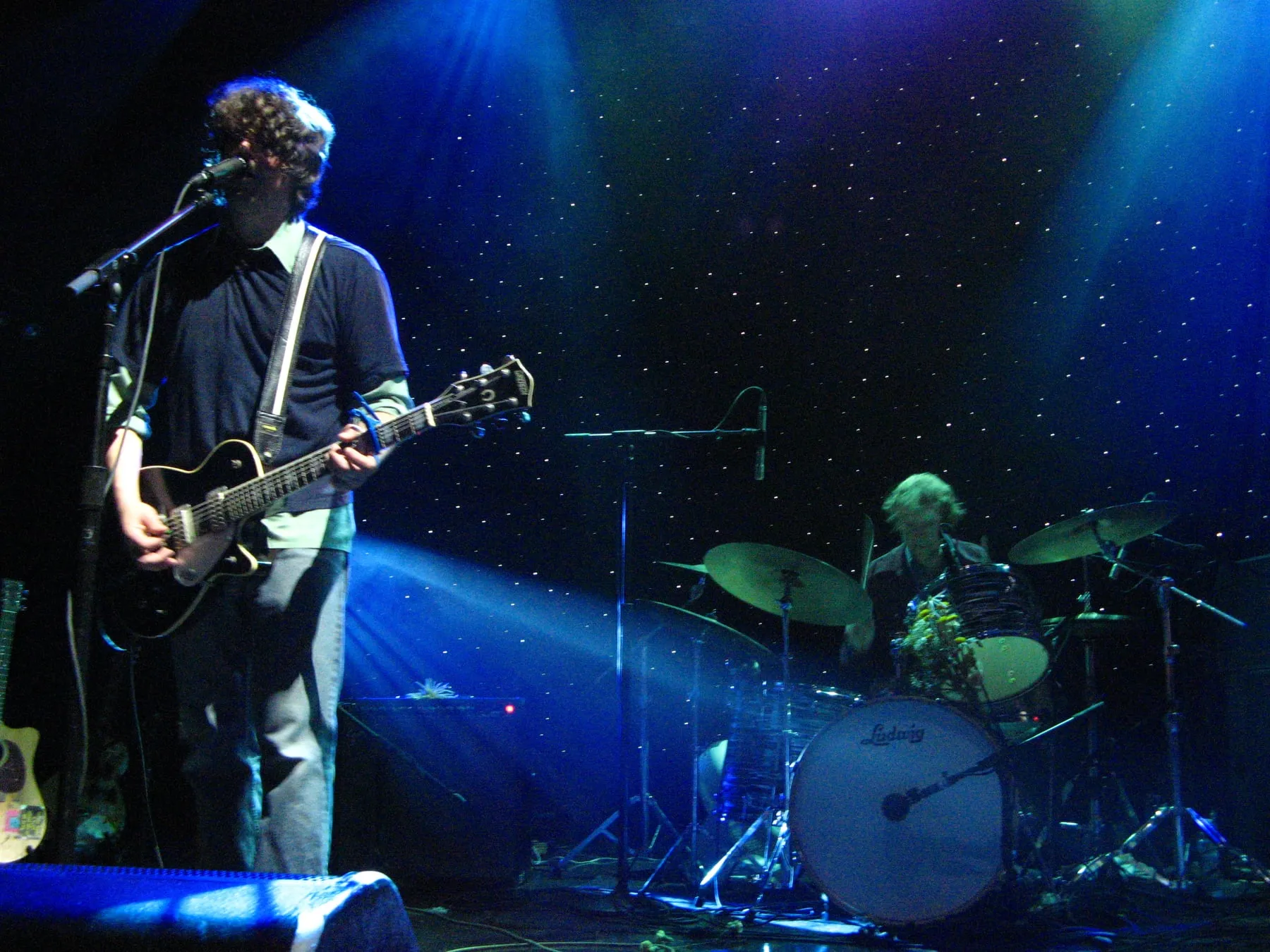
Photo by Mangledorf at English Wikipedia , licensed under Public domain · Wikimedia Commons
Rank #447
Sebadoh
Lou Barlow's lo-fi indie band, an essential 90s touchstone.
From Wikipedia
Sebadoh is an American indie rock band formed in 1986 in Northampton, Massachusetts, by Eric Gaffney and Lou Barlow, with multi-instrumentalist Jason Loewenstein completing the line-up in 1989. Barlow co-created Sebadoh as an outlet for his songwriting when J. Mascis gradually took over creative control of Dinosaur Jr., in which Barlow plays bass guitar.
Members
- Lou Barlow
Deep Dive
Overview
Sebadoh is an American indie rock band formed in 1986 in Northampton, Massachusetts, by Eric Gaffney and Lou Barlow. Emerging from the American underground during a period when lo-fi production values were becoming an aesthetic choice rather than a limitation, Sebadoh established themselves as essential architects of 1990s indie rock. The band’s prolific output and commitment to unpolished, emotionally direct songwriting made them a touchstone for the slacker rock movement and a proving ground for experimental approaches to indie composition.
The band’s founding grew from a practical necessity: Barlow, whose bass work anchored J. Mascis’s Dinosaur Jr., created Sebadoh as a creative outlet when Mascis increasingly dominated that band’s songwriting and direction. Rather than compete, Barlow built his own vehicle, one that would ultimately prove equally influential in shaping the decade’s underground rock landscape.
Formation Story
Lou Barlow and Eric Gaffney formed Sebadoh in 1986 in Westfield, Massachusetts, emerging from the same New England indie scene that had produced Dinosaur Jr. and countless other bands operating outside mainstream channels. The early incarnation was decidedly lo-fi, with Barlow and Gaffney layering home recordings and tape-based experiments into a dense, textured sound that predated much of the lo-fi movement’s later codification.
Jason Loewenstein joined the lineup in 1989, solidifying the classic trio that would define the band’s most celebrated period. Loewenstein’s addition brought additional instrumental versatility and contributed writing and vocal work that expanded Sebadoh’s compositional palette. The three-piece configuration proved durable and productive, establishing the foundation for a discography that would span decades.
Breakthrough Moment
Sebadoh’s commercial and critical breakthrough arrived with Bakesale in 1994, an album that synthesized the band’s accumulated experiments into a more cohesive, song-focused statement without abandoning their characteristic roughness. Released during the height of 1990s indie rock’s mainstream visibility, Bakesale introduced Sebadoh to wider audiences while maintaining the unvarnished aesthetic that had won them devoted listeners in underground circles.
The album’s success—relative to indie standards—established Sebadoh as more than a side project or experimental venture; it confirmed them as a legitimate, sustained creative force. Their earlier albums, including III (1991), Weed Forestin (1990), and Bubble and Scrape (1993), had built a reputation for prolific, idiosyncratic songwriting, but Bakesale marked their transition into the band’s most visible era.
Peak Era
The period spanning the early-to-mid 1990s, roughly 1993 to 1996, constituted Sebadoh’s peak creative and commercial moment. During this window, the band released Bubble and Scrape (1993), Bakesale (1994), and Harmacy (1996), three albums that demonstrated both consistency and evolution. These records balanced Barlow’s lo-fi sensibilities with increasingly sophisticated songwriting, allowing the band to reach listeners who appreciated both experimental production and strong melodic content.
Harmacy, arriving two years after Bakesale, saw the band continuing to refine their approach while maintaining the accessible-yet-unpolished character that defined them. This period represented Sebadoh at their most productive and artistically confident, establishing the template for indie rock that would influence countless bands throughout the late 1990s and into the 2000s.
Musical Style
Sebadoh’s sound is rooted in lo-fi indie rock, though the band’s approach evolved considerably across their catalog. Early records like Weed Forestin and III embraced deliberate lo-fi production, with home-recording techniques creating a deliberately murky, intimate aesthetic. Barlow’s bass-driven songwriting, inherited from his work with Dinosaur Jr., provided melodic anchoring even when surrounded by noisy textures and lo-fi effects.
As the 1990s progressed, Sebadoh’s production improved without sacrificing rawness. Loewenstein’s guitar work and vocal contributions introduced a power-pop sensibility that balanced Barlow’s more introspective tendencies. The band’s genre classification spans indie rock, alternative rock, and slacker rock—labels that reflect their position between purely experimental acts and more conventional alternative rock bands. Their songwriting prioritized emotional directness over technical precision, with vocal melodies often pushed forward against densely layered instrumental arrangements. By Bakesale and Harmacy, the band had developed a signature hybrid of lush instrumentation and intentionally rough production, creating a distinctive textural identity.
Major Albums
Weed Forestin (1990)
Sebadoh’s second album, which refined the lo-fi approach of their debut with more developed songwriting and tighter arrangements while maintaining the tape-based aesthetic that defined their early work.
Bubble and Scrape (1993)
This album marked a turning point in the band’s sound, introducing cleaner production values and more polished songwriting while preserving the lo-fi ethos that had become their trademark.
Bakesale (1994)
Sebadoh’s most commercially successful album, balancing accessibility with their characteristic unpolished approach and containing their most widely recognized material.
Harmacy (1996)
The band’s final release before a period of reduced activity, demonstrating continued artistic development and a fuller, more layered production aesthetic.
The Sebadoh (1999)
Returning after a gap in releases, this self-titled effort reasserted the band’s presence in the indie rock landscape as the 1990s concluded.
Signature Songs
- Soul and Fire — A defining moment of Barlow’s melodic sensibility married to the band’s textural complexity, representing their emotional directness.
- The Freed Man — The title track from their debut, establishing the lo-fi aesthetic and intimate songwriting approach that would define them.
- Gimme Indie Now — An anthemic statement of indie rock principles that became synonymous with Sebadoh’s approach to outsider music.
Influence on Rock
Sebadoh’s influence on 1990s indie rock cannot be overstated. At a moment when lo-fi production was becoming a deliberate aesthetic choice rather than an economic necessity, Sebadoh demonstrated that intentional roughness could coexist with strong songwriting and emotional resonance. Their commitment to prolific output, DIY ethos, and uncompromising approach to recording inspired countless bedroom producers and indie bands.
The band’s work helped legitimate lo-fi production as a valid artistic choice in a decade when production fidelity was increasingly accessible to independent artists. Their layering of multiple vocal and instrumental parts within lo-fi frameworks influenced how subsequent generations of indie and alternative rock musicians approached recording and production. Sebadoh’s position between experimental electronic music and traditional rock songwriting opened pathways that would be explored by slacker rock and emo-adjacent bands throughout the late 1990s and 2000s.
Legacy
Sebadoh remained active through the 2000s and beyond, releasing Defend Yourself (2013) and Act Surprised (2019), demonstrating sustained creative engagement decades after their initial formation. While their most influential period remained centered on the 1990s, the band’s ability to continue recording and performing affirmed their status as more than a historical artifact.
Their Northampton, Massachusetts roots became part of indie rock mythology, a place where creative and commercial ambitions could be pursued outside major urban centers. The band’s discography from 1986 onward remains a central reference point in discussions of lo-fi aesthetics and 1990s indie rock, with subsequent generations discovering their work through streaming platforms and reissues that have kept their early albums in circulation.
Fun Facts
- Lou Barlow formed Sebadoh while remaining the bassist for J. Mascis’s Dinosaur Jr., managing both projects simultaneously during the band’s most creatively fertile period.
- The band’s prolific early releases came out on numerous independent labels, including Joyful Noise Recordings and Flying Nun Records, reflecting the distributed nature of 1990s indie rock distribution.
- Eric Gaffney’s production and arrangement work on early Sebadoh records made extensive use of home recording techniques and tape layering that became characteristic of the lo-fi movement.
- Sebadoh’s consistent touring and recording schedule throughout the 1990s established them as one of the more reliable and productive acts in the underground rock world.