
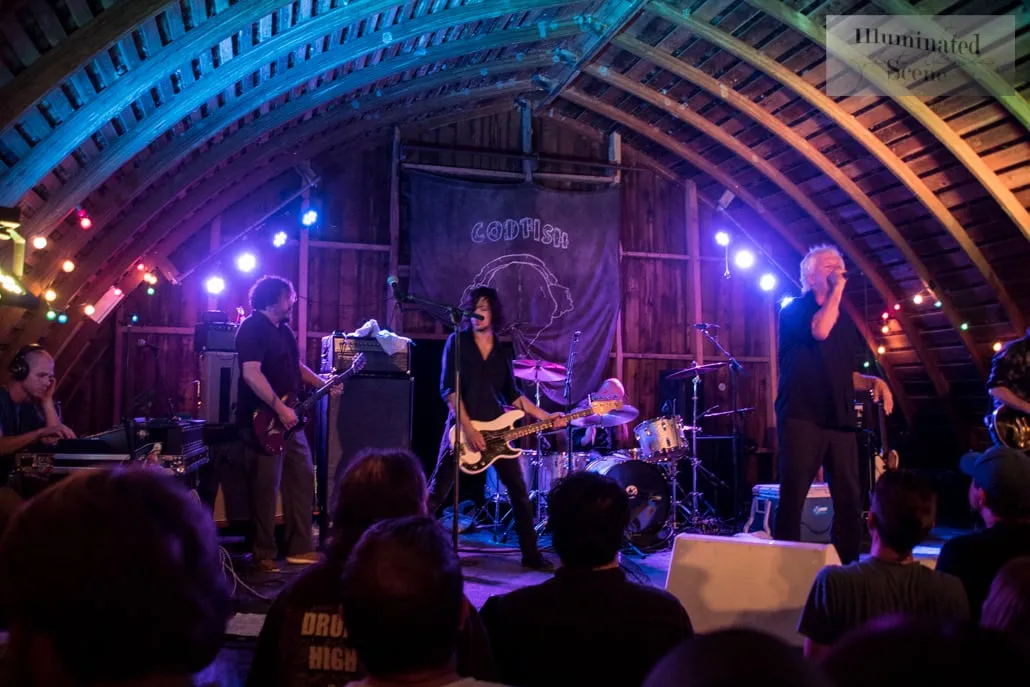
Photo by Roberta , licensed under CC BY 2.0 · Wikimedia Commons
Rank #448
Guided by Voices
Dayton indie-rock institution of Robert Pollard's prolific four-track songwriting.
From Wikipedia
Guided by Voices is an American indie rock band formed in 1983 in Dayton, Ohio. The band had various lineup changes, with singer and songwriter Robert Pollard remaining the group's sole constant. The most well-known lineup of the band consisted of Pollard, his brother Jim, Mitch Mitchell, Tobin Sprout, Kevin Fennell (drums), and bassist Greg Demos.
Members
- Bobby Bare, Jr.
- Chris Slusarenko
- Doug Gillard
- Greg Demos
- Jim Pollard
- Kevin Fennell
- Kevin March
- Mark Shue
- Mitch Mitchell
- Nate Farley
- Paul Comstock
- Robert Pollard
- Timothy Payton Earick
- Tobin Sprout
Deep Dive
Overview
Guided by Voices is an American indie rock band formed in 1983 in Dayton, Ohio, that became one of the most prolific and influential acts in lo-fi and indie rock. Led by singer and songwriter Robert Pollard, whose restless creative output has defined the band’s trajectory across four decades, Guided by Voices emerged from the American heartland to reshape underground rock music in the 1990s. The band’s core identity rests on Pollard’s gift for crafting melodic songs on four-track tape machines, a DIY approach that influenced countless indie and alternative rock artists long before lo-fi production became fashionable.
Formation Story
Guided by Voices coalesced in Dayton, Ohio, in 1983 as Robert Pollard began recording songs in isolation, treating the project initially as a solo venture with studio collaborators. Pollard remained the group’s sole constant through numerous lineup changes, a deliberate artistic choice that allowed him to pursue his prolific songwriting impulses without constraint. By the early 1990s, a stable working lineup emerged featuring Pollard on vocals, his brother Jim, guitarist and keyboardist Tobin Sprout, drummer Kevin Fennell, bassist Greg Demos, and guitarist Mitch Mitchell. This ensemble became the most recognizable incarnation of the band and would drive their mainstream indie rock breakthrough.
Breakthrough Moment
Guided by Voices’ transition from Dayton cult phenomenon to national indie rock presence crystallized with the release of Bee Thousand in 1994, a 20-track collection that immediately became a touchstone for lo-fi aesthetics in underground rock. The album’s deliberately lo-fi production, melodic song construction, and sheer volume of ideas—each track a fully realized pop-rock miniature—struck a chord with college radio and indie rock publications. The following year, Alien Lanes (1995) cemented this momentum, expanding the band’s audience while maintaining the stripped-down sound that had defined their earlier work. These two albums positioned Guided by Voices as central figures in a broader 1990s movement that valued songwriting craft and emotional directness over studio polish.
Peak Era
The mid-to-late 1990s marked Guided by Voices’ period of greatest creative visibility and cultural impact. Albums including Vampire on Titus (1993), Bee Thousand (1994), Alien Lanes (1995), Under the Bushes Under the Stars (1996), and Mag Earwhig! (1997) established the band’s sonic template and proved its sustainability. Do the Collapse (1999) demonstrated an evolution toward more polished production while retaining the melodic urgency that defined their sound. Throughout this era, Pollard’s songwriting remained the nucleus, with supporting musicians like Tobin Sprout and Mitch Mitchell contributing instrumental textures and arrangements that enriched the foundational compositions. The band’s ability to release multiple albums in single years—a pattern visible throughout their discography—reflected both Pollard’s prolific nature and the band’s commitment to keeping material in circulation.
Musical Style
Guided by Voices’ sound draws from power pop, post-punk, and 1980s alternative rock, filtered through the lo-fi production methods that became central to their identity. The band’s early recordings, made on four-track tape machines, embraced audible hiss, compression artifacts, and tape saturation as integral to the music’s character rather than limitations to overcome. Melodically, Pollard and Sprout crafted songs in the tradition of British Invasion pop-rock, with angular guitar riffs, unexpected harmonic turns, and vocal melodies that often subverted conventional song structures. As the band matured across the late 1990s and beyond, production quality increased on some releases, though the emphasis on direct melodic communication and unconventional arrangements remained constant. The rhythm section—Fennell’s drums and Demos’ bass—typically operated within tight, propulsive frameworks that anchored Pollard’s wandering vocal lines and layered guitar textures. Sprout’s keyboard playing added harmonic sophistication and occasional psychedelic coloring, while guest musicians expanded the sonic palette without diluting the band’s core identity.
Major Albums
Bee Thousand (1994)
A defining lo-fi indie rock statement, Bee Thousand’s 20 concise tracks established Guided by Voices as architects of a new underground aesthetic, with melodic construction trumping production fidelity.
Alien Lanes (1995)
Expanding on Bee Thousand’s formula with slightly expanded arrangements and a broader emotional range, Alien Lanes became the band’s most beloved album, proving the durability of their songwriting approach.
Under the Bushes Under the Stars (1996)
This album marked a step toward fuller production without abandoning the band’s core melodic identity, featuring some of their most fully realized pop-rock compositions alongside experimental detours.
Mag Earwhig! (1997)
Reflecting Pollard’s continued restlessness, Mag Earwhig! showcased further sonic expansion and varied influences, demonstrating that the band could sustain creative momentum into the late 1990s.
Do the Collapse (1999)
Moving beyond lo-fi constraints while retaining melodic focus, Do the Collapse represented a natural evolution and arguably the band’s final album of the original peak era before a hiatus.
Isolation Drills (2001)
Returning after a two-year absence, Isolation Drills reasserted the band’s relevance in a post-lo-fi independent rock landscape, proving Guided by Voices’ appeal transcended production trends.
Signature Songs
- “Gold Soul Standard” — A propulsive power-pop moment that distills the band’s melodic ambitions into a radio-friendly format.
- “A Little Space” — An intimate vocal-and-guitar composition that showcases Pollard’s ability to convey emotional vulnerability within the band’s broader aesthetic.
- “Game of Pricks” — A driving track that combines aggressive guitar work with hooky vocal melodies, exemplifying the band’s tonal range.
- “I Am a Scientist” — An indie rock anthem that achieved wider exposure, demonstrating the band’s crossover potential without compromising artistic vision.
- “Tractor Rape Chain” — A lo-fi gem from Alien Lanes that encapsulates the band’s gift for memorable melodic fragments buried in tape hiss.
- “The Official Ironmen Rally Song” — A quirky, structured pop-rock piece that reveals the band’s sense of humor and willingness to embrace unconventional song subjects.
Influence on Rock
Guided by Voices fundamentally altered indie rock’s relationship with production quality and commercial viability. By demonstrating that lo-fi aesthetics could serve compelling songwriting rather than function as markers of poverty, the band gave permission to countless artists to embrace rough textures, tape compression, and home-recording as artistic choices. The band’s influence radiated across 1990s and 2000s indie rock, affecting acts ranging from Neutral Milk Hotel to Lo-Fidelity Allstars, who adopted Guided by Voices’ philosophy that melody and emotional sincerity transcended studio polish. Robert Pollard’s prolific output—multiple album releases per year—also influenced the independent rock model of direct artist-to-listener distribution, presaging the streaming era’s album-centric release schedules. The band’s success on independent and eventually major indie labels (Matador Records, TVT Records) proved there was a substantial audience for uncompromising alternative rock in the 1990s, opening doors for other Midwestern acts and validating regional rock scenes outside traditional industry centers.
Legacy
Guided by Voices’ sustained activity across four decades—continuing to release albums regularly into the 2020s, with releases like Strut of Kings (2024) and Universe Room (2025) demonstrating ongoing creative momentum—positions them as elder statesmen of indie rock. The band’s prolific catalog, spanning from Sandbox (1987) to recent work, documents a consistent artistic vision even as individual lineups shifted. Though not typically discussed in the same breath as mainstream 1990s rock phenomena, their influence on the underground remains substantial, with their reissues and catalog serving as historical markers of American independent music’s evolution. The band’s transition from lo-fi pioneers to established indie rock institution reflects broader changes in how alternative music is consumed and valorized; what once seemed marginal or deliberately anti-commercial has become canonized. Robert Pollard’s longevity as a recording artist—continuing to produce new material well into his sixties—offers a model of artistic persistence and creative renewal that stands apart from rock’s typical boom-and-bust cycles.
Fun Facts
- Robert Pollard recorded early Guided by Voices material largely in isolation before assembling the core band lineup, making the project initially more solo endeavor than traditional rock group.
- The band has maintained remarkable consistency in album releases across decades, with production accelerating notably from 2012 onward, suggesting a shift toward greater output in their mature years.
- Guided by Voices emerged from Dayton, Ohio, a region not typically associated with indie rock prominence at the time, helping establish the Midwest as a wellspring of underground musical creativity.
- The band’s most well-known lineup featured two guitarists—Tobin Sprout and Mitch Mitchell—whose complementary playing styles and instrumental contributions helped define the band’s signature sound.