
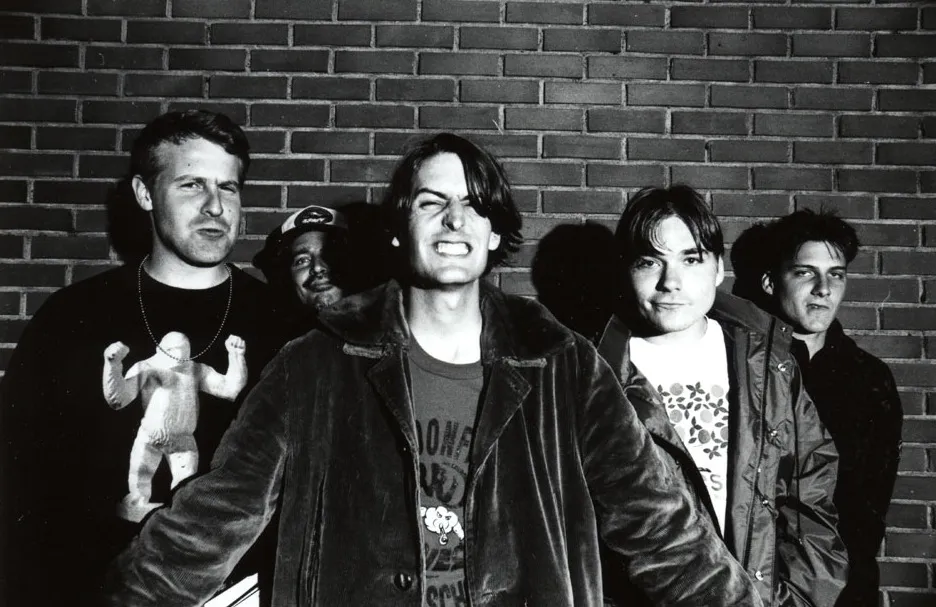
Photo by Masao Nakagami , licensed under CC BY-SA 2.0 · Wikimedia Commons
Rank #446
Pavement
Stockton lo-fi indie cornerstone whose albums remain indie-rock canon.
From Wikipedia
Pavement is an American indie rock band that formed in Stockton, California in 1989. For most of their career, the group consisted of vocalist and guitarist Stephen Malkmus, guitarist and vocalist Scott Kannberg, bassist Mark Ibold, drummer Steve West and vocalist and multi-instrumentalist Bob Nastanovich. Initially conceived as a recording project, the band at first avoided press or live performances, while attracting considerable underground attention with their early releases. Gradually evolving into a more polished band, Pavement recorded five full-length albums and ten EPs over the course of a decade, though the group disbanded with some acrimony in 1999 as the members moved on to other projects. In 2010, Pavement undertook a well-received reunion tour, followed by another international tour from 2022 to 2024.
Members
- Stephen Malkmus
Studio Albums
- 1992 Slanted and Enchanted
- 1993 Summer Babe
- 1994 Crooked Rain, Crooked Rain
- 1995 Wowee Zowee
- 1997 Brighten the Corners
- 1999 Terror Twilight
Source: MusicBrainz
Deep Dive
Overview
Pavement is an American indie rock band formed in Stockton, California in 1989, during a pivotal moment when underground recording technology and DIY distribution networks were beginning to reshape popular music. For most of their career, the group consisted of vocalist and guitarist Stephen Malkmus, guitarist and vocalist Scott Kannberg, bassist Mark Ibold, drummer Steve West, and vocalist and multi-instrumentalist Bob Nastanovich. Initially conceived as a recording project rather than a traditional touring ensemble, Pavement occupied a central position in the 1990s indie rock landscape—deliberately obscure yet undeniably influential, crafting albums that balanced lo-fi production aesthetics with increasingly sophisticated songwriting and arrangement. The band’s catalog remains embedded in indie rock canon, foundational to how a generation understood the relationship between underground credibility and artistic ambition.
Formation Story
Pavement began as an experimental venture in 1989 when Stephen Malkmus and Scott Kannberg started recording together in Stockton, a city in California’s Central Valley with little established music infrastructure. The two worked in isolation, deliberately avoiding the press and live performances that might have forced the project into conventional band narratives. This early period of anonymity was deliberate: Pavement emerged from a cultural moment when indie rock was being defined partly by what it rejected—major-label machinery, predictable promotion, and the expectation that unknown bands must quickly seek validation through touring. The nucleus of Malkmus and Kannberg, supported by Mark Ibold on bass, Steve West on drums, and Bob Nastanovich on vocals and keyboards, gradually solidified the lineup that would record their most celebrated work. Rather than announcing themselves as a new band seeking attention, Pavement simply released material and let listeners discover them through underground channels and word-of-mouth.
Breakthrough Moment
Pavement’s transition from underground curiosity to recognized force occurred through their early EPs and the release of their debut full-length album Slanted and Enchanted in 1992. The album, recorded on a modest budget with lo-fi production that became part of its character rather than a limitation to be overcome, demonstrated that Malkmus and Kannberg could write melodies that lodged in the ear despite—or because of—the murky, compressed sound. Slanted and Enchanted circulated through independent record shops, college radio, and the growing network of indie rock fans who prized bands that seemed indifferent to mainstream approval. By 1994, with the release of Crooked Rain, Crooked Rain, Pavement’s reputation had solidified enough that indie rock listeners recognized them as essential. The album’s more polished production and Malkmus’s increasingly distinctive vocal delivery—at once detached and emotionally precise—established Pavement as central to the American indie rock conversation alongside bands like Sonic Youth and Pixies. This was not a moment of radio breakthrough or MTV penetration; it was the slower, deeper process by which a band becomes necessary to the people who care most about contemporary rock music.
Peak Era
Pavement’s creative and commercial apex stretched from 1994 through 1997, encompassing Crooked Rain, Crooked Rain, Wowee Zowee (1995), and Brighten the Corners (1997). During these years, the band managed the difficult balance of maintaining underground credibility while slowly broadening their audience—playing larger venues, appearing in independent film and television contexts, and receiving serious critical attention. Wowee Zowee in particular showcased the band’s willingness to experiment with structure and timbre; the album sprawled across its runtime with a kind of controlled chaos, mixing lo-fi textures with unexpectedly lush arrangements. Brighten the Corners represented a shift toward greater studio polish and pop sensibility without sacrificing the band’s essential identity. By 1997, Pavement had become one of the most important American rock bands of their generation, yet they remained outside the mainstream commercial machinery. They toured extensively and built a devoted international following, but never achieved the level of radio or MTV success of some of their contemporaries. This positioning—as a band of supreme importance within rock culture while remaining marginal to pop culture at large—became central to Pavement’s identity and cultural significance.
Musical Style
Pavement’s sound synthesized influences from punk, post-punk, and art rock while filtering them through a distinctly 1990s lo-fi sensibility. Stephen Malkmus’s vocals were characteristically flat and ironic, delivered with precision but without obvious emotion—a cool remove that paradoxically conveyed intensity. The band’s guitar work, centered on Malkmus and Scott Kannberg’s complementary approaches, ranged from angular, feedback-laden passages to surprisingly melodic figures that hooked the listener despite the austere production. Songs were often structured in unexpected ways: verses and choruses that did not follow standard pop templates, bridges that introduced entirely new melodic ideas, and arrangements that shifted textures mid-song without fanfare. The rhythm section of Mark Ibold and Steve West provided both propulsive drive and textural variety, sometimes locking into a groove and sometimes fragmenting to create tension. Bob Nastanovich’s additions on keyboards, percussion, and vocals added layers of color and irony. As Pavement’s career progressed, their production grew cleaner and more detailed, but the band never abandoned the rough aesthetic or the compositional adventurousness that defined their early work. They remained skeptical of polish for its own sake, suspicious of obvious hooks, and committed to songs that revealed themselves gradually.
Major Albums
Slanted and Enchanted (1992)
Pavement’s debut introduced their core sound—melodic, lo-fi, self-aware—and established the template for their best work. The album’s modest production became part of its appeal, offering a portrait of a band fully formed in their artistic intentions despite limited resources.
Crooked Rain, Crooked Rain (1994)
With a slightly fuller production and sharper songwriting, this album crystallized Pavement’s status as a major indie rock voice. It remains perhaps their most widely recognized work and the album that solidified their reputation among rock listeners who followed underground music.
Wowee Zowee (1995)
The band’s most experimental and sprawling album, Wowee Zowee showcased their willingness to stretch song structures and textures across an eclectic, sometimes chaotic framework. It alienated some listeners while deepening the devotion of others.
Brighten the Corners (1997)
A refinement toward greater accessibility and studio craft, Brighten the Corners balanced the band’s indie rock credentials with increasingly sophisticated arrangements and production choices, demonstrating their ability to evolve without losing identity.
Terror Twilight (1999)
Pavement’s final album before their breakup, Terror Twilight marked another shift in sound and approach, further emphasizing studio production and more conventional song structures as the band moved toward their eventual dissolution.
Signature Songs
- “Gold Soundz” — A deceptively simple melody carrying Malkmus’s observational lyrics, the song epitomizes Pavement’s ability to make understated beauty feel necessary.
- “Cut Me Like a Knife” — A brief, stark piece showcasing the band’s economy of expression and emotional weight despite minimal instrumentation.
- “Range Life” — A rambling, conversational song that exemplifies Pavement’s lyrical style and their refusal of conventional pop structure.
- “Shady Lane” — Built on a hypnotic guitar figure and deadpan vocal delivery, the song demonstrates how Pavement could create forward momentum through repetition and restraint.
Influence on Rock
Pavement’s influence on rock music lay partly in legitimizing a particular vision of indie rock—one that rejected both mainstream commercialism and the po-faced seriousness of earlier art-rock movements, instead finding sophistication in incompleteness and irony as an artistic tool rather than a dodge. Bands from the late 1990s onward owed debts to Pavement’s template: the idea that a rock band could be essential while remaining outside commercial structures, that lo-fi production was not necessarily a limitation but a choice, and that songwriting could be structurally adventurous while remaining emotionally resonant. The broader alternative rock movement of the 1990s included Pavement as a foundational reference point, and their approach to guitar-based indie rock influenced countless subsequent bands. They demonstrated that American indie rock could develop its own identity distinct from British post-punk or American post-punk, instead drawing on a combination of sources uniquely filtered through 1990s skepticism and aesthetic choices.
Legacy
After disbanding in 1999 with some internal tension, Pavement largely remained absent from active recording and touring for over a decade, though their albums continued to circulate and gain listeners through subsequent generations discovering indie rock. The band undertook a well-received reunion tour in 2010, signaling that their breakup was not permanent but rather a pause. From 2022 to 2024, Pavement again toured internationally, introducing their music to new audiences while satisfying longtime supporters. Their five studio albums and numerous EPs have maintained consistent prestige in rock criticism and remain central texts for understanding 1990s indie rock. Pavement never achieved the commercial scale of Nirvana or the sustained mainstream presence of U2, yet their artistic influence and the cult status of their catalog have only deepened with time. The band’s refusal of easy categorization—neither punk nor art-rock, neither lo-fi purists nor polished pop-rockers—ultimately became their greatest strength, creating a body of work that continually reveals new dimensions to listeners.
Fun Facts
- Pavement began as a recording project with deliberate avoidance of live performance and press interaction, a strategy unusual for bands seeking recognition in the era of MTV and radio promotion.
- The band recorded five full-length studio albums and ten EPs across approximately a decade of active recording, a prolific output that established their place in independent rock history.
- Stephen Malkmus’s vocal delivery became so identified with Pavement’s sound that his distinctive, flat intonation influenced a generation of indie rock singers attempting to balance irony with earnestness.
Discography & Previews
Click any album to expand its track list. Each track plays a 30-second preview streamed from Apple Music. Tap the link icon next to a track to open it in Apple Music for full playback.


- 1 We Dance ↗ 3:01
- 2 Rattled by the Rush ↗ 4:17
- 3 Black Out ↗ 2:10
- 4 Brinx Job ↗ 1:32
- 5 Grounded ↗ 4:15
- 6 Serpentine Pad ↗ 1:16
- 7 Motion Suggests ↗ 3:15
- 8 Father to a Sister of Thought ↗ 3:31
- 9 Extradition ↗ 2:12
- 10 Best Friends Arm ↗ 2:19
- 11 Grave Architecture ↗ 4:16
- 12 At&T ↗ 3:33
- 13 Flux = Rad ↗ 1:45
- 14 Fight This Generation ↗ 4:23
- 15 Kennel District ↗ 3:00
- 16 Pueblo ↗ 3:25
- 17 Half a Canyon ↗ 6:10
- 18 Western Homes ↗ 1:50

