
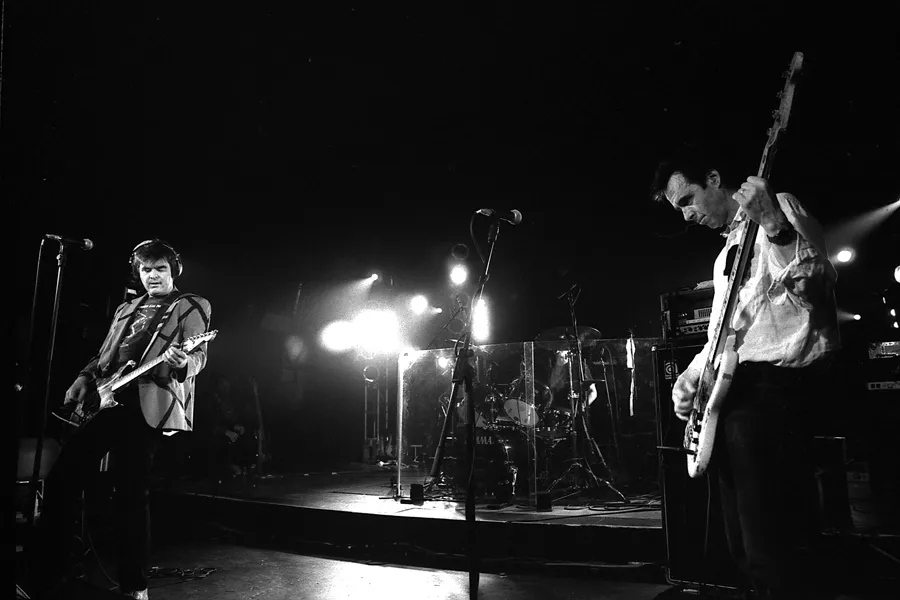
Photo by neonwar , licensed under CC BY 2.0 · Wikimedia Commons
Rank #140
Mission of Burma
Boston post-punks whose noisy intelligence prefigured indie rock.
From Wikipedia
Mission of Burma was an American post-punk band from Boston, Massachusetts. The group formed in 1979 with Roger Miller on guitar, Clint Conley on bass, Peter Prescott on drums, and Martin Swope contributing audiotape manipulation and acting as the band’s sound engineer. In this initial lineup, Miller, Conley, and Prescott all shared singing and songwriting duties.
Members
- Bob Weston
- Clint Conley
- Martin Swope
- Peter Prescott
- Roger Miller
Studio Albums
- 1982 Vs.
- 2004 ONoffON
- 2006 The Obliterati
- 2009 The Sound the Speed the Light
- 2012 Unsound
Source: MusicBrainz
Deep Dive
Overview
Mission of Burma stands as one of the defining post-punk bands of the early 1980s, emerging from Boston with a sound that married punk’s raw urgency to experimental noise manipulation and intricate songcraft. Formed in 1979, the band’s four-piece lineup of Roger Miller (guitar), Clint Conley (bass), Peter Prescott (drums), and Martin Swope (audiotape manipulation and sound engineering) created a template for intelligent, deliberately abrasive rock music that would prove enormously influential on the alternative rock and indie rock movements that followed. Their brief but prolific tenure—active through the early 1980s—produced a single studio album during their original run, yet their reputation far exceeded that modest output, cementing them as a crucial link between punk’s confrontational ethos and the texturally sophisticated post-punk that defined the latter half of the decade.
Formation Story
Mission of Burma coalesced in Boston in 1979, drawing its core members from the city’s emerging underground rock scene. The band’s formation was distinctive in its collaborative composition: rather than a single songwriter driving the group’s direction, Roger Miller, Clint Conley, and Peter Prescott all contributed equally to singing and songwriting duties. Martin Swope’s role as both sound engineer and audiotape manipulator was central to the band’s identity from the outset, making him not merely a member but an essential creative voice whose contributions shaped the textures and production philosophy that became the band’s hallmark. This democratic approach to songwriting and the integrated role of electronic sound manipulation set Mission of Burma apart from conventional punk and post-punk bands of the era.
Breakthrough Moment
Mission of Burma’s recorded legacy began with the release of Vs. in 1982, an album that announced the band as a major creative force in post-punk. The album crystallized the group’s approach: dense, propulsive rhythms undercut by dissonant guitar work and strategic bursts of noise, all anchored by the interplay between Miller, Conley, and Prescott’s vocal and instrumental contributions. Vs. demonstrated that post-punk could be both intellectually rigorous and viscerally exciting, offering no concessions to mainstream accessibility while retaining enough melodic structure and rhythmic discipline to engage listeners beyond the avant-garde underground. The album’s release positioned the band as a critical darling and a key figure in an emerging conversation about what post-punk could become when expanded beyond the formal experimentation of bands like Wire or the anxious introspection of Joy Division.
Peak Era
Mission of Burma’s most creatively vital period encompassed the years immediately surrounding Vs. in 1982, though the band’s early-1980s recordings have only been partially documented in the official discography. After their initial run, which lasted through the early 1980s, the group disbanded. The band would eventually reform decades later, releasing ONoffON in 2004, followed by The Obliterati in 2006, The Sound the Speed the Light in 2009, and Unsound in 2012. These later recordings demonstrated that the core creative tension and production sophistication that defined their earlier work remained intact, even as the broader context of rock music had shifted dramatically. The reunion albums proved that Mission of Burma’s approach—married to evolving musicianship and production technologies—continued to yield substantial, challenging work.
Musical Style
Mission of Burma’s sound was defined by controlled chaos: propulsive basslines and precise, driving drumwork collided with fragmented, heavily textured guitar lines and strategic deployments of audiotape manipulation and electronic noise. The band eschewed the post-punk preference for sparse, echoing production in favor of density and layering, filling the sonic space with competing instrumental voices and timbral variation. Martin Swope’s role was fundamental here; his audiotape manipulation and sound engineering created an architectural framework within which Miller’s guitar work and the rhythm section could operate, adding moments of abstraction and noise into compositions that remained fundamentally rooted in rock structure. Vocally, the band’s approach of distributing singing duties among Miller, Conley, and Prescott meant that no single voice dominated; instead, the human voice became one more textural element within the overall composition. This approach aligned Mission of Burma with a broader post-punk lineage that viewed rock instrumentation as raw material to be reshaped through production and arrangement rather than merely performed.
Major Albums
Vs. (1982)
The band’s sole studio album during their initial run, Vs. presents Mission of Burma at their creative peak, synthesizing post-punk sophistication with noise rock’s aggressive textures into a series of dense, interlocking compositions that reward repeated listening.
ONoffON (2004)
Released nearly two decades after the band’s breakup, ONoffON marked their return as a fully reformed unit, demonstrating that their core approach to noisy, intricate composition remained undiminished by time.
The Obliterati (2006)
Following closely on their reunion, The Obliterati deepened the band’s engagement with contemporary production techniques while maintaining fidelity to the texturally complex, harmony-rich songwriting that had always characterized their work.
The Sound the Speed the Light (2009)
This album reinforced the band’s commitment to intelligent, challenging post-punk forms, proving that their influence and relevance extended well into the 21st century indie rock landscape.
Signature Songs
- “That’s When I Reach for My Revolver” — A propulsive, rhythm-driven track that exemplifies the band’s ability to marry punk’s forward momentum to post-punk’s textural density.
- “Tussle” — Demonstrates the band’s skill at building compositional complexity through layered guitar work and tightly coordinated rhythm playing.
- “Fame and Fortune” — Showcases the band’s approach to vocal distribution and their ability to construct engaging melodies within deliberately abrasive arrangements.
- “Red and Blue” — A signature example of how the band deployed audiotape manipulation and electronic textures as compositional tools rather than mere effects.
Influence on Rock
Mission of Burma’s influence radiates through post-punk, alternative rock, and indie rock, particularly among bands concerned with texture and production as compositional elements. Their demonstration that post-punk could be simultaneously intellectually demanding and emotionally engaging helped shape the trajectory of alternative rock through the 1980s and beyond. Bands emerging in the post-punk and indie rock contexts in the decades following the early 1980s inherited Mission of Burma’s template: the notion that guitar-based rock could accommodate noise, dissonance, and electronic manipulation without sacrificing melodic or rhythmic coherence. The band’s insistence on treating sound engineering as a creative force equal to instrumental performance proved especially influential, anticipating the genre-wide shift toward producer-driven, texture-conscious rock production that would define much of alternative rock’s evolution.
Legacy
Mission of Burma’s legacy rests on their demonstration that post-punk was a capacious enough form to incorporate noise, electronic abstraction, and collaborative composition without sacrificing its fundamental grounding in rock structure. Their reunion in the 2000s and subsequent recording activities have ensured that new generations of listeners have access not only to Vs. but to their continuing work as active composers. The band’s influence is particularly pronounced within indie rock and post-punk revival circles, where their integration of production sophistication and compositional complexity represents an aspiration rather than an outdated historical artifact. The existence of a coherent body of post-reunion work spanning from 2004 to 2012 distinguishes Mission of Burma from many other post-punk bands of their era, whose legacies rest primarily on brief, historically distant catalog entries; instead, the band’s willingness to engage with contemporary production and remain creatively active has kept their work in circulation and conversation.
Fun Facts
- Martin Swope’s role as audiotape manipulator and sound engineer made Mission of Burma one of the earliest rock bands to integrate electronic sound processing as a core compositional element, predating the widespread adoption of such techniques in alternative rock.
- The band’s practice of distributing vocal and songwriting duties equally among three members created a compositional democracy unusual within punk and post-punk, where single songwriters typically dominated.
- Mission of Burma operated under the Ace of Hearts Records label during their original run, connecting them to the Boston underground record label ecosystem of the early 1980s.
- The band maintained an official website (missionofburma.com) documenting their activities and reunion work, reflecting their engagement with digital-era fan communication long before it became standard for reunited acts.
Discography & Previews
Click any album to expand its track list. Each track plays a 30-second preview streamed from Apple Music. Tap the link icon next to a track to open it in Apple Music for full playback.

- 1 Secrets ↗ 3:23
- 2 Train ↗ 3:32
- 3 Trem Two ↗ 4:11
- 4 New Nails ↗ 3:01
- 5 Dead Pool ↗ 4:06
- 6 Learn How ↗ 3:56
- 7 Mica ↗ 3:35
- 8 Weatherbox ↗ 3:28
- 9 The Ballad of Johnny Burma ↗ 2:03
- 10 Einstein's Day ↗ 4:36
- 11 Fun World ↗ 3:41
- 12 That's How I Escaped My Certain Fate ↗ 2:06
- 13 Laugh the World Away ↗ 3:53
- 14 Forget ↗ 2:59
- 15 Progress ↗ 3:07
- 16 OK/No Way ↗ 1:58

- 1 The Setup ↗ 3:08
- 2 Hunt Again ↗ 2:16
- 3 The Enthusiast ↗ 3:38
- 4 Falling ↗ 4:00
- 5 What We Really Were ↗ 4:12
- 6 Max Ernst's Dream ↗ 3:31
- 7 Fake Blood ↗ 3:32
- 8 Prepared ↗ 3:02
- 9 (Interlude/Silence) ↗ 0:15
- 10 Wounded World ↗ 3:29
- 11 Dirt ↗ 3:45
- 12 Into the Fire ↗ 3:41
- 13 Fever Moon ↗ 3:47
- 14 Nicotine Bomb ↗ 3:16
- 15 Playland ↗ 2:32
- 16 Absent Mind ↗ 5:21

- 1 2Wice ↗ 3:36
- 2 Spider's Web ↗ 3:25
- 3 Donna Sumeria ↗ 5:37
- 4 Let Yourself Go ↗ 3:31
- 5 1001 Pleasant Dreams ↗ 3:50
- 6 Good, Not Great ↗ 2:08
- 7 13 ↗ 4:17
- 8 Man in Decline ↗ 3:22
- 9 Careening with Conviction ↗ 3:49
- 10 Birthday ↗ 3:11
- 11 The Mute Speaks Out ↗ 3:24
- 12 Is This Where? ↗ 3:36
- 13 Period ↗ 3:27
- 14 Nancy Reagan's Head ↗ 4:35

