
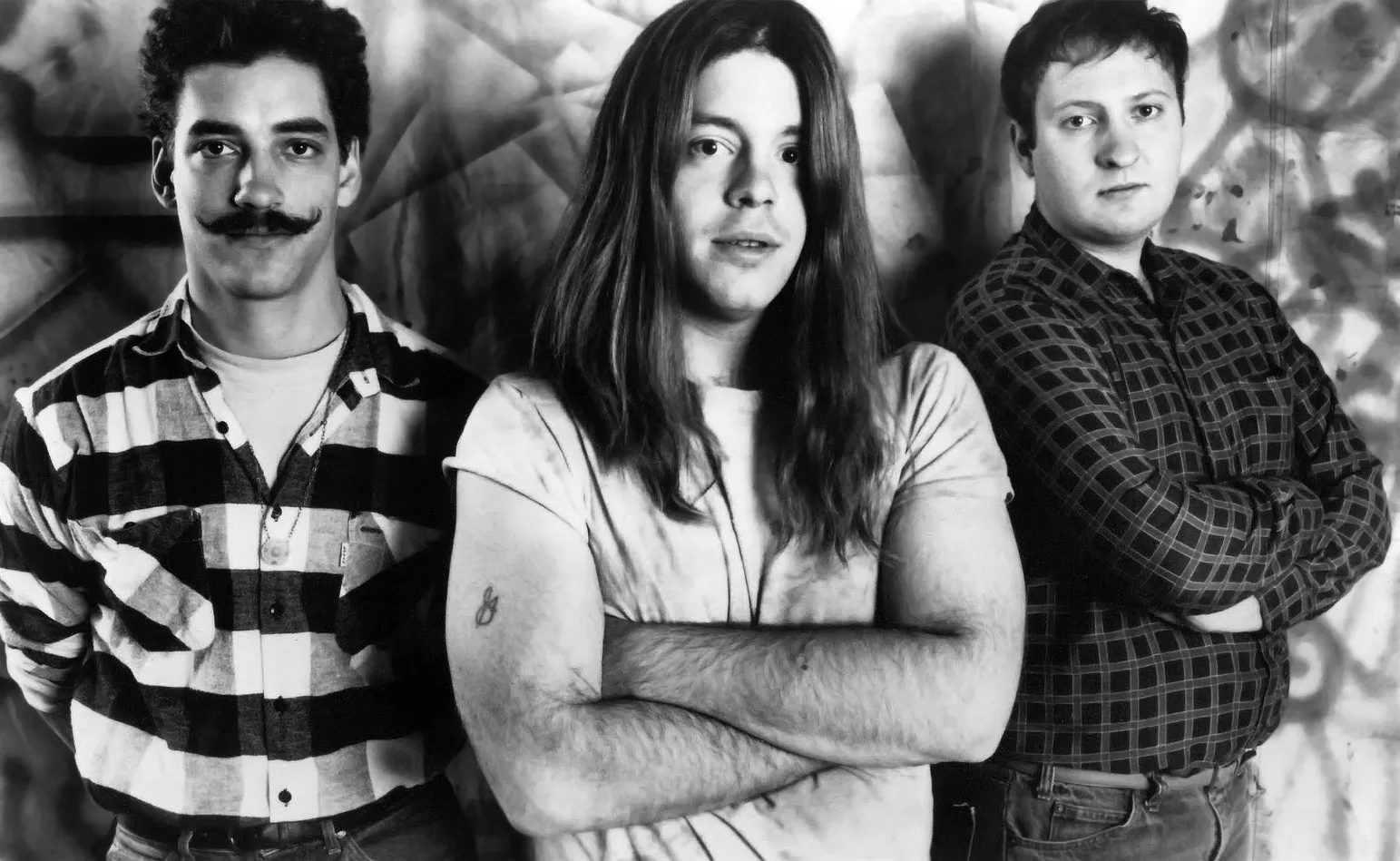
Photo by Photograph by Daniel Corrigan. Distributed by Warner Bros. Records. , licensed under Public domain · Wikimedia Commons
Rank #139
Hüsker Dü
Twin Cities trio who proved hardcore could carry melody and ambition.
From Wikipedia
Hüsker Dü was an American punk rock band formed in Saint Paul, Minnesota, in 1979. The band's continuous members were guitarist/vocalist Bob Mould, bassist Greg Norton, and drummer/vocalist Grant Hart. They first gained notability as a hardcore punk band, and later crossed over into alternative rock. Mould and Hart were the band's principal songwriters, with Hart's higher-pitched vocals and Mould's baritone taking the lead in alternating songs.
Members
- Bob Mould
- Grant Hart
- Greg Norton
Studio Albums
- 1983 Everything Falls Apart
- 1984 Zen Arcade
- 1985 New Day Rising
- 1985 Flip Your Wig
- 1986 Candy Apple Grey
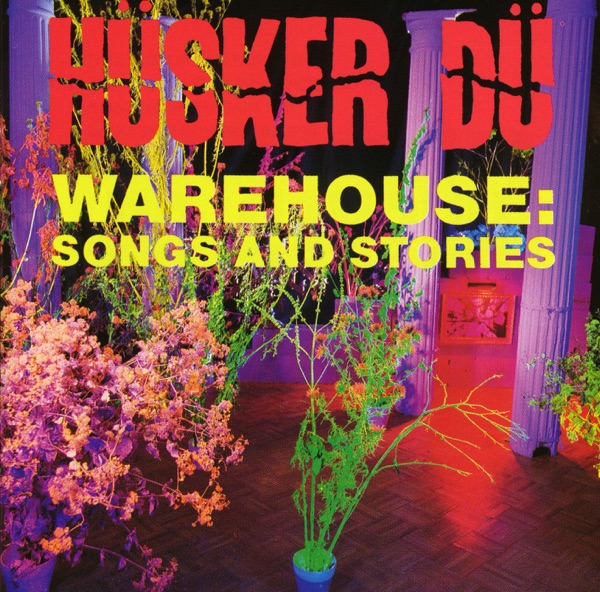
- 1987 Warehouse: Songs and Stories
Source: MusicBrainz
Deep Dive
Overview
Hüsker Dü was an American punk rock band formed in Saint Paul, Minnesota, in 1979, and remained active through 1988. The group proved that hardcore punk—a genre often dismissed as simplistic and aggressive—could accommodate sophisticated songwriting, emotional range, and technical ambition without sacrificing intensity or rawness. Led by guitarist/vocalist Bob Mould and drummer/vocalist Grant Hart, with bassist Greg Norton completing the lineup, Hüsker Dü emerged from the Twin Cities underground and became one of the decade’s most influential bridges between hardcore and the emerging alternative rock movement.
Formation Story
Bob Mould and Grant Hart formed Hüsker Dü in Saint Paul in 1979, with Greg Norton on bass. The trio arrived at a moment when hardcore punk had fractured into regional scenes, each with distinct attitudes and sound. The Twin Cities scene, while smaller than the coasts, harbored a particular intensity and DIY ethos. Mould and Hart’s partnership proved immediately fertile; both were accomplished songwriters and vocalists, with Hart’s higher-pitched tenor contrasting sharply against Mould’s heavier baritone. This vocal dynamic would become one of the band’s defining characteristics, allowing them to alternate as lead singers and giving individual songs distinct emotional textures. Norton’s steady, propulsive bass work provided the foundation upon which the two guitarists’ wall of sound could build.
Breakthrough Moment
Hüsker Dü’s early releases on small labels built a reputation within hardcore circles, but their breakthrough to wider recognition came with the double album Zen Arcade in 1984. Recorded for SST Records, the album demonstrated that a hardcore punk band could sustain a listener’s attention across a full-length format without resorting to overproduction or genre compromise. Zen Arcade balanced unrelenting sonic fury with pop sensibilities, introspective lyrics, and melodic hooks that refused easy dismissal. The album’s success established Hüsker Dü as more than a regional phenomenon and positioned them as serious contenders in the shifting landscape of 1980s rock. By the mid-1980s, they were performing increasingly larger venues and attracting the attention of major labels.
Peak Era
The period from 1984 to 1987 represented Hüsker Dü’s creative and commercial peak. Following Zen Arcade, the band released New Day Rising and Flip Your Wig in 1985, each refining their signature sound and expanding their audience. Candy Apple Grey (1986) arrived as the band shifted toward the alternative rock mainstream, with cleaner production and slightly more radio-friendly structures, yet without losing the underlying tension and urgency that made them vital. The double album Warehouse: Songs and Stories (1987) served as a culminating statement—ambitious in scope, diverse in songwriting, and sophisticated in arrangement. Throughout this period, Hüsker Dü maintained relentless touring schedules while working with respected labels including SST, Alternative Tentacles, and eventually Warner Bros. Records, marking their move toward the mainstream.
Musical Style
Hüsker Dü’s sound merged the distorted guitars, fast tempos, and raw energy of hardcore punk with the melodic sensibilities and emotional transparency more commonly associated with college rock and indie pop. Mould’s guitar work oscillated between textural walls of distortion and surprisingly delicate, clean passages, while Norton’s bass operated both as a foundational anchor and as a melodic instrument in its own right. The drumming of Grant Hart drove the band forward with precision and power, but Hart’s drumming also incorporated dynamic shifts and fills that suggested jazz or progressive rock influences. Lyrically, Hüsker Dü moved beyond the political sloganeering or nihilistic posturing that dominated much of hardcore; instead, they explored personal anxiety, relationship dissolution, and existential questioning. The band’s evolution can be traced through their discography: the early brutality of Everything Falls Apart gradually gave way to the ambitious cross-genre hybridity of Zen Arcade and beyond, where punk intensity coexisted with major-key melodies, intricate arrangements, and production sophistication.
Major Albums
Everything Falls Apart (1983)
Hüsker Dü’s debut established their hardcore credentials with short, punishing songs and a raw, unpolished production that captured the band’s uncompromising stage presence.
Zen Arcade (1984)
A double album that proved hardcore could sustain artistic ambition across an extended format, balancing sonic assault with melodic hooks and introspective songwriting that set the template for alternative rock’s ascent.
New Day Rising (1985)
Sharpening their craft further, New Day Rising married aggressive instrumentation with increasingly sophisticated pop structures and emotional vulnerability.
Candy Apple Grey (1986)
Recorded for Warner Bros. Records, the album represented the band’s most polished work to date, with cleaner production and radio-conscious songwriting while retaining their fundamental intensity.
Warehouse: Songs and Stories (1987)
A sprawling double album that showcased the band’s range and ambition, featuring some of their most elaborate arrangements and serving as a major statement before the band’s eventual dissolution.
Signature Songs
- “Divide and Conquer” — A showcase of Hart’s drumming and the band’s ability to generate propulsive energy while maintaining melodic clarity.
- “Makes No Sense at All” — Exemplifies Hüsker Dü’s gift for marrying pop hooks with abrasive guitar textures.
- “Could You Be the One?” — Demonstrates the emotional range and introspection that separated the band from their more one-dimensional hardcore peers.
- “New Day Rising” — The title track captures the band’s anthemic potential and their skill at building dynamics across a single song.
- “Ice Cold Ice” — A stark example of the band’s ability to deliver vulnerability without sacrificing impact.
Influence on Rock
Hüsker Dü’s trajectory in the 1980s anticipated and helped define the alternative rock explosion of the early 1990s. By demonstrating that hardcore punk could absorb melodic, emotional, and technical sophistication without becoming either arena rock or art-punk, they provided a blueprint that countless bands would follow. The band’s success on the SST and Alternative Tentacles labels, and ultimately on Warner Bros. Records, proved that independent and major-label rock could coexist and that underground credibility and mainstream visibility were not mutually exclusive. Bands from Nirvana to The Replacements traced lineage through Hüsker Dü’s example: the idea that punk energy and rock melody, personal honesty and distorted guitars, could occupy the same space. Their influence rippled through post-hardcore, noise rock, and shoegaze communities, and their songwriting sophistication elevated expectations for what punk-adjacent music could accomplish.
Legacy
Hüsker Dü disbanded in 1988, their dissolution occurring just as the broader culture was beginning to embrace the alternative rock that they had helped pioneer. In the decades since, their reputation has only grown. The band’s albums remain in print and are consistently cited by musicians and critics as foundational texts of 1980s rock. They are regularly acknowledged as forerunners of the grunge and alternative rock movements that dominated the 1990s, and their dual-vocalist, guitar-driven approach has been revisited by countless contemporary acts. Streaming platforms have ensured their catalog reaches new listeners regularly, and retrospective critical reassessment has positioned albums like Zen Arcade and Warehouse: Songs and Stories as masterpieces of their era. Though the band members pursued separate projects after the initial breakup, Hüsker Dü’s catalog stands as a powerful testament to the creative possibilities latent within punk rock when pursued with ambition and emotional honesty.
Fun Facts
- Hüsker Dü is Swedish for “Do you remember?”—a phrase taken from a Swedish children’s board game—chosen as a name that was distinctive, easy to remember, and carried no obvious political or scene-specific baggage.
- The band’s early releases on the New Alliance Records label helped establish that small-scale independent labels could produce serious punk rock without sacrificing sound quality.
- Grant Hart was known for his songwriting contributions to be more introspective and personal than those of Bob Mould, creating a dynamic within the band where different songs could reflect distinctly different emotional perspectives.
Discography & Previews
Click any album to expand its track list. Each track plays a 30-second preview streamed from Apple Music. Tap the link icon next to a track to open it in Apple Music for full playback.


- 1 Something I Learned Today ↗ 2:03
- 2 Broken Home, Broken Heart ↗ 2:05
- 3 Never Talking to You Again ↗ 1:41
- 4 Chartered Trips ↗ 3:39
- 5 Dreams Reoccurring ↗ 1:41
- 6 Indecision Time ↗ 2:14
- 7 Hare Krsna ↗ 3:36
- 8 Beyond the Threshold ↗ 1:37
- 9 Pride ↗ 1:48
- 10 I'll Never Forget You ↗ 2:20
- 11 The Biggest Lie ↗ 2:03
- 12 What's Going On ↗ 4:24
- 13 Masochism World ↗ 2:48
- 14 Standing by the Sea ↗ 3:23
- 15 Somewhere ↗ 2:31
- 16 One Step at a Time ↗ 0:45
- 17 Pink Turns to Blue ↗ 2:43
- 18 Newest Industry ↗ 3:06
- 19 Monday Will Never Be the Same ↗ 0:53
- 20 Whatever ↗ 3:53
- 21 The Tooth Fairy and the Princess ↗ 2:45
- 22 Turn on the News ↗ 4:28
- 23 Reoccurring Dreams ↗ 14:01

- 1 New Day Rising ↗ 2:35
- 2 The Girl Who Lives On Heaven Hill ↗ 3:06
- 3 I Apologize ↗ 3:37
- 4 Folk Lore ↗ 1:36
- 5 If I Told You ↗ 2:08
- 6 Celebrated Summer ↗ 4:03
- 7 Perfect Example ↗ 3:18
- 8 Terms Of Psychic Warfare ↗ 2:19
- 9 59 Times The Pain ↗ 3:16
- 10 Powerline ↗ 2:24
- 11 Books About UFOs ↗ 2:50
- 12 I Don't Know What You're Talking About ↗ 2:24
- 13 How To Skin A Cat ↗ 1:53
- 14 Whatcha Drinkin' ↗ 1:33
- 15 Plans I Make ↗ 4:22

- 1 Flip Your Wig ↗ 2:35
- 2 Every Everything ↗ 1:58
- 3 Makes No Sense At All ↗ 2:46
- 4 Hate Paper Doll ↗ 1:54
- 5 Green Eyes ↗ 3:02
- 6 Divide and Conquer ↗ 3:47
- 7 Games ↗ 4:08
- 8 Find Me ↗ 4:09
- 9 The Baby Song ↗ 0:47
- 10 Flexible Flyer ↗ 3:02
- 11 Private Plane ↗ 3:20
- 12 Keep Hanging On ↗ 3:19
- 13 The Wit and the Wisdom ↗ 3:42
- 14 Don't Know Yet ↗ 2:18

- 1 These Important Years ↗ 3:51
- 2 Charity, Chastity, Prudence, and Hope ↗ 3:15
- 3 Standing In the Rain ↗ 3:48
- 4 Back from Somewhere ↗ 2:19
- 5 Ice Cold Ice ↗ 4:23
- 6 You're a Soldier ↗ 3:04
- 7 Could You Be the One? ↗ 2:35
- 8 Too Much Spice ↗ 2:56
- 9 Friend, You've Got to Fall ↗ 3:21
- 10 Visionary ↗ 2:33
- 11 She Floated Away ↗ 3:39
- 12 Bed of Nails ↗ 4:48
- 13 Tell You Why Tomorrow ↗ 2:53
- 14 It's Not Peculiar ↗ 4:10
- 15 Actual Condition ↗ 1:52
- 16 No Reservations ↗ 3:44
- 17 Turn It Around ↗ 4:34
- 18 She's a Woman (And Now He Is a Man) ↗ 3:22
- 19 Up In the Air ↗ 3:07
- 20 You Can Live At Home ↗ 5:25