
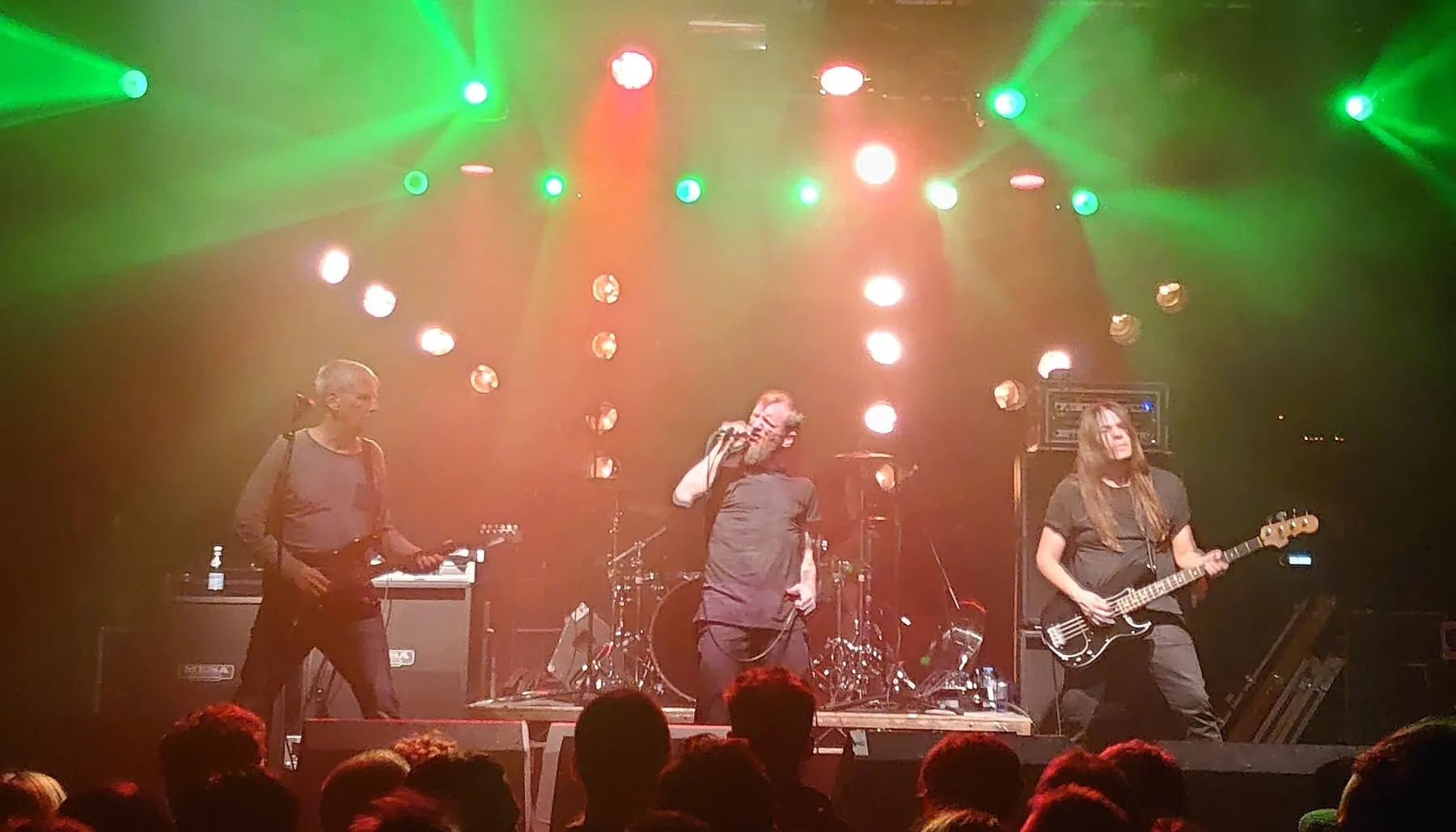
Photo by BrandanRidd , licensed under CC BY-SA 4.0 · Wikimedia Commons
Rank #141
Black Flag
L.A. hardcore touring monsters whose DIY ethic shaped American punk.
From Wikipedia
Black Flag is an American punk rock band formed in 1976 in Hermosa Beach, California. The band was founded as Panic by guitarist Greg Ginn, and singer Keith Morris. They are widely considered to be one of the first hardcore punk bands, as well as one of the pioneers of post-hardcore. After breaking up in 1986, Black Flag reunited in 2003 and again in 2013, however due to a legal dispute two versions of Black Flag were formed, one under the Black Flag name featuring Ginn and a revolving door of touring musicians and the other, FLAG, featuring Morris, Chuck Dukowski, Bill Stevenson among other ex-Black Flag members. This resulted in a highly public lawsuit between Ginn and FLAG, ultimately ending with both versions to exist and tour. The second Black Flag reunion lasted well over a year, during which they released their first studio album in nearly three decades, What The... (2013). Ginn announced Black Flag’s third reunion in January 2019.
Members
- Greg Ginn
- Henry Rollins
- Kira Roessler
Studio Albums
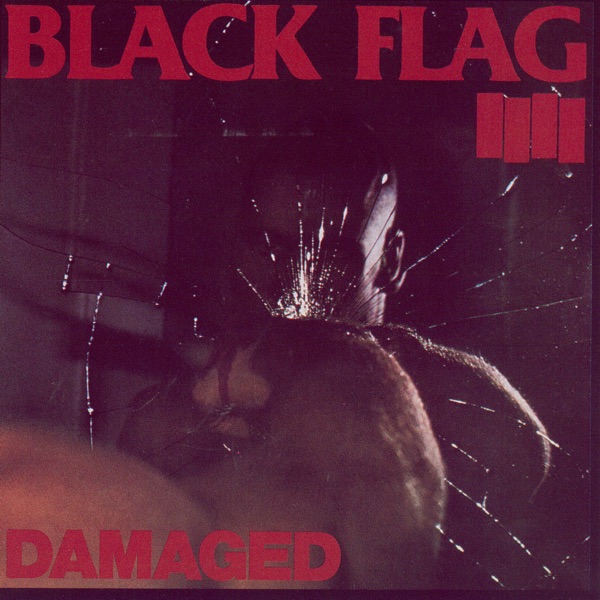
- 1981 Damaged
- 1984 Slip It In
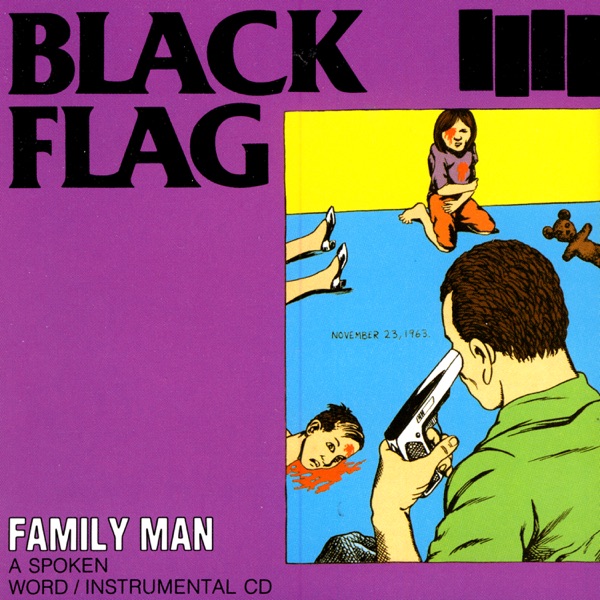
- 1984 Family Man
- 1984 My War
- 1985 Loose Nut
- 1985 In My Head
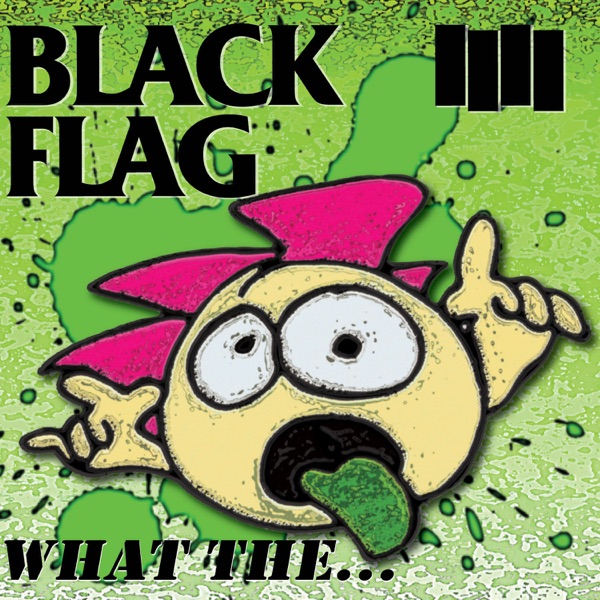
- 2013 What The…
Source: MusicBrainz
Deep Dive
Overview
Black Flag stands as one of the foundational bands of American hardcore punk, emerging from the Southern California suburbs in 1976 and establishing a template for underground music distribution and relentless touring that would shape punk and alternative rock for decades. Formed in Hermosa Beach by guitarist Greg Ginn and vocalist Keith Morris, the band transformed from a regional L.A. punk group into one of the most influential touring acts of the 1980s, building a devoted cult following through sheer volume of performances and an uncompromising musical identity. Their significance rests not on mainstream chart success but on their pioneering role in the hardcore punk underground and their demonstration that a band could operate entirely outside corporate distribution channels.
Formation Story
Black Flag originated in 1976 when Greg Ginn, a guitarist with roots in the nascent Los Angeles punk scene, founded a group initially called Panic alongside vocalist Keith Morris. The band emerged from Hermosa Beach, a coastal community south of Los Angeles, during a period when American punk was still finding its regional character distinct from British models. The early iteration reflected the raw, aggressive energy developing within the Southern California underground, where bands performed in small clubs and warehouses to audiences hungry for music that rejected mainstream rock conventions.
Breakthrough Moment
Black Flag’s first major album, Damaged, released in 1981, marked their emergence as a serious creative force in hardcore punk. The record established many of the group’s defining characteristics: direct, often shouted vocals; stripped-down instrumentation; and lyrics addressing alienation, frustration, and social disconnection. Damaged became a cornerstone of hardcore punk identity and signaled that the band possessed both the songwriting discipline and raw intensity necessary to sustain more than novelty interest. The album’s impact extended beyond music, demonstrating to other underground bands that viable distribution networks existed outside major record labels, particularly through the SST Records imprint—the label that would become synonymous with Black Flag’s entire catalogue.
Peak Era
The period from 1981 through 1985 represented Black Flag’s most prolific and artistically significant phase. The rapid succession of studio albums—Damaged in 1981, followed by My War, Family Man, and Slip It In in 1984, then Loose Nut and In My Head in 1985—demonstrated extraordinary creative output and musical restlessness. During these years, the band refined its approach to hardcore punk, experimenting with song structures and intensity levels while maintaining the unpolished, confrontational aesthetic that distinguished them from more commercially oriented new-wave and post-punk acts. This era cemented Black Flag’s reputation as tireless touring musicians, building a national fanbase through hundreds of performances across America.
Musical Style
Black Flag’s sound combined punk rock’s three-chord simplicity with a physicality and intensity that exceeded most of their contemporaries. Greg Ginn’s guitar work favored raw distortion and angular riffs over technical virtuosity, while the rhythm section provided propulsive, often tribal-feeling backbones. Vocal delivery shifted significantly across the band’s active periods: Keith Morris’s early approach gave way to other voices, each bringing different intensity and phrasing to the material. The songwriting eschewed verse-chorus-verse pop formulas, instead favoring repetitive, hypnotic structures that allowed songs to build or collapse with devastating abruptness. This approach aligned Black Flag with emerging post-hardcore innovations, a genre category reflecting their willingness to push beyond hardcore punk’s established boundaries while remaining rooted in its ethos of confrontation and authenticity.
Major Albums
Damaged (1981)
The band’s debut full-length established their hardcore identity and became a touchstone for the genre, combining aggressive musicianship with lyrics addressing psychological and social dysfunction. The record’s success demonstrated the viability of underground distribution through independent labels.
My War (1984)
Released alongside other 1984 albums, My War showed the band deepening their experimental tendencies, stretching songs into longer forms and exploring dynamics within the hardcore framework. The album revealed a band uninterested in repeating a formula.
Slip It In (1984)
A more deliberately structured offering, Slip It In balanced the band’s abrasive tendencies with clearer songwriting, showcasing their ability to craft memorable material within hardcore’s constraints.
Loose Nut (1985)
One of the final studio albums before the band’s dissolution, Loose Nut maintained the relentless touring schedule’s energy and continued to explore the band’s evolving relationship with song structure and production approaches.
Signature Songs
- “Rise Above”—An anthemic statement of defiance and self-determination that became the band’s most widely recognized composition.
- “TV Party”—A critique of media consumption and conformity that exemplified the band’s ability to build urgent, repetitive songs from minimal material.
- “My War”—A brutally direct examination of personal conflict that showcased the vocal intensity central to the band’s identity.
- “Police Story”—A pointed examination of police harassment and street-level conflict that resonated throughout the hardcore community.
Influence on Rock
Black Flag’s impact on American underground and alternative music extended far beyond their commercial reach. Their rigorous DIY approach—establishing their own independent label distribution, controlling their own touring schedule, and refusing to compromise artistic vision for mainstream acceptance—created a blueprint that influenced punk, hardcore, indie rock, and later metal bands. The band demonstrated that sustainable careers existed outside major-label systems, inspiring countless musicians to establish underground networks and release mechanisms. Bands ranging from post-hardcore acts to 1990s alternative rock groups built directly on Black Flag’s sonic and operational foundations, making them one of the most influential punk acts in American rock history despite limited mainstream visibility.
Legacy
After breaking up in 1986, Black Flag’s original era became increasingly canonized within punk and underground rock history. The band’s reunion in 2003 and subsequent 2013 reunion, which yielded the studio album What The…, demonstrated sustained audience interest and the band’s historical significance. A legal dispute over the Black Flag name resulted in two versions of the group operating simultaneously, with Greg Ginn leading one iteration and original vocalist Keith Morris leading FLAG with other longtime members. Despite this fragmentation, Black Flag’s original albums remain foundational documents of American hardcore punk, continuously reissued and discovered by new generations of musicians and listeners. The band’s touring legacy and DIY ethic continue to resonate within punk and alternative music communities worldwide.
Fun Facts
- Black Flag was originally named Panic before adopting the Black Flag moniker, marking one of punk rock’s most consequential name changes.
- The band’s commitment to touring resulted in performances across America at a scale and frequency that few rock acts, mainstream or underground, have matched.
- SST Records, the label that released Black Flag’s discography, became one of American rock’s most important independent record labels, extending influence across punk, post-punk, and alternative rock.
Discography & Previews
Click any album to expand its track list. Each track plays a 30-second preview streamed from Apple Music. Tap the link icon next to a track to open it in Apple Music for full playback.
- 1 Rise Above ↗ 2:27
- 2 Spray Paint ↗ 0:33
- 3 Six Pack ↗ 2:20
- 4 What I See ↗ 1:56
- 5 TV Party ↗ 3:31
- 6 Thirsty And Miserable ↗ 2:06
- 7 Police Story ↗ 1:33
- 8 Gimmie Gimmie Gimmie ↗ 1:47
- 9 Depression ↗ 2:29
- 10 Room 13 ↗ 2:05
- 11 Damaged II ↗ 3:23
- 12 No More ↗ 2:26
- 13 Padded Cell ↗ 1:47
- 14 Life of Pain ↗ 2:50
- 15 Damaged I ↗ 3:51

- 1 Family Man ↗ 1:20
- 2 Salt On a Slug ↗ 1:31
- 3 Hollywood Diary ↗ 0:36
- 4 Let Your Fingers Do the Walking ↗ 2:33
- 5 Shed Reading (Rattus Norvegicus) ↗ 1:23
- 6 No Deposit - No Return ↗ 0:39
- 7 Armageddon Man ↗ 9:14
- 8 Long Lost Dog of It ↗ 2:04
- 9 I Won't Stick Any of You Unless and Until I Can Stick All of You! ↗ 5:49
- 10 Account for What? ↗ 4:19
- 11 The Pups Are Doggin' It ↗ 4:16


- 1 My Heart's Pumping ↗ 2:13
- 2 Down in the Dirt ↗ 3:39
- 3 Blood and Ashes ↗ 1:48
- 4 Now Is the Time ↗ 1:48
- 5 Wallow in Despair ↗ 1:30
- 6 Slow Your Ass Down ↗ 1:51
- 7 It's so Absurd ↗ 1:11
- 8 Shut Up ↗ 1:43
- 9 This Is Hell ↗ 2:02
- 10 Go Away ↗ 2:33
- 11 The Bitter End ↗ 2:03
- 12 The Chase ↗ 2:18
- 13 I'm Sick ↗ 1:45
- 14 It's Not My Time to Go-Go ↗ 1:37
- 15 Lies ↗ 2:47
- 16 Get out of My Way ↗ 1:01
- 17 Outside ↗ 2:44
- 18 No Teeth ↗ 1:44
- 19 To Hell and Back ↗ 1:43
- 20 Give Me All Your Dough ↗ 1:29
- 21 You Gotta Be Joking ↗ 1:18
- 22 Off My Shoulders ↗ 3:19