
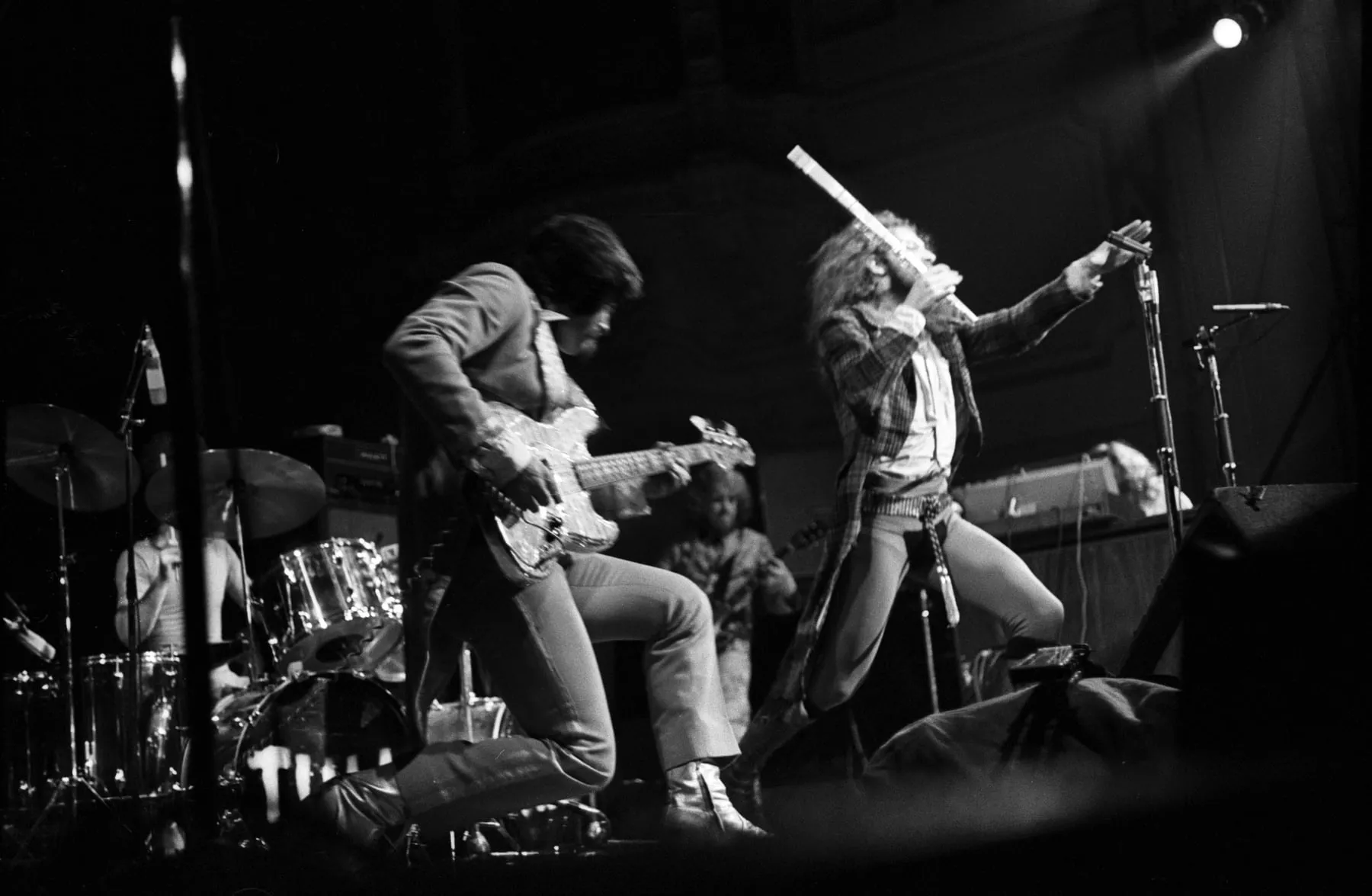
Photo by Heinrich Klaffs , licensed under CC BY-SA 2.0 · Wikimedia Commons
Rank #99
Jethro Tull
Flute-fronted British prog band fusing folk, hard rock, and theatre.
From Wikipedia
Jethro Tull are a British rock band formed in Blackpool, Lancashire in 1967. Emerging from the 1960s British blues scene, the band soon developed a distinctive progressive rock sound, blending hard rock, English folk music and classical music, while undergoing numerous stylistic shifts throughout its history. The band was founded and has been continuously led by Ian Anderson, its principal composer, lead vocalist and a multi-instrumentalist best known for his flute playing. The group has featured a succession of musicians throughout its history, including significant contributors such as long-time guitarist Martin Barre, bassists Glenn Cornick, Jeffrey Hammond, John Glascock and Dave Pegg; drummers Clive Bunker, Barrie "Barriemore" Barlow and Doane Perry; and keyboardists John Evan, Dee Palmer and Peter-John Vettese.
Members
- Clive Bunker
- Ian Anderson
- Jeffrey Hammond
- John Evan
- Martin Barre
Deep Dive
Overview
Jethro Tull are a British rock band formed in 1967, emerging from the Blackpool and Luton music scenes and ranking among the most distinctive voices in progressive rock. Founded and continuously led by Ian Anderson—a multi-instrumentalist best known for his flute playing—the band synthesized hard rock, English folk music, and classical forms into a sound that resisted easy categorization. Over more than five decades, they moved through numerous stylistic phases while maintaining Anderson’s compositional center and the flute as their primary voice, an unconventional choice that became their defining signature in rock music.
Formation Story
Jethro Tull coalesced in the mid-1960s from the British blues underground, a fertile ground that also produced Led Zeppelin and Black Sabbath. Ian Anderson, a flute player unusual in the context of electric rock, formed the band’s core around 1967, assembling a lineup that included guitarist Martin Barre, who would become the band’s long-serving collaborator. The early group drew from both the blues-rock vocabulary of contemporaries and Anderson’s classical training and folk music interests. By 1968, they were ready to record their debut, establishing a beachhead in the album-oriented rock market that was beginning to reward longer, more ambitious compositions.
Breakthrough Moment
Jethro Tull’s commercial and critical breakthrough came with their second album, Stand Up (1969), which introduced audiences to their fusion of pastoral folk themes with hard rock intensity and Anderson’s flute as a lead melodic instrument. The album established a template that the band would refine over the next several years: storytelling lyrics rooted in English rural life and mythology, complex song structures that borrowed from classical and folk traditions, and a willingness to use silence and dynamics as compositional tools. By 1970–1971, their third and fourth albums, Benefit and My God!, consolidated their reputation as serious musicians working beyond the blues-rock formula that dominated much of the era.
Peak Era
The years 1971 to 1974 represent Jethro Tull’s most celebrated and artistically fertile period. Aqualung (1971) became their first major international success, moving beyond previous efforts into a more cohesive conceptual work that paired acoustic and electric textures with Anderson’s acidic social commentary. Thick as a Brick (1972) pushed further into progressive ambition, constructed as a single multi-section piece across a double album, showcasing the band’s ability to sustain intricate arrangements and thematic development. A Passion Play (1973) continued this trajectory with another lengthy, suite-like structure, cementing Jethro Tull’s place alongside Yes, Genesis, and Emerson, Lake & Palmer as leaders in the progressive rock movement. WarChild (1974) marked a slight pivot toward shorter songs and slightly more conventional song structures while retaining harmonic and textural complexity.
Musical Style
Jethro Tull’s sound is grounded in Ian Anderson’s flute, which functions as both a melodic lead instrument and a textural anchor—a role normally occupied by guitar or keyboards in rock music. The flute allows for a lighter, more aerating quality to their arrangements, often paired with Martin Barre’s often blues-influenced but classically aware guitar work. The band’s rhythm section, anchored by drummers Clive Bunker and later others, and a succession of bassists and keyboardists including John Evan, provided harmonic density and dynamic control. Lyrically, Anderson drew consistently from English folk traditions, mythology, and rural imagery, often at odds with the electric intensity surrounding these themes. Over their history, the band’s production moved from the compressed, warm sound of their early albums toward more elaborate studio arrangements, though never losing the essential voice of the flute at the center.
Major Albums
Aqualung (1971)
Jethro Tull’s breakthrough album merged their progressive ambitions with greater melodic accessibility, built on contrasts between acoustic and electric sections, and established Anderson’s satirical commentary on social hypocrisy as a central theme.
Thick as a Brick (1972)
Constructed as a continuous multi-section composition across two vinyl sides, this album demonstrated the band’s ability to sustain complex arrangements and thematic development over an extended formal structure, establishing them as serious architectural composers within rock.
A Passion Play (1973)
Continuing the suite-based approach, this album presented a more narrative and theatrical ambition, with Anderson’s flute and voice weaving through intricate ensemble arrangements of folk and classical inspiration.
Songs From the Wood (1977)
After several years of more electric and elaborate production, this album returned to acoustic folk instrumentation as its foundation, drawing explicitly on English rural traditions and demonstrating the band’s comfort across stylistic ranges.
Crest of a Knave (1987)
Released after a period of relative commercial dormancy, this album proved the band’s continued ability to compose cohesive and inventive work, earning recognition with Grammy award consideration.
Signature Songs
- “Aqualung” — The title track from their 1971 breakthrough album, combining acoustic fingerpicking with electric intensity and Anderson’s biting social critique.
- “Thick as a Brick” — The extended opening movement of their 1972 double album, showcasing the band’s ability to sustain thematic and harmonic development across multiple sections.
- “My God” — A 1970 composition demonstrating the interplay between acoustic and electric textures that became central to their style.
- “Locomotive Breath” — From Aqualung, a propulsive piece built on repetitive rhythmic and melodic motifs, featuring Anderson’s flute in dialogue with Barre’s guitar.
- “Hymn 43” — A shorter composition from Benefit that shows the band’s facility with both pop-length songs and progressive ambition within compact form.
Influence on Rock
Jethro Tull’s most enduring influence lies in demonstrating that rock music could incorporate non-traditional lead instruments and folk traditions without sacrificing electric intensity. The flute’s presence in rock became more credible through Anderson’s work, and the band’s willingness to build entire albums around folk-based narratives and mythology encouraged other progressive acts to draw from pre-rock cultural traditions. Their structural experiments with extended suites and their treatment of the album as a unified artistic statement influenced musicians working in progressive rock throughout the 1970s and beyond. The band’s relatively consistent output across decades, including studio albums into the 2020s, established a model of sustained creative practice that moved beyond the typical commercial lifecycle of rock bands.
Legacy
Jethro Tull’s place in rock history rests primarily on their 1970s work, particularly Aqualung and Thick as a Brick, which remain widely heard and critically respected as exemplary progressive rock documents. The band’s continued activity—releasing new studio albums as recently as The Zealot Gene (2022) and RökFlöte (2023)—maintains their presence in contemporary rock discourse. Ian Anderson’s consistent leadership and the band’s resistance to reunion-tour nostalgia in favor of ongoing creative work distinguish them from many contemporaries. The flute’s role as a primary rock voice, established through Jethro Tull’s decades-long presence, remains their singular contribution to the instrument’s trajectory in popular music.
Fun Facts
- Ian Anderson’s flute technique was largely self-taught and refined through folk music traditions before he brought it into electric rock contexts, making his approach to rock flute fundamentally different from classical training pathways.
- The band’s album A Passion Play (1973) was initially poorly received by critics upon release, though it later found reassessment among progressive rock scholars and listeners.
- Jethro Tull released a Christmas album in 2003, The Jethro Tull Christmas Album, demonstrating Anderson’s willingness to apply the band’s approach to entirely different musical traditions.
- The band’s longevity across more than 50 years of continuous activity with over 25 studio albums places them among the most prolific rock acts, with releases continuing into 2025.