
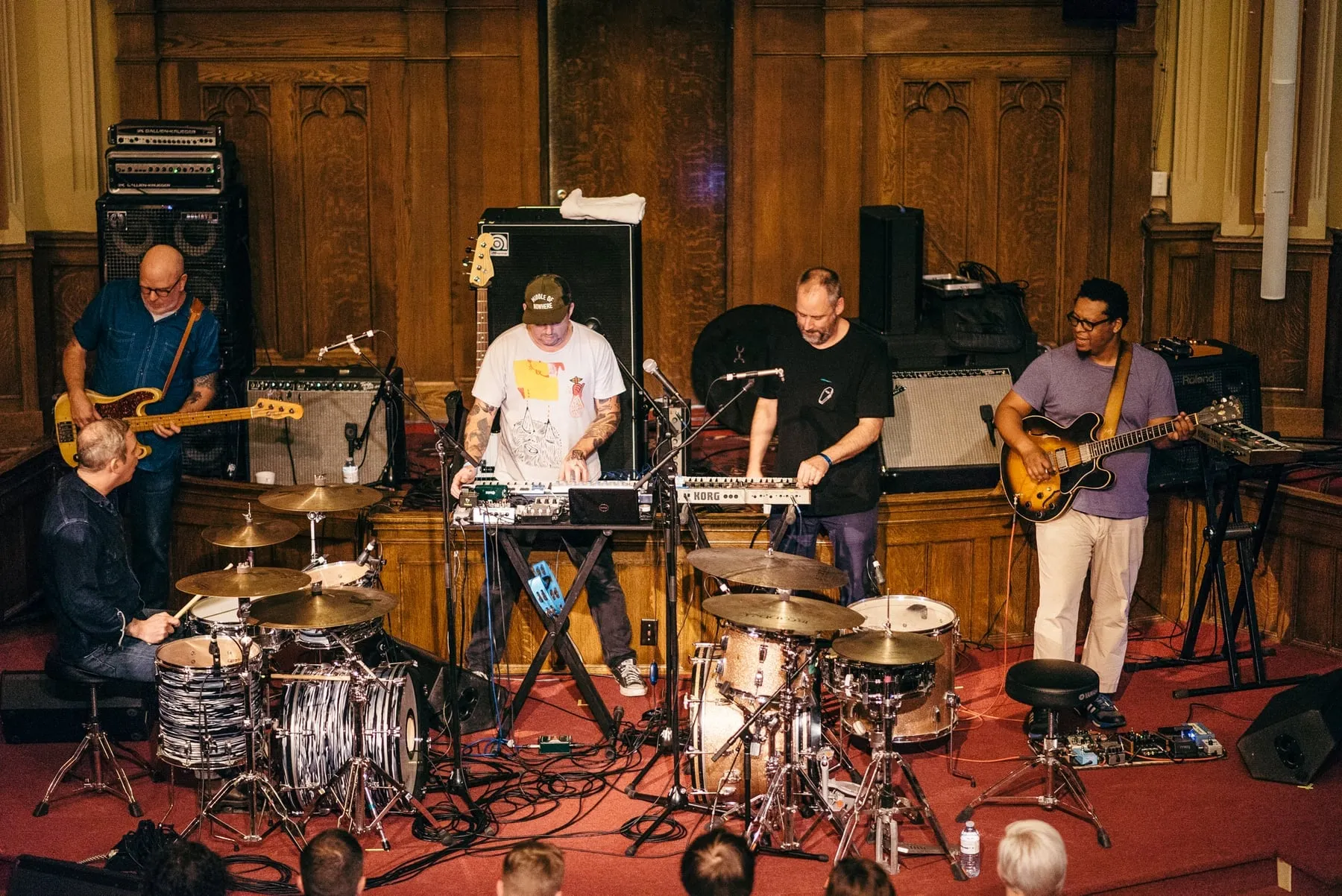
Photo by Levi Manchak , licensed under CC BY 2.0 · Wikimedia Commons
Rank #442
Tortoise
Chicago instrumental band central to post-rock's American emergence.
From Wikipedia
Tortoise is an American post-rock band formed in Chicago, Illinois, in 1990. The band incorporates krautrock, dub, minimal music, electronica and jazz into their music, and their eclectic style has left a great influence on the post-rock genre. Tortoise have been consistently credited, as part of the Chicago school of post-rock, for its rise in the 1990s.
Members
- Bundy K. Brown
Studio Albums
- 1994 Tortoise
- 1996 Millions Now Living Will Never Die
- 1998 TNT
- 2001 Standards
- 2004 It’s All Around You
- 2006 The Brave and the Bold
- 2009 Beacons of Ancestorship
- 2016 The Catastrophist
- 2025 Touch
Source: MusicBrainz
Deep Dive
Overview
Tortoise is an American instrumental post-rock band formed in Chicago in 1990. Built on a foundation of krautrock, dub, minimal music, electronica, and jazz, the band emerged as a central figure in the American post-rock movement’s establishment during the 1990s. Tortoise’s role in the so-called Chicago school of post-rock — a network of bands that redefined what rock music could be without vocals — earned them consistent credit for the genre’s rise and consolidation across that decade and beyond.
Formation Story
Tortoise coalesced in Chicago in 1990, arriving at a moment when rock was fragmenting into countless directions. The city itself was fertile ground for experimental music, with a thriving independent scene and record labels like Thrill Jockey positioned to nurture ambitious instrumental work. The band’s formation marked the beginning of a project that would reject the verse-chorus-verse orthodoxy of mainstream rock in favor of compositional complexity, textural layering, and an almost classical approach to instrumental dynamics. Bundy K. Brown stood among the core members guiding the band’s vision from inception.
Breakthrough Moment
Tortoise’s 1994 self-titled debut introduced their instrumental blueprint to a wider audience and signaled that post-rock was a viable aesthetic force in American rock. The album’s reception positioned the band as leaders rather than followers in a movement that was simultaneously coalescing across Chicago and finding resonance internationally. By the time of Millions Now Living Will Never Die in 1996, Tortoise had crystallized their approach: extended instrumental compositions built on layered guitars, keyboards, and rhythm sections that drew equally from post-punk minimalism and jazz sophistication. This album became the defining statement of American post-rock’s possibilities, establishing Tortoise as the genre’s most consistent and influential American exponent.
Peak Era
The period from 1996 through 2004 represented Tortoise’s most prolific and creatively central years. TNT arrived in 1998, followed by Standards in 2001 and It’s All Around You in 2004, a run that demonstrated the band’s capacity to evolve while maintaining their core identity. These albums saw the band experimenting with production texture, song length, and instrumental voicing while remaining rooted in the post-rock grammar they had helped establish. The band’s influence on the broader musical landscape during these years was profound; countless bands took cues from Tortoise’s template of intricate instrumental interplay and dynamic song architecture.
Musical Style
Tortoise’s sound synthesizes multiple lineages without allegiance to a single one. Krautrock’s mechanical precision and electronic texture, dub’s emphasis on space and echo, minimal music’s repetitive structures, electronica’s production sophistication, and jazz’s harmonic language all circulate through their compositions. Structurally, their songs tend toward slow builds and textural accretion rather than traditional rock’s repetition-variation model. A Tortoise composition might begin with a single guitar line, gradually welcoming keyboards, strings, and drums until a dense, multi-layered landscape emerges — only to strip away elements or shift direction entirely in its final minutes. Bundy K. Brown’s role within this framework anchored the band’s compositional and performance practice throughout their history. Their approach proved enormously influential on how later post-rock and progressive instrumental bands conceived of song structure and ensemble interplay.
Major Albums
Tortoise (1994)
The band’s debut announced their instrumental post-rock methodology and established the Chicago scene’s aesthetic credibility, signaling that American rock had room for ambitious, vocal-free composition.
Millions Now Living Will Never Die (1996)
This album became the definitive statement of American post-rock’s early maturity, with extended compositions demonstrating the genre’s dynamic range and emotional depth beyond its academic origins.
TNT (1998)
A more concise and direct offering that proved Tortoise could balance accessibility with structural complexity, consolidating their status as the genre’s leading American practitioners.
Standards (2001)
The band’s fifth studio album further refined their production aesthetic and compositional approach, demonstrating continued artistic development within an established framework.
It’s All Around You (2004)
This album maintained Tortoise’s creative momentum while reflecting a decade-plus of accumulated experience in instrumental rock composition and ensemble dynamics.
The Catastrophist (2016)
After a seven-year gap, Tortoise returned with a lean, focused statement that reasserted their relevance and demonstrated their sustained command of post-rock’s possibilities.
Signature Songs
- “Millions Now Living Will Never Die” — The album’s title track and extended centerpiece showcasing the band’s mastery of dynamics and compositional patience.
- “Djed” — A landmark early composition demonstrating Tortoise’s gift for building tension across multiple instrumental voices.
- “Seneca” — An exemplary study in textural layering and the band’s use of space and silence within instrumental writing.
Influence on Rock
Tortoise’s impact on post-rock cannot be overstated. They provided a blueprint for American instrumental rock that departed from both progressive rock’s virtuosity-first mentality and alternative rock’s vocalist-centric tradition. Their synthesis of diverse influences — particularly their integration of electronica and dub into guitar-based rock — opened pathways that countless bands would follow. The Chicago school of post-rock, with Tortoise at its center, became a model for how instrumental music could command critical and commercial attention. Beyond post-rock proper, their influence rippled through math rock, progressive metal, and art rock communities, all of which drew lessons from Tortoise’s compositional approach and their proof that rock could thrive without vocals. The band’s consistent use of Thrill Jockey as their label partner also helped establish that independent label as a crucial incubator for experimental instrumental rock.
Legacy
Tortoise’s legacy rests on their role in legitimizing post-rock as a major rock subgenre and on their sustained output across more than three decades. From their 1994 debut through their 2025 album Touch, the band maintained artistic credibility while the broader post-rock landscape shifted around them. They remain touchstones for musicians and listeners seeking sophisticated instrumental rock that draws from classical, electronic, and jazz traditions. The band’s discography stands as a comprehensive document of post-rock’s evolution from underground Chicago curiosity to internationally recognized movement. Their continued activity — with studio albums arriving regularly — has kept them relevant across generations of instrumental rock listeners and musicians. Tortoise’s influence on the shape of contemporary independent rock cannot be separated from post-rock’s ascent as a viable aesthetic force in late-twentieth and early-twenty-first-century music.
Fun Facts
- Tortoise took their name from the Aesop’s fable, reflecting their patient, deliberate approach to composition and the slow build that characterizes their instrumental work.
- The band’s longevity — from 1990 to the present — makes them among the longest-continuously-active post-rock ensembles, spanning multiple generations of the genre’s evolution.
- Thrill Jockey Records became nearly synonymous with Tortoise and the broader Chicago post-rock scene, with the label’s reputation built substantially on their association with the band’s catalog.
Discography & Previews
Click any album to expand its track list. Each track plays a 30-second preview streamed from Apple Music. Tap the link icon next to a track to open it in Apple Music for full playback.

- 1 TNT ↗ 7:33
- 2 Swung from the Gutters ↗ 5:53
- 3 Ten-Day Interval ↗ 4:45
- 4 I Set My Face to the Hillside ↗ 6:09
- 5 The Equator ↗ 3:43
- 6 A Simple Way to Go Faster Than Light That Does Not Work ↗ 3:34
- 7 The Suspension Bridge at Iguazú Falls ↗ 5:38
- 8 Four-Day Interval ↗ 4:45
- 9 In Sarah, Mencken, Christ, and Beethoven There Were Women and Men ↗ 7:29
- 10 Almost Always Is Nearly Enough ↗ 2:42
- 11 Jetty ↗ 8:22
- 12 Everglade ↗ 4:22




- 1 The Catastrophist ↗ 3:52
- 2 Ox Duke ↗ 4:49
- 3 Rock On ↗ 3:13
- 4 Gopher Island ↗ 1:13
- 5 Shake Hands with Danger ↗ 4:11
- 6 The Clearing Fills ↗ 4:23
- 7 Gesceap ↗ 7:37
- 8 Hot Coffee ↗ 3:54
- 9 Yonder Blue ↗ 3:19
- 10 Tesseract ↗ 3:55
- 11 At Odds with Logic ↗ 3:16
- 12 The Mystery Won't Reveal Itself (To You) [Bonus Track] ↗ 4:02
