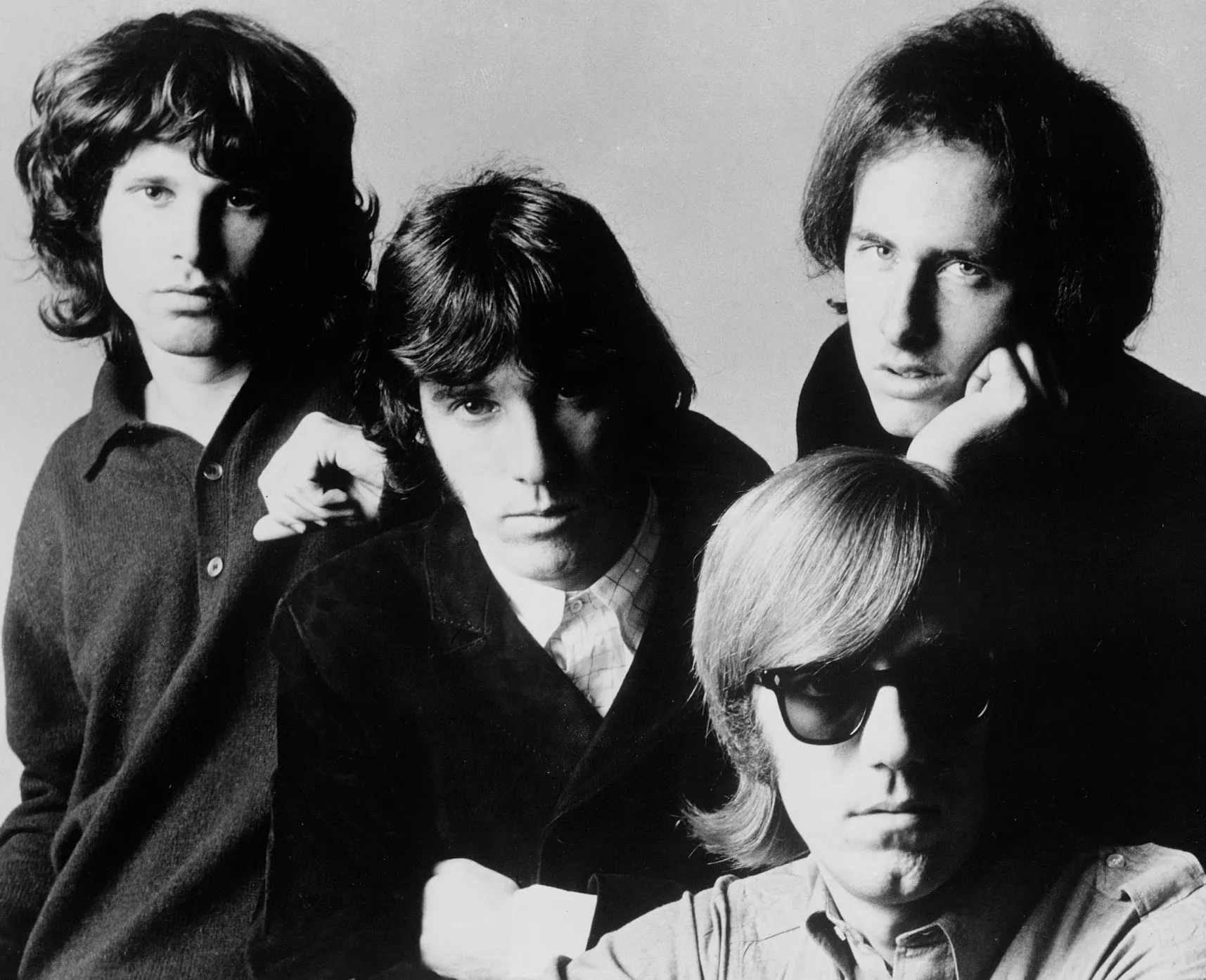
Photo by Joel Brodsky ; Distributed by Agency for the Performing Arts (APA) , licensed under Public domain · Wikimedia Commons
Rank #12
The Doors
Jim Morrison-fronted psychedelic rock unit blending poetry and dark blues.
From Wikipedia
The Doors were an American rock band formed in Los Angeles in 1965, comprising vocalist Jim Morrison, keyboardist Ray Manzarek, guitarist Robby Krieger, and drummer John Densmore. They were among the most influential and controversial rock acts of the 1960s, primarily due to Morrison's lyrics and voice, along with his erratic stage persona and legal issues. The group is widely regarded as representative of the era's counterculture.
Members
- Jim Morrison (?–1971)
- John Densmore
- Ray Manzarek
- Robby Krieger
Studio Albums
- 1967 The Doors
- 1967 Strange Days
- 1968 Waiting for the Sun
- 1969 The Soft Parade
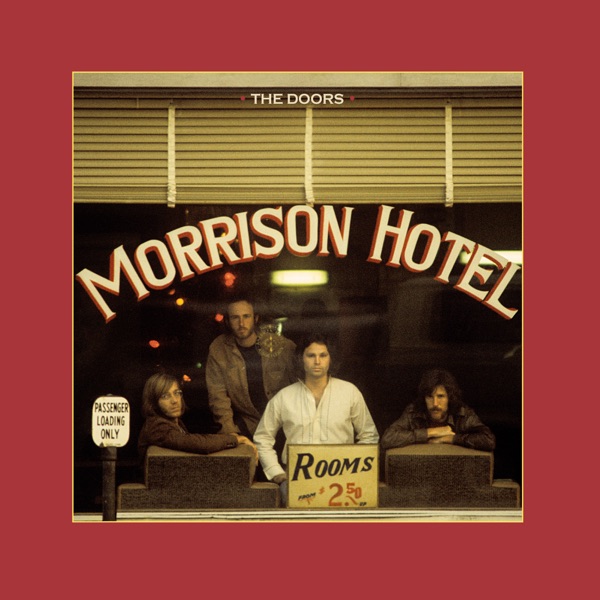
- 1970 Morrison Hotel
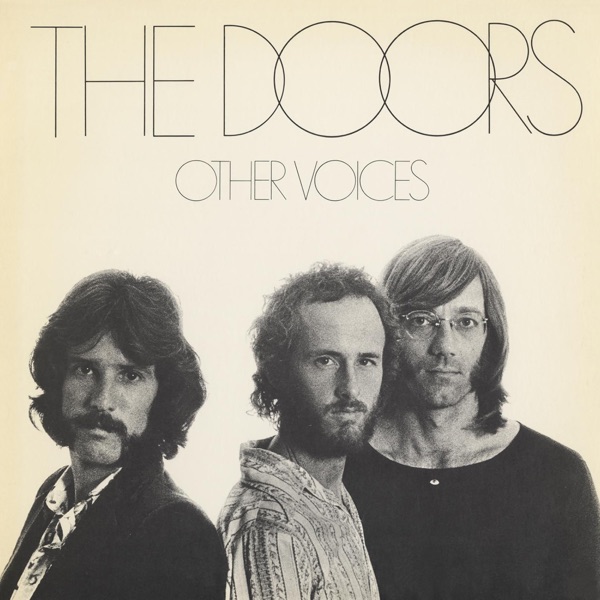
- 1971 Other Voices
- 1971 L.A. Woman
- 1972 Full Circle
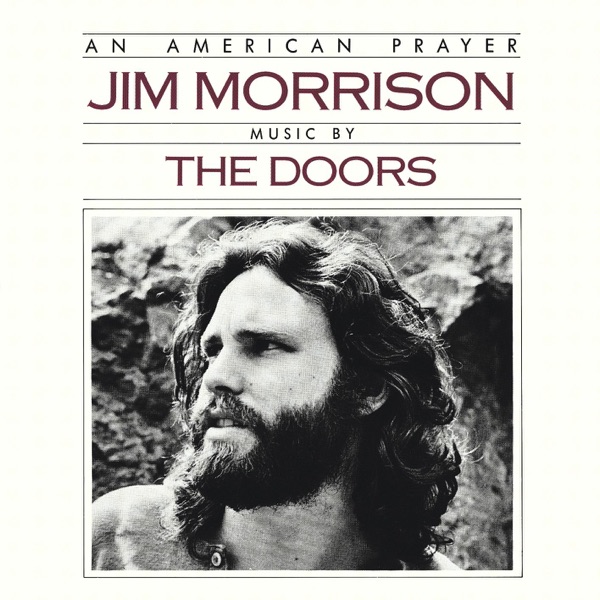
- 1978 An American Prayer
Source: MusicBrainz
Deep Dive
Overview
The Doors were an American rock band formed in Los Angeles in 1965 that became one of the most influential and controversial acts of the 1960s. Comprising vocalist Jim Morrison, keyboardist Ray Manzarek, guitarist Robby Krieger, and drummer John Densmore, the group synthesized psychedelic rock with blues elements and literary sensibility, creating a sound and mystique that would define a generation’s relationship with rock music. Their brief seven-year existence produced a catalogue of albums that remain central to any understanding of late-1960s counterculture and the possibilities of rock as both sonic and poetic expression.
Formation Story
The Doors emerged from the Los Angeles music scene in 1965 when Jim Morrison, a film student at UCLA, and Ray Manzarek, who had previously played in a local band called Rick and the Ravens, met and discovered an immediate creative rapport. Morrison had been writing poetry for years, and Manzarek recognized the potential in combining Morrison’s lyrics and vocal presence with a compositional structure rooted in keyboards and blues changes. They enlisted guitarist Robby Krieger and drummer John Densmore to complete the quartet. The band took their name from Aldous Huxley’s The Doors of Perception, a choice that reflected both their literary ambitions and their interest in consciousness expansion—a preoccupation they shared with much of the era’s counterculture.
Breakthrough Moment
The Doors’ self-titled debut album, released in 1967, announced their arrival with a sound and sensibility that set them apart from their psychedelic contemporaries. The album’s centerpiece, “Light My Fire,” became their breakthrough hit, but the album’s deeper significance lay in its fusion of Manzarek’s hypnotic organ work, Krieger’s modal guitar lines, and Morrison’s baritone delivery of densely poetic lyrics. The album’s success—propelled by both radio play and a growing underground reputation—established them as major figures in the emerging psychedelic rock movement. By the time of their second album, Strange Days, released the same year, The Doors had become a concert draw and a band whose albums were being studied as much for their lyrical content as for their musical arrangements.
Peak Era
The period from 1968 to 1971 represented The Doors’ creative and commercial peak. Waiting for the Sun (1968) expanded their ambitions with longer compositional forms and more elaborate orchestration, while The Soft Parade (1969) continued their exploration of blues-based structures mixed with psychedelic experimentation. Morrison Hotel (1970) and L.A. Woman (1971) found the band refining their sound, with the latter marking one of their final collaborative statements before Morrison’s death in 1971. Across these releases, Morrison’s lyrics grew increasingly introspective and dark, moving away from the more celebratory psychedelia of the mid-1960s toward a harder, more introspective blues aesthetic.
Musical Style
The Doors’ sound was built on a unusual instrumentation for rock music: no bass guitar, with Manzarek’s left hand often providing the low end through Vox Continental organ pedals. This absence created a distinctive spatial quality, allowing Krieger’s guitar work to occupy a more textural and often bluesy role rather than serving as a primary rhythmic anchor. Morrison’s voice—a deep, often deadpan baritone—delivered lyrics that blended street-level American imagery with surrealist and mystical references, drawing from poetry, literature, and his own introspective observations. The band’s approach to song structure was less verse-chorus-verse and more exploratory, with extended instrumental passages and improvisational elements that reflected their roots in jazz and blues as much as in rock. Over their albums, they moved from the dreamy, keyboard-floating psychedelia of their debut toward a harder, grittier blues-rock sound that stripped away some of the ethereal qualities in favor of raw emotional directness.
Major Albums
The Doors (1967)
Their self-titled debut established the blueprint: Manzarek’s organ as the leading voice, Morrison’s poetic vocals, and a setlist including “Light My Fire,” “Break On Through (To the Other Side),” and “The End.” The album announced a band fully formed in concept and execution.
Strange Days (1967)
Released months after their debut, Strange Days deepened their exploration of psychedelic textures while maintaining the blues and literary underpinnings that gave them depth beyond the era’s more purely trippy acts.
Waiting for the Sun (1968)
This album marked an expansion in scope and ambition, with longer songs and more elaborate arrangements that nonetheless retained the band’s core identity of poetry and psychedelic blues.
Morrison Hotel (1970)
A return to a leaner, more blues-focused sound, Morrison Hotel demonstrated the band’s ability to strip back arrangements while maintaining their distinctive character and Morrison’s increasingly philosophical lyrical voice.
L.A. Woman (1971)
Their final album of new material with Morrison showcased a band comfortable in their idiom, mixing standard rock song structures with blues-based explorations and Morrison’s most mature lyrical voice.
Signature Songs
- “Light My Fire” — The band’s most recognizable song and their biggest chart success, featuring Manzarek’s memorable organ introduction and extended keyboard solo.
- “Break On Through (To the Other Side)” — An early statement of purpose combining drive with Morrison’s spoken and sung vocals and themes of transcendence.
- “The End” — An epic closing track from their debut that showcases their ability to construct extended, darkly introspective compositions.
- “Roadhouse Blues” — A stripped-down, hard-blues examination of American life and restlessness that became a live staple.
- “LA Woman” — A later composition that merges introspection with urban imagery and Krieger’s bluesy guitar work.
- “People Are Strange” — A mid-period song that balances melodic accessibility with Morrison’s observations of social alienation.
- “Riders on the Storm” — A late-era composition featuring Manzarek’s jazz-inflected keyboards and Morrison’s weary vocal delivery.
Influence on Rock
The Doors demonstrated that rock music could serve as a vehicle for serious literary ambition without sacrificing groove or accessibility. Their influence extended beyond music into the broader counterculture, with Morrison becoming emblematic of rock’s potential as a vehicle for transgression and poetic expression. Subsequent rock bands adopted their approach to keyboards as a lead instrument, their blues-based compositional logic, and their willingness to blend high literary aspiration with popular music forms. The band’s exploration of extended song structures and improvisational elements influenced progressive rock developments in the 1970s, while their fundamentally blues-centered approach informed hard rock and metal’s evolution. Their model of the rock frontman as poet and controversial figure shaped how rock musicians understood their cultural role throughout subsequent decades.
Legacy
The Doors remain among the best-selling rock bands of all time, with their albums achieving platinum status and remaining continuously in print. Morrison’s death in 1971 cemented their historical status as a band that burned briefly but intensely, their catalogue frozen at its creative peak. The surviving members—Krieger, Manzarek, and Densmore—continued to perform and record, releasing Full Circle in 1972 and An American Prayer in 1978, a spoken-word and instrumental album featuring Morrison’s voice, though these later efforts lacked the creative force of the original run. The band’s place in rock history was solidified by their influence on subsequent generations of musicians, their continued strong streaming and sales presence, and the enduring cultural mystique surrounding Morrison himself. The music has been adapted for film and theatrical contexts, and the band’s core catalogue remains a touchstone for understanding 1960s rock music and the possibilities of the form.
Fun Facts
- Ray Manzarek had previously recorded “Gloria” with his band Rick and the Ravens before joining forces with Morrison; the song would later become a staple of The Doors’ live performances.
- The band’s name derived directly from Aldous Huxley’s The Doors of Perception, a nonfiction work about mescaline and expanded consciousness that reflected the band members’ intellectual interests.
- John Densmore was trained as a jazz drummer before joining The Doors, giving their rhythmic approach a sophistication often overlooked in discussions of their blues-rock foundation.
- The Doors recorded their debut album in fewer than two weeks, establishing their core sound with remarkable efficiency for a band that would become known for extended improvisations.
Discography & Previews
Click any album to expand its track list. Each track plays a 30-second preview streamed from Apple Music. Tap the link icon next to a track to open it in Apple Music for full playback.

- 1 Break On Through (To The Other Side) ↗ 2:26
- 2 Soul Kitchen ↗ 3:31
- 3 The Crystal Ship ↗ 2:32
- 4 Twentieth Century Fox ↗ 2:32
- 5 Alabama Song (Whisky Bar) ↗ 3:16
- 6 Light My Fire ↗ 6:58
- 7 Back Door Man ↗ 3:31
- 8 I Looked At You ↗ 2:21
- 9 End Of The Night ↗ 2:49
- 10 Take It As It Comes ↗ 2:15
- 11 The End ↗ 11:39


- 1 Hello, I Love You ↗ 2:38
- 2 Love Street ↗ 2:56
- 3 Not To Touch The Earth ↗ 3:56
- 4 Summer's Almost Gone ↗ 3:23
- 5 Wintertime Love ↗ 1:56
- 6 The Unknown Soldier ↗ 3:24
- 7 Spanish Caravan ↗ 3:03
- 8 My Wild Love ↗ 3:00
- 9 We Could Be So Good Together ↗ 2:23
- 10 Yes, The River Knows ↗ 2:42
- 11 Five To One ↗ 4:32



- 1 Awake ↗ 0:36
- 2 Ghost Song ↗ 2:51
- 3 Dawn's Highway ↗ 1:22
- 4 Newborn Awakening ↗ 2:25
- 5 To Come of Age ↗ 1:02
- 6 Black Polished Chrome ↗ 1:08
- 7 Latino Chrome ↗ 2:15
- 8 Angels and Sailors ↗ 2:47
- 9 Stoned Immaculate ↗ 1:33
- 10 The Movie ↗ 1:36
- 11 Curses, Invocations ↗ 1:54
- 12 American Night ↗ 0:28
- 13 Roadhouse Blues ↗ 5:53
- 14 The World On Fire ↗ 1:07
- 15 Lament ↗ 2:19
- 16 The Hitchhiker ↗ 2:16
- 17 An American Prayer ↗ 3:04
- 18 Hour for Magic ↗ 1:18
- 19 Freedom Exists ↗ 0:20
- 20 A Feast of Friends ↗ 2:11
- 21 Babylon Fading ↗ 1:40
- 22 Bird of Prey ↗ 1:04
- 23 The Ghost Song ↗ 5:16