
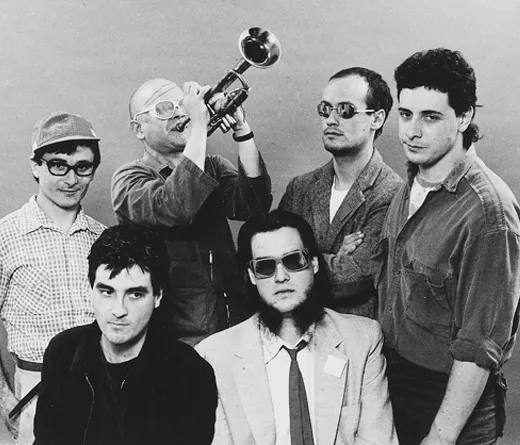
Photo by Unknown author Unknown author , licensed under Public domain · Wikimedia Commons
Rank #269
Sumo
Luca Prodan's Buenos Aires post-punks who reshaped Argentine rock.
From Wikipedia
Sumo was a 1980s Argentine alternative rock band, heavily influenced by post-punk and reggae. Led by Italian-born Scottish Luca Prodan, it remained underground for most of its short activity but was extremely influential in shaping contemporary Argentine rock. Sumo is credited with introducing British post-punk to the Argentine scene, mostly by songs with lyrics in English, and with providing a visceral counterpoint to the progressive and nueva canción influences then dominant in the country's rock en español.
Members
- Alberto "Superman" Troglio
- Alejandro Sokol
- Charly García
- Diego Arnedo
- Germán Daffunchio
- Luca Prodan
- Ricardo Mollo
- Roberto Pettinato
- Stephanie Nuttal
Studio Albums
- 1983 Corpiños en la madrugada
- 1985 Divididos por la felicidad
- 1986 Llegando los monos
- 1987 After chabón
Source: MusicBrainz
Deep Dive
Overview
Sumo was an Argentine alternative rock band that emerged in the early 1980s and operated until 1987, occupying a singular position in the history of rock en español. Led by Italian-born Scottish frontman Luca Prodan, the band remained underground throughout its existence but exerted an outsized influence on the trajectory of Argentine rock music. Sumo’s chief contribution was the introduction of British post-punk aesthetics and sensibilities to Buenos Aires—a departure that proved historically consequential. Where the Argentine rock establishment was dominated by progressive rock virtuosity and the acoustic-driven nueva canción movement, Sumo provided a raw, visceral alternative rooted in post-punk’s spare arrangements, anxious energy, and urban disaffection.
Formation Story
Sumo coalesced in 1981 in Nono, Argentina, bringing together musicians who would become central figures in the country’s alternative rock movement. The band’s nucleus included Luca Prodan on vocals, Ricardo Mollo on guitar, Roberto Pettinato, Alberto “Superman” Troglio, and others including Alejandro Sokol, Germán Daffunchio, and Diego Arnedo. The presence of Charly García and Stephanie Nuttal at various points in the band’s membership reflected the fluid creative environment of the Buenos Aires underground. Prodan, despite his European heritage, became the identifying voice and conceptual force of the band, bringing with him an immersion in post-punk’s canonical sound world. The band’s formation occurred at a moment when Argentina’s rock scene remained internally focused, with little direct engagement with the post-punk movements that had reshaped rock music in Britain and parts of Western Europe between 1978 and 1981.
Breakthrough Moment
Sumo’s first album, Corpiños en la madrugada, released in 1983, announced the band’s artistic vision to the Buenos Aires underground. The record established Sumo’s calling card: English-language lyrics, post-punk instrumentation, and a sensibility at odds with the guitar-heavy progressive rock and folk-influenced songwriting that had long dominated Argentine rock. While the band never achieved mainstream commercial success during its active years, Corpiños en la madrugada circulated among musicians and attentive listeners as a marker that a different kind of rock music was being made in Argentina. The album’s reception created momentum for a band that would remain marginal in terms of radio play and concert attendance but increasingly central to how younger Argentine musicians understood the contemporary possibilities of rock.
Peak Era
From 1985 to 1987, Sumo released three further studio albums—Divididos por la felicidad (1985), Llegando los monos (1986), and After chabón (1987)—that deepened and expanded the group’s artistic reach. This period marked the band’s most sustained creative output and represented the fullest realization of the post-punk template filtered through an Argentine sensibility. The albums benefited from a stable core of musicians while retaining the fluid membership that allowed for collaborative cross-pollination with other figures in the Buenos Aires scene. By 1987, when After chabón appeared, Sumo had established itself as a proving ground for guitarists, bass players, and songwriters who would later shape Argentine rock’s evolution. The band’s output across these five years remained uncompromising in its commitment to post-punk’s lean aesthetic and its refusal to compromise with commercial radio formats.
Musical Style
Sumo’s sound synthesized post-punk’s core elements—economical arrangements, angular guitar work, rhythmic precision, and vocal delivery that prioritized emotional immediacy over technical display—with reggae influences that gave the band rhythmic texture and a certain spaciousness. The use of English-language lyrics was itself a deliberate choice, marking a rejection of the Spanish-language lyrical conventions that bound most Argentine rock to national and regional identity. Luca Prodan’s vocals embodied the post-punk idiom: conversational, sometimes urgent, sometimes distant, always aligned with the emotional tenor of the arrangement rather than showcasing individual virtuosity. The guitar work of Ricardo Mollo and others in the band favored dissonance, repetition, and dynamics over the extended solos that characterized Argentine progressive rock. The rhythm section anchored songs in propulsive simplicity, allowing space for rhythmic and tonal experimentation in the middle register. Over the course of the band’s four albums, Sumo’s sound remained recognizably consistent in its adherence to post-punk principles, though the production and arrangement choices evolved across the releases.
Major Albums
Corpiños en la madrugada (1983)
Sumo’s debut introduced the band’s English-language post-punk vision to the Buenos Aires underground and established their foundational aesthetic. The record announced that a different kind of rock music was being made in Argentina, one indebted to British post-punk rather than local progressive and folk traditions.
Divididos por la felicidad (1985)
The second album refined Sumo’s approach and expanded their songwriting depth, building on the foundation laid by their debut. The record confirmed that the band was not a one-off intervention but a sustained artistic project with growing command of their chosen idiom.
Llegando los monos (1986)
Sumo’s third album maintained their post-punk commitment while exploring fuller production and arrangement possibilities. The record demonstrated the band’s continued evolution and their ability to sustain creative momentum across multiple releases.
After chabón (1987)
The final album released before the band’s dissolution captured Sumo at a peak of creative maturity. After chabón represented the culmination of their six-year run and their most assured statement of the post-punk aesthetic adapted to Argentine context.
Signature Songs
- “El Disco Fantasma” — An early signature of Sumo’s English-language, post-punk approach, the song exemplified their departure from Argentine rock convention.
- “Loco en la cabeza” — A track that balanced post-punk austerity with accessible melody, establishing the band’s ability to write within their chosen idiom.
- “Rockin’ Russian” — A signature demonstration of the band’s reggae-inflected rhythmic sensibility combined with post-punk instrumental arrangements.
- “Cuerpo y alma” — A song that showcased Luca Prodan’s vocal delivery and the band’s capacity for emotional directness within a post-punk framework.
Influence on Rock
Sumo’s historical significance derives from their role as introducers and adaptors of post-punk to the Argentine rock scene at a moment when the movement had already begun to fragment and disperse in its Anglo-American centers. By presenting post-punk not as an imported novelty but as a living artistic framework within which Argentine musicians could work, Sumo opened conceptual space for subsequent generations of Argentine alternative and independent rock musicians. The band demonstrated that post-punk’s formal vocabulary—the emphasis on economy, the distrust of virtuosity, the acceptance of dissonance and tension—could be naturalized within Argentine contexts. Musicians who emerged in the 1990s Argentine rock renaissance, including those working in indie rock and electronic music, inherited a landscape in which Sumo’s work had provided an essential precedent for thinking about Argentine rock outside the bounds of progressive rock and nueva canción.
Legacy
Sumo’s active lifespan ended in 1987, but their influence on Argentine rock continued to expand long after their dissolution. The band acquired the status of a canonical influence for musicians and critics assessing the development of Argentine rock from the 1980s onward. Their four studio albums remained in circulation through reissues and, eventually, digital platforms, allowing new generations of listeners to encounter their work. The band’s historical importance rests not on commercial success or international recognition—neither of which they achieved during their lifetime—but on their decisive role in introducing a new formal and conceptual vocabulary to Argentine rock. In retrospective accounts of Argentine rock history, Sumo occupies a position comparable to that of post-punk pioneers in Anglo-American rock: a small but historically catalytic group whose work reshaped what rock music could sound like and mean.
Fun Facts
- Luca Prodan was Italian-born and Scottish-raised, bringing a non-Argentine sensibility to a band that became central to Buenos Aires underground rock.
- The band members’ fluid lineup included Charly García, a significant figure in Argentine rock in his own right, at various points in Sumo’s existence.
- Sumo’s choice to sing primarily in English was a deliberate artistic stance that distinguished them from the Spanish-language conventions of Argentine rock en español.
- The band’s four studio albums across six years of activity maintained consistent artistic vision despite operating without mainstream radio support or commercial success.
Discography & Previews
Click any album to expand its track list. Each track plays a 30-second preview streamed from Apple Music. Tap the link icon next to a track to open it in Apple Music for full playback.

- 1 Night & Day ↗ 5:54
- 2 Mejor No Hablar ↗ 5:31
- 3 Banderitas y Globos ↗ 3:21
- 4 Teléfonos / White Trash ↗ 8:47
- 5 La Rubia Tarada ↗ 3:38
- 6 Divididos por la Felicidad ↗ 4:45
- 7 Quiero Dinero ↗ 2:52
- 8 F'you ↗ 1:58
- 9 De Be De ↗ 4:09
- 10 Breaking Away ↗ 5:22
- 11 Next Week ↗ 5:26
- 12 Warm Mist ↗ 6:57
- 13 Solo Piano ↗ 2:42


- 1 Crua Chan ↗ 3:31
- 2 No Tan Distintos ↗ 2:40
- 3 Banderitas y Globos ↗ 2:58
- 4 Mañana en el Abasto ↗ 4:08
- 5 Hola Frank ↗ 3:10
- 6 Ojos de Terciopelo ↗ 3:32
- 7 Lo Quiero Ya ↗ 2:17
- 8 La Gota en el Ojo ↗ 3:05
- 9 El Cieguito Volador ↗ 3:20
- 10 No Te Pongas Azul ↗ 4:05
- 11 Noche de Paz ↗ 2:07
- 12 Percussión Baby ↗ 3:46