
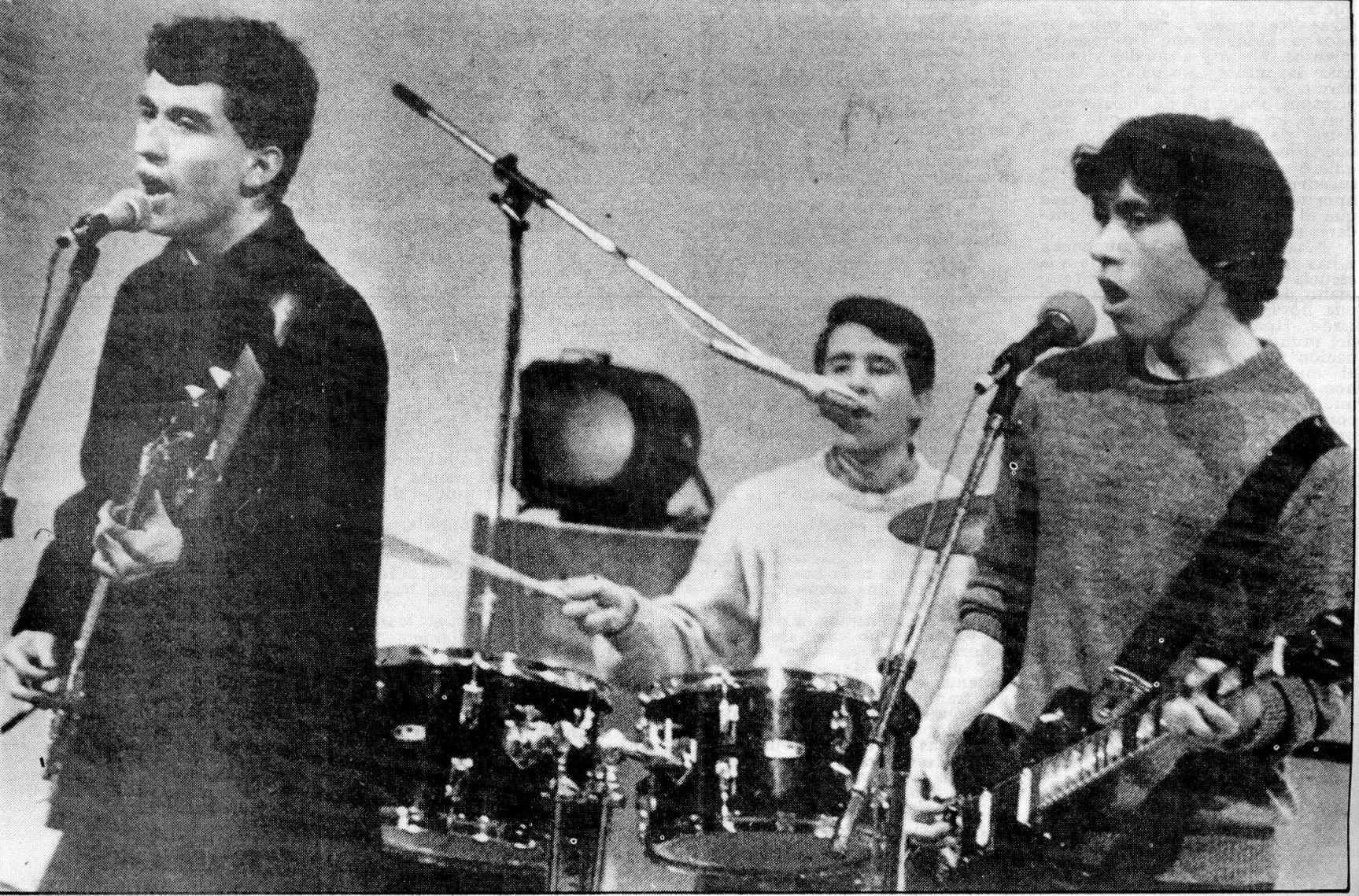
Photo by No especificado , licensed under Public domain · Wikimedia Commons
Rank #270
Los Prisioneros
Santiago band whose synth-rock protests defined Chilean rock under Pinochet.
From Wikipedia
Los Prisioneros was a Chilean rock band formed in San Miguel, Santiago, in 1982. Considered one of the most influential Latin-American bands of all time, they've been evaluated as pioneers of Rock en español by Latin American media and musicians, and one of the strongest socio-political impactful bands in Chile. The group developed a new wave sound that had its roots in British punk rock, in particular the Clash, and incorporated rockabilly, reggae and ska influences, and later synthpop. They became known for their controversial, witty and subversive lyricism that criticized the socio-economic structures, education and societal attitudes of dictatorship-era Chile and Latin America as a whole. This would cause their music to be banned by the Chilean mainstream media between 1985 and 1990, but their music would continue to spread there, aided by word of mouth and shared homemade cassette tapes.
Members
- Claudio Narea
- Jorge González
- Miguel Tapia
Studio Albums
- 1984 La voz de los ’80
- 1984 La voz de los '80 (Fusión)
- 1986 Pateando piedras
- 1987 La cultura de la basura
- 1990 Corazones
- 2003 Los Prisioneros
- 2004 Manzana
- 2006 Raspando la olla
Source: MusicBrainz
Deep Dive
Overview
Los Prisioneros stands as one of the most consequential rock bands to emerge from Latin America, and the most culturally significant musical voice of 1980s Chile. Formed in the San Miguel district of Santiago, they synthesized British new wave and punk with reggae, ska, and rockabilly into a sound that became inseparable from resistance against the Pinochet military dictatorship. Their lyrics—witty, subversive, and unflinching in their critique of socio-economic inequality, education systems, and the regime’s apparatus—transformed them from a local act into an underground phenomenon whose music spread via word of mouth and homemade cassette tapes when radio stations refused to broadcast their work.
Formation Story
Los Prisioneros coalesced in 1979 in San Miguel, Santiago, during the late years of Pinochet’s authoritarian rule. The founding lineup of Jorge González, Claudio Narea, and Miguel Tapia came together at a moment when Chilean rock was searching for a voice capable of speaking to the political and social reality around them. They absorbed the aesthetic of British new wave and punk—particularly the Clash, whose own brand of politicized rock provided both sonic and ideological precedent—while weaving in reggae, ska, and rockabilly elements that gave their sound a distinctly Latin American inflection. By the early 1980s, the band had developed a sharp musical and lyrical identity that would soon make them targets of censorship.
Breakthrough Moment
Los Prisioneros achieved their initial breakthrough with the release of La voz de los ‘80 in 1984, an album that announced their arrival as a major creative force. A second version, La voz de los ‘80 (Fusión), appeared the same year, indicating the band’s eagerness to refine and expand their material. These early records established the sonic blueprint and thematic obsessions that would define their career: synth-driven production, propulsive rhythms, and lyrics that dissected the failures of Chilean society and capitalism. The band’s early commercial success, however, attracted the hostile attention of the dictatorship’s cultural gatekeepers. Between 1985 and 1990, mainstream Chilean media banned their music—a move that paradoxically amplified their cultural reach as underground audiences sought out their records through informal networks, passing cassette tapes hand to hand.
Peak Era
The period from 1986 through 1990 represented Los Prisioneros’ most creatively fertile and socially consequential years. Pateando piedras (1986) and La cultura de la basura (1987) deepened their engagement with synthpop production while maintaining the lyrical bite that had made them dangerous to the regime. Corazones (1990) arrived as Chile’s dictatorship was reaching its end, capturing the band at a moment of maximum cultural influence when their forbidden status had transformed them into generational icons. These albums circulated through universities, youth communities, and working-class neighborhoods, becoming a kind of unofficial soundtrack to resistance and disillusionment. The band’s ability to make complex social critique accessible through memorable melodies and infectious rhythms ensured that their message reached far beyond conventional rock audiences.
Musical Style
Los Prisioneros grafted the angular, synth-forward sound of 1980s new wave onto a foundation of punk rock aggression and Caribbean rhythmic influence. Their production emphasized synthesizers, drum machines, and bass-driven grooves that reflected the era’s electronic innovations while maintaining a rawness that punk had championed. Jorge González’s vocals cut through the mix with an edgy, almost conversational delivery that made even dense social commentary feel immediate and urgent. Rather than the bombast typical of arena rock, they favored a lean, propulsive aesthetic that privileged lyrical clarity and rhythmic propulsion. As the decade progressed, their incorporation of synthpop elements grew more pronounced, but they never abandoned the underlying critique or the punk ethos of confrontation that defined their approach.
Major Albums
La voz de los ‘80 (1984)
Their debut established the band’s signature blend of new wave synths and socially conscious lyrics, introducing audiences to the sound that would define 1980s Chilean rock.
Pateando piedras (1986)
Released during the height of media censorship, this album deepened their synthpop leanings while maintaining scathing commentary on dictatorship-era society and inequality.
La cultura de la basura (1987)
The band’s most fully realized statement of the decade, balancing electronic sophistication with raw lyrical power, making them the voice of a generation seeking cultural and political change.
Corazones (1990)
Arriving as Pinochet’s rule crumbled, this album captured the emotional and social complexity of a nation in transition, cementing their status as Chile’s most important rock band of the period.
Signature Songs
- “El baile de los que sobran” — A searing indictment of economic exclusion and disposable populations under capitalism.
- “Tren al sur” — An exploration of displacement and migration that resonated with millions of Latin American listeners facing similar pressures.
- “La voz de los ‘80” — The title track that announced their arrival as the definitive voice of their generation.
- “Latinoamérica no invierte en educación” — A direct attack on educational inequality and its role in perpetuating class divisions.
Influence on Rock
Los Prisioneros fundamentally reshaped Latin American rock by demonstrating that the genre could serve as a vehicle for serious social critique without sacrificing melodic appeal or commercial accessibility. They proved that Spanish-language rock could compete on an international stage and that bands from the Global South could pioneer their own variations on transatlantic rock forms rather than simply imitating them. Their success catalyzed the development of Rock en español as a recognizable category, influencing generations of Spanish-language rockers across Latin America and Spain who saw in Los Prisioneros a model for marrying artistic ambition with political engagement. The band’s survival and growth despite systematic censorship demonstrated the power of underground networks and grassroots cultural mobilization—a lesson that inspired musicians and activists throughout the region.
Legacy
Los Prisioneros disbanded in 2006, but their cultural footprint has only deepened in the decades since. In Chile, they remain totemic figures whose music is taught in schools and referenced in academic discussions of dictatorship-era culture. The band reunited briefly for performances and continued to record sporadically, including the albums Los Prisioneros (2003), Manzana (2004), and Raspando la olla (2006). Their place in Latin American rock history is secure, recognized by historians and musicians as pioneers of Rock en español and as one of the strongest socio-political voices in the continent’s modern music. Streaming platforms have introduced their catalog to new international audiences, while their influence persists in contemporary Latin American rock and leftist cultural movements that continue to draw inspiration from their model of politically engaged artistry. Their music endures as a historical document of resistance and as proof that rock, in the right hands, could challenge power and voice the voiceless.
Fun Facts
- The band’s homemade cassette tape network was so effective that their banned music spread faster underground than it would have through radio, creating a counterculture phenomenon that prefigured digital-era file sharing by decades.
- Los Prisioneros emerged from San Miguel, one of Santiago’s working-class districts, a geographic origin that grounded their social critique in lived experience rather than abstract ideology.
- The dictatorship’s ban on their music between 1985 and 1990 transformed them from a successful commercial act into symbols of cultural resistance, a paradox that amplified rather than diminished their influence.
Discography & Previews
Click any album to expand its track list. Each track plays a 30-second preview streamed from Apple Music. Tap the link icon next to a track to open it in Apple Music for full playback.


- 1 Manzana ↗ 3:12
- 2 Mr. Right ↗ 4:12
- 3 El Muro ↗ 4:54
- 4 ¿Por Qué No Me Dejas? ↗ 4:31
- 5 Eres Mi Hogar ↗ 4:51
- 6 El Verdadero Sexo ↗ 3:42
- 7 Azota ↗ 2:52
- 8 Que Llueva, Que Llueva ↗ 3:53
- 9 Te Amo ↗ 4:49
- 10 Come, Come, Come ↗ 4:01
- 11 Acomodado en el Rock and Roll ↗ 3:51
- 12 Limpieza Racial ↗ 4:13
- 13 Insatisfacción ↗ 4:15
- 14 Voy a Trabajar ↗ 3:50
- 15 Argentina ↗ 4:29