Photo by Doomed Shadow , licensed under CC BY 4.0 · Wikimedia Commons
Rank #56
Slipknot
Iowa nine-piece whose theatrical brutality redefined extreme metal performance.
From Wikipedia
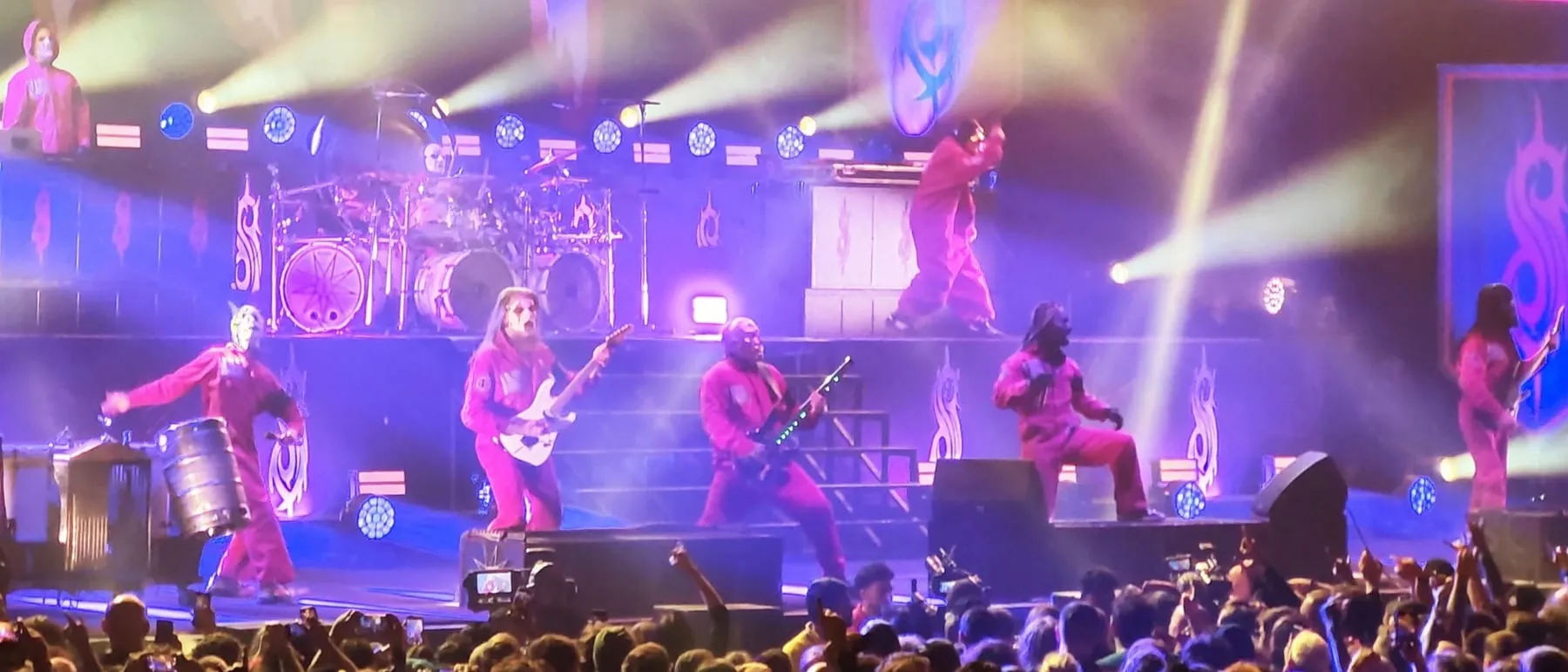
Slipknot is an American heavy metal band formed in Des Moines, Iowa, in 1995 by percussionist Shawn Crahan, vocalist Anders Colsefni and bassist Paul Gray. After several lineup changes in its early years, the band settled on nine members for more than a decade: Crahan, Gray, Joey Jordison, Craig Jones, Mick Thomson, Corey Taylor, Sid Wilson, Chris Fehn, and Jim Root. Slipknot is well known for its attention-grabbing image, aggressive style of music, and energetic and chaotic live shows.
Members
- Anders Colsefni (1995–1997)
- Donnie Steele (1995–2014)
- Joey Jordison (1995–2013)
- Josh Brainard (1995–1999)
- Paul Gray (1995–2010)
- Craig Jones (1996–2023)
- Mick Thomson (1996–present)
- Corey Taylor (1997–present)
- Greg Welts (1997–1998)
- Chris Fehn (1998–2019)
- Sid Wilson (1998–present)
- Jim Root (1999–present)
- Alessandro Venturella (2014–present)
- Jay Weinberg (2014–2023)
- Michael Pfaff (2021–present)
- Eloy Casagrande (2024–present)
- Brandon Darner
- Shawn Crahan
Studio Albums
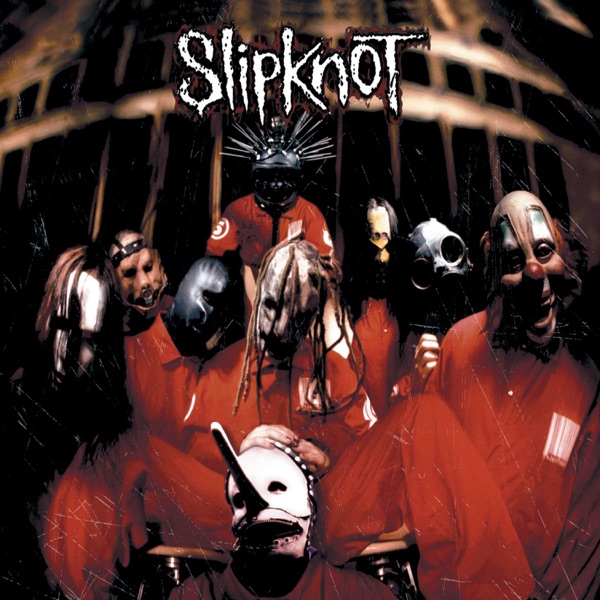
- 1999 Slipknot
- 2001 Iowa
- 2004 Vol. 3: (The Subliminal Verses)
- 2008 All Hope Is Gone
- 2014 .5: The Gray Chapter
- 2019 We Are Not Your Kind
- 2022 The End, So Far
Source: MusicBrainz
Deep Dive
Overview
Slipknot emerged from Des Moines, Iowa, in 1995 as an American heavy metal band formed by percussionist Shawn Crahan, vocalist Anders Colsefni, and bassist Paul Gray. Over the subsequent decade, the band crystallized into a nine-member unit that would come to define nu metal’s theatrical extreme—a configuration that remained remarkably stable from the early 2000s through much of the 2010s. The band is recognized for its attention-grabbing visual presentation, aggressive musical approach, and chaotic, high-energy live performances that positioned them among the most visually and sonically distinctive acts in contemporary heavy metal.
Formation Story
Slipknot coalesced in Des Moines during the mid-1990s, a period when the Midwest industrial and metal underground was beginning to coalesce into something distinct from coastal scenes. The band’s initial lineup included Crahan, Colsefni, and Gray, but the early years saw significant membership flux. Josh Brainard, Donnie Steele, and other musicians cycled through before the lineup solidified around 1998–1999. By the time the band entered the studio for its debut, Corey Taylor had replaced Colsefni as vocalist in 1997, bringing a new vocal intensity to the project. The addition of Joey Jordison on drums and the gradual incorporation of guitarists Jim Root (joining in 1999) and Mick Thomson (from 1996) rounded out the core instrumental foundation that would carry the band through its most commercially successful period.
Breakthrough Moment
Slipknot’s self-titled debut album, released in 1999 on Roadrunner Records, introduced the band’s singular fusion of heavy grooves, polyrhythmic percussion, and visceral vocals to a broader audience. The nine-piece arrangement—featuring dual guitars, multiple percussionists, and sampler/turntablist Sid Wilson—created a sound dense enough to justify the expanded lineup. However, it was Iowa, released in 2001, that cemented the band’s arrival as a major force in heavy metal. Iowa’s darker, more cohesive songwriting and production marked a quantum leap in both craft and impact, establishing Slipknot not merely as a novelty act obscured by masks and shock value but as musicians capable of sustaining complex, brutally effective compositions across a full album. The record’s success translated into global touring and a fanbase that extended well beyond metal’s traditional borders.
Peak Era
The period from 2001 through 2008 represented Slipknot’s creative and commercial apex. Vol. 3: (The Subliminal Verses), released in 2004, continued the trajectory of Iowa while exploring more varied production textures and song structures—evidence that the band was refining rather than repeating itself. All Hope Is Gone, arriving in 2008, maintained their position as one of heavy metal’s most commercially viable acts. Throughout this span, the band’s core nine-member lineup remained unchanged, allowing for an unusually stable creative partnership and live presentation. Tours during these years became legendarily intense, with the visual spectacle of nine masked performers executing precision arrangements at high volume establishing Slipknot as arena-capable heavy metal attraction rather than a club-level novelty.
Musical Style
Slipknot occupies a crossroads among groove metal, alternative metal, and nu metal—genres themselves defined by rapid genre-blending in the 1990s and early 2000s. The band’s instrumental approach centers on syncopated, often polyrhythmic guitar riffs grounded by Craig Jones’s sampler and Sid Wilson’s turntable textures, layered atop dual-kick-drum patterns and multiple percussion stations. The result carries none of the rap-metal specificity of Limp Bizkit or the industrial precision of Nine Inch Nails, instead favoring a chaotic, almost prog-metal level of rhythmic complexity welded to song structures that remained accessible despite their density. Corey Taylor’s vocal approach ranges from melodic singing to piercing screams and guttural growls—a versatility that mirrors the band’s instrumental diversity. The production across their albums favors clarity and definition; despite the number of moving parts, the mix remains legible, allowing listeners to discern individual elements rather than experiencing an undifferentiated wash of noise.
Major Albums
Slipknot (1999)
The self-titled debut announced the band’s sound and visual identity to the world, introducing fans to the mask-and-number concept and the nine-piece arrangement that would define the project. Tracks like “Spit It Out” and “Wait and Bleed” established the template: syncopated riffs, polyrhythmic percussion, and Taylor’s volatile vocal dynamics.
Iowa (2001)
The second album deepened the band’s musical approach while abandoning much of the theatrical novelty that surrounded the debut. Darker in tone and more unified in vision, Iowa demonstrated that Slipknot could sustain complex compositional ideas across a full record and compete with established heavy metal bands on craft rather than shock value alone.
Vol. 3: (The Subliminal Verses) (2004)
This album showcased the band’s willingness to vary tempos, dynamics, and production textures without abandoning their core sound. The expanded song palette and refined arrangements suggested a band moving beyond formula while consolidating their gains from Iowa.
All Hope Is Gone (2008)
Released at the band’s commercial peak, this album maintained their touring momentum and reinforced their place among heavy metal’s most visible acts, balancing aggression with increasingly polished production.
.5: The Gray Chapter (2014)
Ariving after a significant lineup adjustment (Joey Jordison’s 2013 departure and the introduction of new drummer Jay Weinberg), the album proved the band could weather major personnel changes while preserving their essential identity.
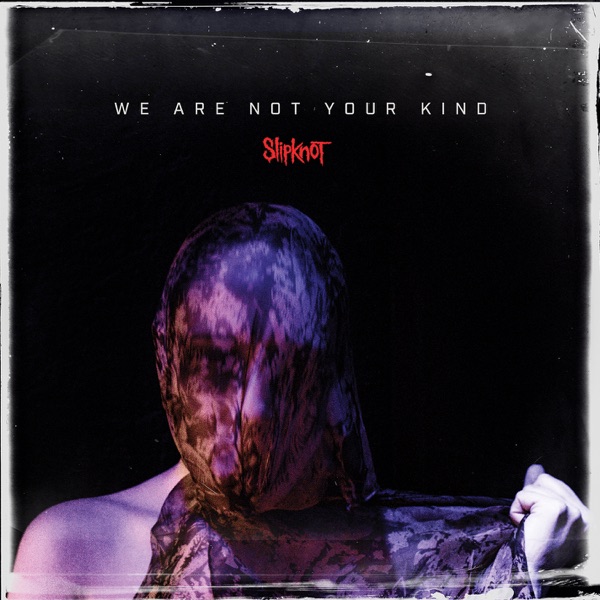
We Are Not Your Kind (2019)
This release demonstrated continued creative vitality and the band’s ability to maintain relevance within heavy metal’s evolving landscape, more than two decades after their formation.
Signature Songs
- “Wait and Bleed” — The most recognizable Slipknot track, it distilled the band’s chaotic intensity into a three-minute statement, becoming their closest analog to a radio-friendly single.
- “Spit It Out” — An early showcase for the band’s polyrhythmic approach and the call-and-response dynamic between Taylor’s vocals and the crowd, establishing a concert ritual that endured across decades.
- “Duality” — From Vol. 3, this track balanced melody and brutality in a way that broadened the band’s appeal without diluting their heaviness.
- “Psychosocial” — A centerpiece of their live shows, featuring some of Taylor’s most effective vocal layering and the band’s tightest groove-metal riffing.
- “People = Shit” — From Iowa, this composition exemplified the album’s darker sensibility and more complex arrangement philosophy.
Influence on Rock
Slipknot’s nine-piece configuration and explicit embrace of visual spectacle as integral to the musical experience pushed heavy metal toward a more theatrical, visually conscious presentation in the 2000s. Their commercial success on Roadrunner Records—itself a label that became synonymous with nu metal and its derivatives—helped legitimize extreme metal within mainstream distribution channels. The band influenced subsequent generations of heavy metal performers to invest in elaborate stage designs and synchronized choreography rather than relying solely on instrumental prowess or shock value in isolation. Their synthesis of accessibility and uncompromising heaviness provided a template for nu metal and post-nu metal bands attempting to reach stadium audiences without compromising their fundamental sound.
Legacy
Slipknot’s continued activity into the 2020s—with new albums like We Are Not Your Kind (2019) and The End, So Far (2022)—ensures their presence as an active rather than historical act. The band’s stability as a commercial draw, evidenced by their ongoing touring and streaming presence, reflects a fanbase that has remained remarkably loyal across nearly three decades. While the core nine-member lineup experienced attrition (Paul Gray’s death in 2010, Joey Jordison’s departure in 2013, the subsequent exits of Craig Jones and Jay Weinberg by 2023), the band’s name retained sufficient cultural weight to absorb these losses and reconstitute with new personnel. Their influence extends beyond metal into alternative rock, industrial music, and the broader culture of masked performance art, establishing Slipknot as one of the rare metal acts to transcend purely musical significance and become a recognizable cultural phenomenon.
Fun Facts
- Each band member adopted a number from 0 to 8 as part of their stage identity, a numerical system that persisted across lineup changes and personnel rotations.
- The band’s mask designs evolved significantly across album cycles, with each member’s visual presentation often changing in tandem with the band’s sonic direction.
- Shawn Crahan’s percussion setup involved multiple instruments and samples triggered in real time, making the percussionist’s role as compositionally central as any guitarist in the arrangement.
- The band’s Des Moines origin positioned them outside the established metal capitals of Los Angeles, New York, and San Francisco, lending their emergence a sense of geographic outsider status unusual for a group achieving such mainstream success.
Discography & Previews
Click any album to expand its track list. Each track plays a 30-second preview streamed from Apple Music. Tap the link icon next to a track to open it in Apple Music for full playback.


- 1 Prelude 3.0 ↗ 3:57
- 2 The Blister Exists ↗ 5:19
- 3 Three Nil ↗ 4:48
- 4 Duality ↗ 4:13
- 5 Opium of the People ↗ 3:13
- 6 Circle ↗ 4:23
- 7 Welcome ↗ 3:15
- 8 Vermilion ↗ 5:17
- 9 Pulse of the Maggots ↗ 4:20
- 10 Before I Forget ↗ 4:39
- 11 Vermilion Pt. 2 ↗ 3:44
- 12 The Nameless ↗ 4:28
- 13 The Virus of Life ↗ 5:25
- 14 Danger - Keep Away ↗ 3:14


- 1 XIX ↗ 3:10
- 2 Sarcastrophe ↗ 5:06
- 3 AOV ↗ 5:33
- 4 The Devil In I ↗ 5:43
- 5 Killpop ↗ 3:45
- 6 Skeptic ↗ 4:47
- 7 Lech ↗ 4:50
- 8 Goodbye ↗ 4:35
- 9 Nomadic ↗ 4:18
- 10 The One That Kills the Least ↗ 4:12
- 11 Custer ↗ 4:14
- 12 Be Prepared For Hell ↗ 1:58
- 13 The Negative One ↗ 5:25
- 14 If Rain Is What You Want ↗ 6:21
- 1 Insert Coin ↗ 1:39
- 2 Unsainted ↗ 4:21
- 3 Birth of the Cruel ↗ 4:36
- 4 Death Because of Death ↗ 1:21
- 5 Nero Forte ↗ 5:15
- 6 Critical Darling ↗ 6:26
- 7 A Liar's Funeral ↗ 5:27
- 8 Red Flag ↗ 4:12
- 9 What's Next ↗ 0:54
- 10 Spiders ↗ 4:04
- 11 Orphan ↗ 6:02
- 12 My Pain ↗ 6:48
- 13 Not Long for This World ↗ 6:36
- 14 Solway Firth ↗ 5:56
