
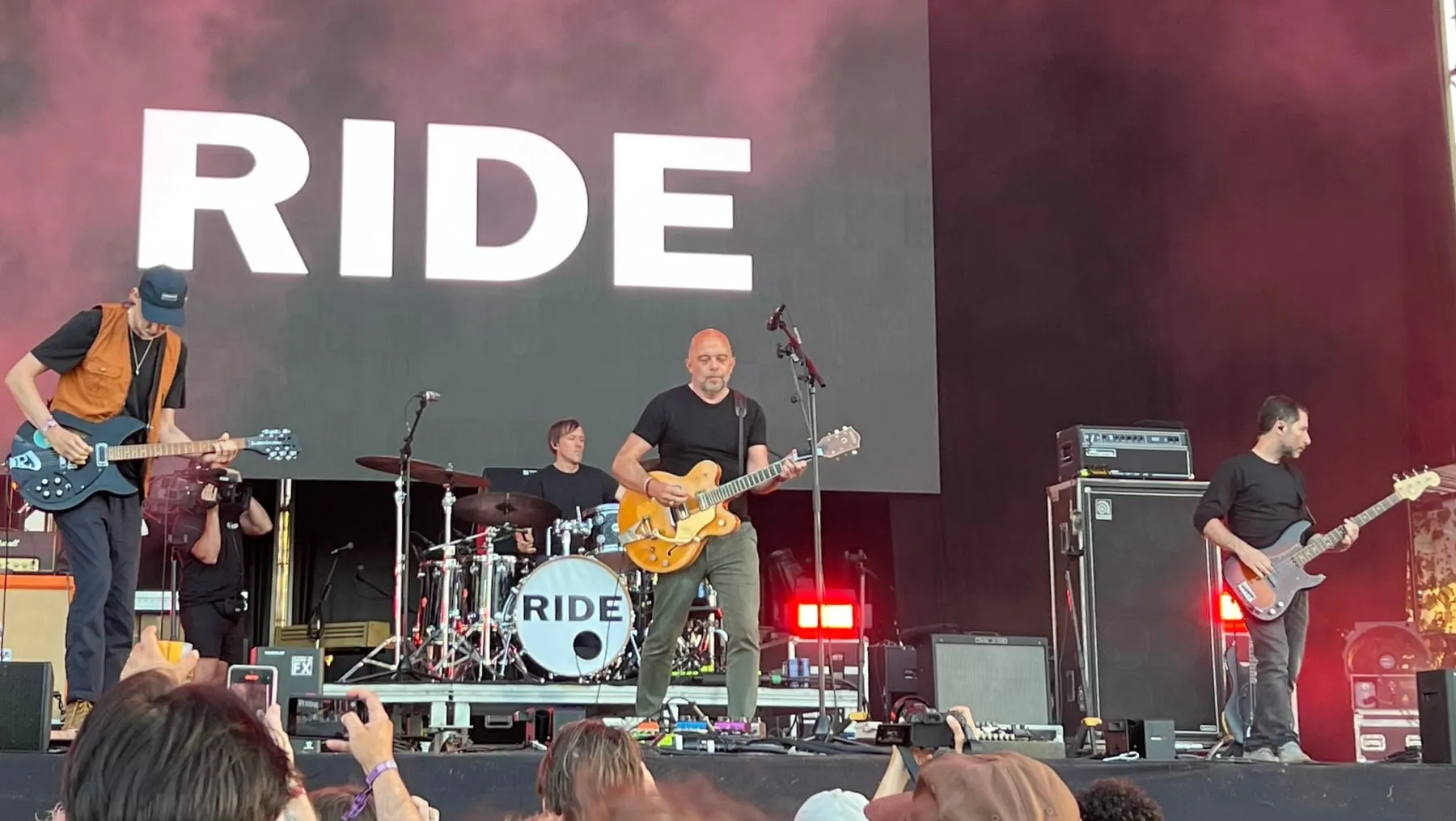
Photo by Will Bonniker , licensed under CC BY-SA 4.0 · Wikimedia Commons
Rank #114
Ride
Oxford four-piece blending Byrdsian jangle with shoegaze haze.
From Wikipedia
Ride are an English rock band formed in Oxford in 1988. The band consists of vocalists and guitarists Andy Bell and Mark Gardener, drummer Laurence "Loz" Colbert and bassist Steve Queralt. They have been recognised as one of the key pioneers of shoegaze, an alternative rock subgenre that emerged to prominence in the United Kingdom during the early 1990s.
Members
- Andy Bell
Studio Albums
- 1990 Nowhere
- 1992 Going Blank Again
- 1994 Carnival of Light
- 1996 Tarantula
- 2017 Weather Diaries
- 2019 This Is Not a Safe Place
- 2024 Interplay
Source: MusicBrainz
Deep Dive
Overview
Ride are an English rock band formed in Oxford in 1988 who emerged as one of the key figures in the shoegaze movement of the early 1990s. The four-piece—vocalists and guitarists Andy Bell and Mark Gardener, drummer Laurence “Loz” Colbert, and bassist Steve Queralt—synthesized the jangly guitar traditions of 1960s Byrds-influenced pop with the textural wall-of-sound aesthetics that would define shoegaze. Across their initial run in the 1990s and their reformation from 2015 onward, Ride have maintained a distinctive approach to alternative rock that balances melodic accessibility with sonic density.
Formation Story
Ride coalesced in Oxford during 1988, drawing from the local independent rock scene and the broader ferment of British alternative music. The partnership between Andy Bell and Mark Gardener as dual songwriters and guitarists formed the creative core, with Colbert and Queralt completing the rhythm section. Oxford in the late 1980s was not a major music hub like Manchester or London, yet the band’s emergence there positioned them as part of a wider generation of acts who were synthesizing influences from post-punk, indie pop, and the then-nascent shoegaze sound. The band’s foundation rested on tight musicianship and a clear melodic sensibility that would distinguish them from purely atmospheric peers.
Breakthrough Moment
Ride’s debut album Nowhere, released in 1990, introduced their signature blend of radiant guitar interplay and hook-driven songwriting to a growing audience of alternative rock listeners. The record established them as serious contenders in the shoegaze field just as the subgenre began to gain critical and commercial traction in the UK. Following this strong debut, the band’s second album, Going Blank Again (1992), solidified their position as one of shoegaze’s leading acts. These early releases demonstrated that Ride could deliver both the textural innovations the genre demanded and the melodic infrastructure that separated them from more purely effects-dependent competitors.
Peak Era
The period spanning 1990 to 1996 represented Ride’s initial creative and commercial peak. During these six years, the band released four studio albums: Nowhere (1990), Going Blank Again (1992), Carnival of Light (1994), and Tarantula (1996). This run saw the band navigate the rise and eventual decline of shoegaze’s mainstream profile, moving from the subgenre’s moment of peak industry interest in 1992–1993 through its commercial contraction by the mid-1990s. Throughout this period, Ride maintained a distinctive identity rooted in their melodic foundations while embracing the layered, guitar-driven production values central to their sound.
Musical Style
Ride’s sonic approach rested on a deliberate fusion of opposing impulses: the crystalline jangle of 1960s guitar pop and the dense, feedback-laden textures of 1980s post-punk and alternative rock. The band’s dual-guitar setup, with Bell and Gardener often playing complementary rather than unison parts, created a shimmering interplay that became their trademark. Colbert’s drumming maintained a grounded, often propulsive rhythm section that prevented their sound from becoming purely ambient or diffuse, while Queralt’s bass lines provided harmonic definition beneath the atmospheric surface. Vocally, Bell and Gardener shared lead duties, their voices often processed and layered within the mix rather than isolated as dominant focal points. This arrangement allowed lyrics and melody to coexist with texture and timbre as equal compositional elements. The band’s production aesthetic favored clarity and depth over murkiness, a quality that set them apart from some of shoegaze’s more deliberately obscured practitioners.
Major Albums
Nowhere (1990)
Ride’s debut announced their core aesthetic fully formed: melodic guitar-pop foundations wrapped in rich, shimmering production. The album established them as serious contenders in the emerging shoegaze movement.
Going Blank Again (1992)
The band’s second album deepened their exploration of texture and hook-craft, representing shoegaze at its commercial peak. The record demonstrated their ability to balance accessibility with sonic ambition.
Carnival of Light (1994)
Released as the shoegaze mainstream began to contract, this third album showed Ride adjusting their approach while maintaining their core melodic sensibility and layered guitar work.
Tarantula (1996)
The band’s final album of their initial run, Tarantula saw them continuing to evolve their sound as the broader alternative rock landscape shifted toward different aesthetic priorities.
Signature Songs
- “Vapour Trail” — A defining moment of the band’s early period, showcasing their gift for melancholy melody set against uplifting, textured guitars.
- “Taste” — Exemplifies their ability to craft radio-friendly alternative rock without sacrificing sonic depth or production ambition.
- “Leave Them All Behind” — Demonstrates the dual-vocal approach that distinguished Bell and Gardener’s songwriting partnership.
- “Drive Blind” — Captures the band’s knack for pairing introspective lyricism with propulsive, jangly instrumentation.
Influence on Rock
As pioneers of shoegaze alongside contemporaries like Slowdive, Cocteau Twins–influenced acts, and creation Records label-mates, Ride helped define the sonic and aesthetic parameters of the movement. Their emphasis on melody and accessibility within the shoegaze framework demonstrated that the subgenre could appeal beyond underground listeners and college radio. The band’s influence extended across alternative rock more broadly, informing subsequent generations of indie and alternative acts who sought to balance production sophistication with genuine tunefulness. Their reunion and continued recording activity from 2015 onward have renewed interest in shoegaze among younger audiences, positioning the genre as a recurring touchstone in alternative rock rather than a period-bound artifact of the early 1990s.
Legacy
Ride’s disbandment during the late 1990s and their eventual reunion in 2015 marked two distinct chapters in their history. The band’s return to recording with Weather Diaries (2017), This Is Not a Safe Place (2019), and Interplay (2024) demonstrated their continued creative engagement and relevance within contemporary alternative rock. Their standing as one of shoegaze’s defining acts remains secure; the band is consistently cited among the era’s most accomplished practitioners. The continued streaming presence and critical reassessment of 1990s shoegaze as a whole has solidified Ride’s place in alternative rock history, with their albums regularly revisited by both longtime listeners and those discovering the genre for the first time.
Fun Facts
- Ride were among the first major acts on Creation Records, the legendary British independent label that also housed Oasis, Primal Scream, and other defining 1990s alternative acts.
- The band formed in Oxford, making them part of a broader wave of shoegaze and alternative rock acts that emerged from outside London’s traditional rock infrastructure.
- Andy Bell’s and Mark Gardener’s songwriting partnership remained the creative bedrock throughout both the band’s original run and their reformation, spanning more than three decades.
- After more than 15 years apart, Ride’s 2015 reunion was driven largely by fan demand and the broadening critical reappraisal of 1990s shoegaze as a significant artistic movement.
Discography & Previews
Click any album to expand its track list. Each track plays a 30-second preview streamed from Apple Music. Tap the link icon next to a track to open it in Apple Music for full playback.

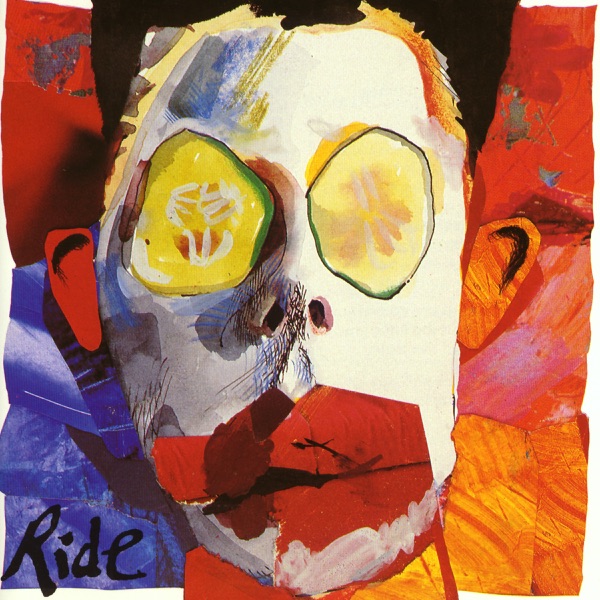
- 1 Leave Them All Behind ↗ 8:17
- 2 Twisterella ↗ 3:42
- 3 Not Fazed ↗ 4:24
- 4 Chrome Waves ↗ 3:53
- 5 Mouse Trap ↗ 5:14
- 6 Time of Her Time ↗ 3:16
- 7 Cool Your Boots ↗ 6:01
- 8 Making Judy Smile ↗ 2:39
- 9 Time Machine ↗ 5:54
- 10 OX4 ↗ 7:03
- 11 Going Blank Again ↗ 3:21
- 12 Howard Hughes ↗ 4:03
- 13 Stampede ↗ 4:16
- 14 Grasshopper ↗ 10:56

- 1 Moonlight Medicine ↗ 6:50
- 2 1000 Miles ↗ 5:00
- 3 From Time To Time ↗ 5:05
- 4 Natural Grace ↗ 4:39
- 5 Only Now ↗ 4:25
- 6 Birdman ↗ 6:39
- 7 Crown of Creation ↗ 4:41
- 8 How Does It Feel To Feel? ↗ 3:40
- 9 Endless Road ↗ 3:29
- 10 Magical Spring ↗ 4:27
- 11 Rolling Thunder ↗ 2:07
- 12 I Don't Know Where It comes From ↗ 5:33
- 13 Don't Let It Die ↗ 3:12
- 14 Let's Get Lost ↗ 3:56
- 15 At the End of the Universe ↗ 7:54

- 1 Black Nite ↗ 2:33
- 2 Sunshine-Nowhere To Run ↗ 4:48
- 3 Dead Man ↗ 3:34
- 4 Walk On Water ↗ 4:20
- 5 Deep Inside My Pocket ↗ 5:24
- 6 Mary Anne ↗ 6:50
- 7 Castle On the Hill ↗ 3:17
- 8 Gonna Be Alright ↗ 2:53
- 9 The Dawn Patrol ↗ 4:05
- 10 Ride the Wind ↗ 3:46
- 11 Burnin' ↗ 5:18
- 12 Starlight Motel ↗ 3:34
- 13 Nothing Lasts Forever ↗ 3:32
- 14 Slave ↗ 3:51
- 15 A Trip Down Ronnie Lane ↗ 3:39


- 1 Peace Sign ↗ 4:38
- 2 Last Frontier ↗ 4:10
- 3 Light in a Quiet Room ↗ 6:02
- 4 Monaco ↗ 4:15
- 5 I Came to See the Wreck ↗ 5:58
- 6 Stay Free ↗ 5:01
- 7 Last Night I Went Somewhere to Dream ↗ 4:14
- 8 Sunrise Chaser ↗ 4:18
- 9 Midnight Rider ↗ 4:23
- 10 Portland Rocks ↗ 5:02
- 11 Essaouira ↗ 7:10
- 12 Yesterday Is Just a Song ↗ 3:35