
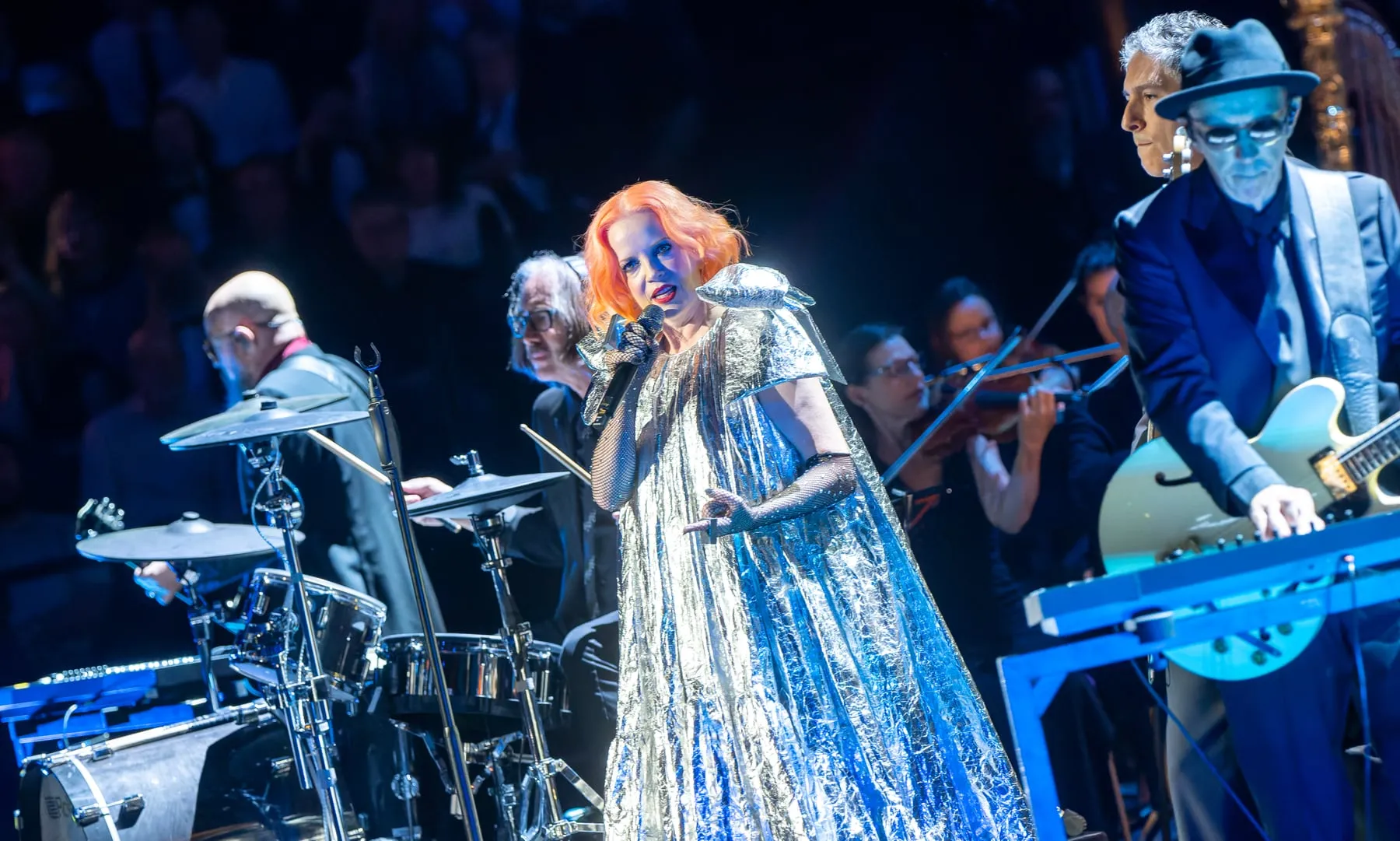
Photo by Raph_PH , licensed under CC BY 2.0 · Wikimedia Commons
Rank #409
Garbage
Anglo-American band fronted by Shirley Manson whose 90s alt-rock hits remain canonical.
From Wikipedia
Garbage is an American rock band formed in 1993 in Madison, Wisconsin. The band's line-up, consisting of Scottish musician Shirley Manson (vocals) and American musicians Duke Erikson, Steve Marker, and Butch Vig, has remained unchanged since its inception. All four members are involved in songwriting and production. Garbage has sold over 17 million albums worldwide.
Members
- Shirley Manson
Studio Albums
- 1995 Garbage
- 1998 Version 2.0
- 2001 beautifulgarbage
- 2005 Bleed Like Me
- 2012 Not Your Kind of People
- 2016 Strange Little Birds
- 2021 No Gods No Masters
- 2025 Let All That We Imagine Be the Light
Source: MusicBrainz
Deep Dive
Overview
Garbage is an American rock band formed in 1993 in Madison, Wisconsin, that emerged as one of the defining alternative rock acts of the 1990s. Fronted by Scottish vocalist Shirley Manson and anchored by American producers and musicians Duke Erikson, Steve Marker, and Butch Vig, the band synthesized industrial textures, pop sensibility, and raw rock energy into a sound that bridged underground credibility and mainstream accessibility. Over three decades, Garbage has sold more than 17 million albums worldwide, establishing themselves as a canonical force in alternative and industrial rock.
Formation Story
Garbage coalesced in Madison, Wisconsin, in 1993 when three seasoned music producers—Duke Erikson, Steve Marker, and Butch Vig—decided to form a band after years of working behind the scenes in recording studios. The trio began crafting songs and recording material in their own facility, blending sample-driven production with live instrumentation. In 1995, Scottish singer Shirley Manson joined the band as vocalist and full songwriting collaborator. Manson brought a distinctive vocal presence—alternately sultry, caustic, and emotionally direct—that transformed the project from producer experiment into a complete artistic entity. From the outset, all four members shared equally in songwriting and production duties, establishing a democratic creative model that would define the band’s approach across three decades.
Breakthrough Moment
Garbage’s self-titled debut album, released in 1995, announced the band’s arrival with a cohesive artistic statement that caught both underground and mainstream attention. The record showcased the band’s signature production approach: densely layered electronic textures woven through live drums, bass, and guitar, with Manson’s vocals cutting through the arrangement with frank lyricism addressing identity, desire, and social alienation. The album generated strong college radio play and alternative rock radio support, positioning Garbage as a major contender in the mid-1990s alt-rock landscape. By 1998, the release of Version 2.0 cemented their commercial breakthrough. That album refined and expanded their sonic palette, achieving wider chart penetration and establishing Garbage as a headlining act on international tours. The combination of sophisticated production, Manson’s distinctive presence, and songs that balanced introspection with explosive dynamics made Version 2.0 a watershed moment for the band’s visibility and commercial viability.
Peak Era
The period from 1998 through the early 2000s marked Garbage’s creative and commercial apex. Version 2.0 (1998) and beautifulgarbage (2001) represented the band at full creative confidence, with songs that dominated alternative rock radio and gained crossover recognition. During these years, Garbage toured extensively, built a dedicated international fanbase, and established themselves as regular presences at major rock festivals. The band’s live shows became known for their intensity and precision, translating the studio’s meticulous production into visceral performances. Bleed Like Me (2005) continued the band’s trajectory, demonstrating their ability to evolve their sound while maintaining the core elements that defined their identity. Throughout this era, Garbage remained active in touring and recording without significant hiatuses, building a catalog of work that spanned multiple musical eras and cultural moments in rock.
Musical Style
Garbage’s sound emerged from the intersection of 1980s electronic pop production, industrial rock textures, and alternative rock songwriting. The band’s production style—developed across years of studio work before forming Garbage—emphasized intricate layering of samples, drum loops, synthesizers, and processed vocals over live rock instrumentation. Shirley Manson’s vocals functioned as another textural element within the mix, alternating between whispered intimacy and full-voiced assertion, often within a single song. Lyrically, Manson’s writing addressed themes of self-doubt, female desire, social disconnection, and personal agency with a frankness that distinguished Garbage from contemporary alternative rock peers. The band’s compositional approach favored hooks and memorable melodies embedded within complex arrangements, allowing them to function simultaneously as an underground electronic act and a mainstream rock band. Over their career, they experimented with variations on this formula—emphasizing live instrumentation more on some records, electronic manipulation more heavily on others—but the core DNA remained consistent: precision-engineered pop-rock infrastructure housing emotionally direct, often darkly humorous songwriting.
Major Albums
Garbage (1995)
The debut established the band’s core sound and introduced Shirley Manson as a major vocal presence. Its success proved that experimental production techniques and alternative sensibilities could achieve broad appeal without sacrificing artistic integrity.
Version 2.0 (1998)
Garbage’s commercial breakthrough, Version 2.0 refined the production approach and songwriting to maximum effect, generating widespread radio play and establishing the band as arena-level performers.
beautifulgarbage (2001)
Released in the early 2000s, this album demonstrated the band’s sustained creative vitality, expanding their sonic range while deepening their thematic preoccupations with identity and social critique.
Bleed Like Me (2005)
Continuing the band’s evolution, Bleed Like Me balanced electronic sophistication with guitar-driven rock, showcasing their enduring ability to renew their sound without abandoning their core aesthetic.
Not Your Kind of People (2012)
After a hiatus, this album marked Garbage’s return to recording, signaling their continued relevance and commitment to the project across changing musical landscapes.
Strange Little Birds (2016)
Released in the mid-2010s, this record demonstrated Garbage’s capacity to remain contemporary and artistically engaged, maintaining their position within alternative rock discourse decades after their formation.
Signature Songs
- Stupid Girl — An early showcase for Manson’s vocal delivery and the band’s ability to combine electronic production with rock intensity, becoming a rock radio staple throughout the late 1990s.
- Only When I Lose Myself — A showcase of the band’s melodic sophistication, blending intimate verses with expansive choruses that exemplified their pop-rock duality.
- Push It — Demonstrating Garbage’s command of rhythm and production, the track became emblematic of their ability to create dancefloor-adjacent alternative rock.
- Milk — An example of the band’s darker, more introspective side, showcasing Manson’s capacity for vulnerability within the band’s layered sonic framework.
- Queer — A politically charged track that exemplified Garbage’s willingness to address social and identity-focused themes with directness and musical sophistication.
- Special — A ballad-inflected track that displayed the band’s emotional range and Manson’s vocal expressiveness beyond the uptempo alternative rock context.
Influence on Rock
Garbage occupied a unique position in 1990s rock, proving that electronic production and dance music sensibilities could coexist with alternative rock credibility and live instrumentation without diluting any element. Their success influenced a generation of alternative rock acts to embrace electronic textures and production sophistication, contributing to the mainstreaming of electronic-inflected rock in the 2000s. Shirley Manson’s presence as a lead vocalist in a band of producers also contributed meaningfully to the visibility of female voices in electronic and alternative rock contexts, establishing a model of creative parity and equal songwriting contribution that contrasted with many contemporary band formations. The band’s influence extended across genres, with their production techniques and compositional approach resonating within industrial rock, synth-pop, and electronic music communities alongside their primary impact on alternative rock.
Legacy
Garbage’s legacy rests on their sustained creative engagement across three decades and their role in establishing alternative rock as a viable commercial form without compromise. The band’s decision to continue recording and touring—with occasional hiatuses—demonstrates their commitment to the project beyond the initial 1990s success window. Their catalog has endured in alternative rock radio rotation and streaming platforms, with their 1990s recordings remaining canonical entries in that era’s rock history. The band’s all-members-as-writers model and Shirley Manson’s role as an equal creative partner established a template that influenced subsequent band formations and demonstrated the viability of collaborative, producer-led rock music at scale. Garbage’s continued activity into the 2020s, with the release of No Gods No Masters in 2021 and Let All That We Imagine Be the Light in 2025, confirms their enduring relevance within contemporary rock discourse and establishes them as a long-term institutional presence rather than a time-bound phenomenon.
Fun Facts
- The band’s formation in Madison, Wisconsin represented an unlikely geographic origin point for a group that would achieve international prominence, emerging from the Midwest rather than coastal music industry centers.
- All four members maintain equal creative input in songwriting and production, a collaborative model established from the band’s inception that remains unchanged across their entire catalog.
- Shirley Manson was born and raised in Scotland before joining the Wisconsin-based band, making Garbage a genuinely Anglo-American creative partnership in both personnel and sensibility.
- The band’s 17 million album sales worldwide mark one of the most commercially successful alternative rock projects of their generation, demonstrating sustained commercial viability alongside critical credibility.
Discography & Previews
Click any album to expand its track list. Each track plays a 30-second preview streamed from Apple Music. Tap the link icon next to a track to open it in Apple Music for full playback.




- 1 The Men Who Rule the World ↗ 4:27
- 1 No Horses ↗ 5:23
- 2 The Creeps ↗ 3:34
- 2 Starman ↗ 4:09
- 3 Uncomfortably Me ↗ 3:17
- 3 Girls Talk (with Brody Dalle) [with Brody Dalle] ↗ 3:37
- 4 Wolves ↗ 4:17
- 4 Because the Night ↗ 5:00
- 5 Waiting for God ↗ 4:05
- 5 On Fire ↗ 5:07
- 6 Godhead ↗ 4:08
- 6 The Chemicals (with Brian Aubert) [with Brian Aubert] ↗ 4:20
- 7 Anonymous XXX ↗ 4:08
- 7 Destroying Angels (feat. John Doe & Exene Cervenka) ↗ 5:01
- 8 A Woman Destroyed ↗ 5:32
- 8 Time Will Destroy Everything ↗ 4:43
- 9 Flipping the Bird ↗ 3:37
- 10 No Gods No Masters ↗ 4:31
- 11 This City Will Kill You ↗ 4:36
