
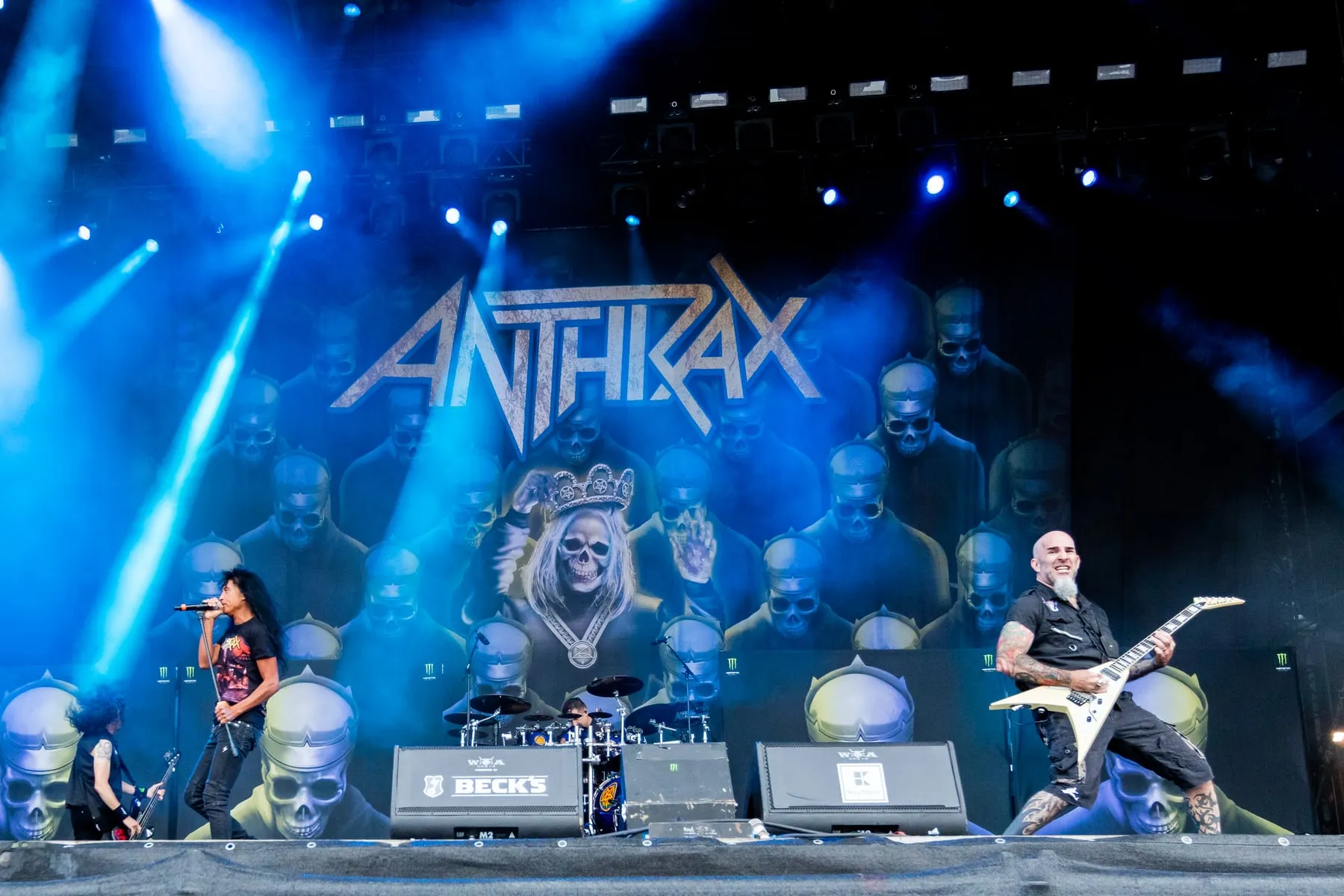
Photo by Sven Mandel , licensed under CC BY-SA 4.0 · Wikimedia Commons
Rank #62
Anthrax
New York thrash mainstay rounding out the Big Four with crossover swagger.
From Wikipedia
Anthrax is an American heavy metal band from New York City, formed in 1981 by rhythm guitarist Scott Ian and bassist Dan Lilker. The group is considered one of the leaders of the thrash metal scene from the 1980s and is part of the "Big Four" of the genre, along with Metallica, Megadeth and Slayer. They were also one of the first thrash metal bands to emerge from the East Coast. The band's current lineup consists of Scott Ian, drummer Charlie Benante, bassist Frank Bello, vocalist Joey Belladonna and lead guitarist Jonathan Donais. Anthrax's lineup has changed numerous times over their career, leaving Ian as the only constant member of the band. Ian and Benante are the only two members to appear on all of Anthrax's albums, while Bello has been a member of Anthrax since 1984, replacing Lilker.
Members
- Joey Belladonna
Studio Albums
- 1984 Fistful of Metal
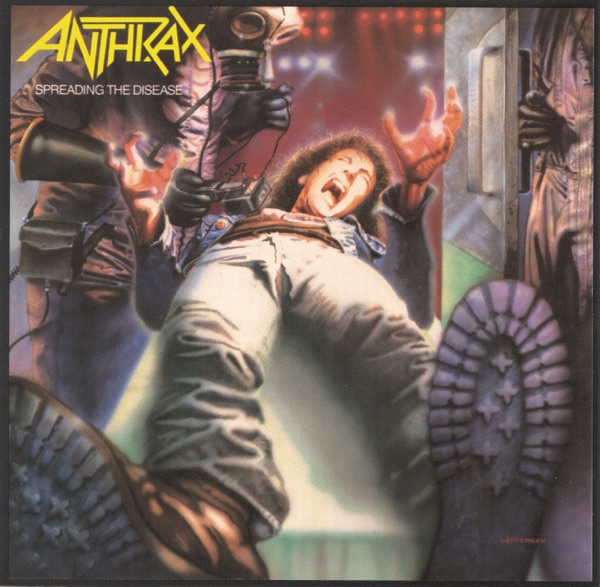
- 1985 Spreading the Disease
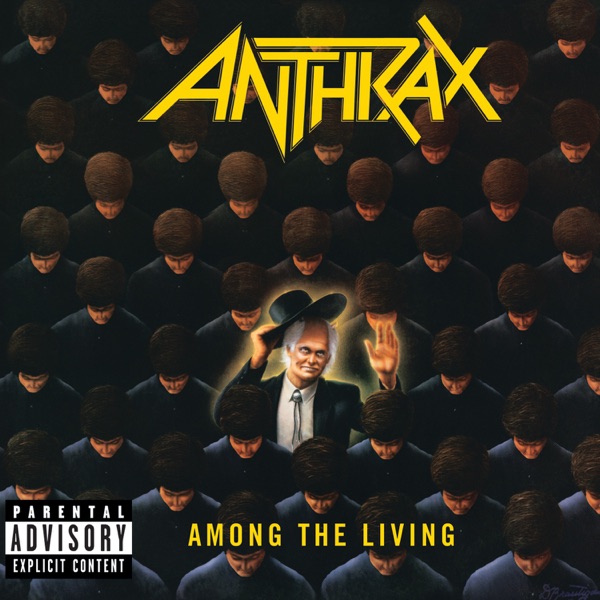
- 1987 Among the Living
- 1988 State of Euphoria
- 1990 Persistence of Time
- 1993 Sound of White Noise
- 1995 Stomp 442
- 1998 Volume 8: The Threat Is Real
- 2003 We’ve Come for You All
- 2004 The Greater of Two Evils
- 2011 Worship Music
- 2016 For All Kings
- 2025 Crazy Sheep
Source: MusicBrainz
Deep Dive
Overview
Anthrax is an American heavy metal band from New York City formed in 1981, standing as one of the four foundational acts of thrash metal alongside Metallica, Megadeth, and Slayer. Where Metallica dominated the West Coast and Slayer pushed into death metal territory, Anthrax staked claim to the East Coast thrash sound, blending the genre’s speed and aggression with a distinctive swagger rooted in the New York hardcore and punk scenes. Their significance lies not only in their musicianship and prolific output across four decades, but in their role as ambassadors of thrash metal beyond the underground, bringing crossover appeal to a genre initially dismissed by mainstream rock audiences.
Formation Story
Anthrax coalesced in 1981 when rhythm guitarist Scott Ian and bassist Dan Lilker joined forces to forge a new sound from the remnants of New York’s metal underground. The band emerged from a thriving scene in the city, where the influence of British New Wave of British Heavy Metal bands like Motörhead and Judas Priest collided with the raw energy of local punk and hardcore acts. Ian remained the constant anchor as the group solidified its vision, while other members cycled in and out, establishing a pattern of lineup flux that would define the band’s history. Drummer Charlie Benante and bassist Frank Bello—who replaced Lilker in 1984—became the bedrock of Anthrax’s classic sound, with Frank Bello’s bass work and Benante’s precise, polyrhythmic drumming becoming hallmarks of the band’s identity from their earliest recordings onward.
Breakthrough Moment
Anthrax’s initial breakthrough arrived with their third studio album, Among the Living (1987), which transformed them from a respected underground presence into a major force in thrash metal. The album showcased a tighter, more confident version of the band, with sharper songwriting and production that captured the raw power of their live shows. Among the Living established Anthrax as serious contenders within the Big Four, proving they could stand alongside Metallica and Slayer in terms of technical prowess and commercial reach. The album’s success was bolstered by extensive touring, which cemented their reputation on both sides of the Atlantic and opened doors to larger festival slots and mainstream metal media attention.
Peak Era
Anthrax’s most creatively fertile and commercially successful period spanned the late 1980s and early 1990s, anchored by Among the Living (1987), State of Euphoria (1988), and Persistence of Time (1990). These three albums represented the band at peak artistic confidence, with increasingly sophisticated songwriting, tighter arrangements, and a growing willingness to experiment with structure and tempo changes. Persistence of Time, in particular, showcased a more introspective side of the band, with longer compositions and more ambitious production that hinted at their evolution beyond pure speed-metal assault. The early 1990s saw the band continue to push boundaries with Sound of White Noise (1993), which marked a significant sonic shift and demonstrated their refusal to rest on the conventions of thrash metal as it had become codified by their peers.
Musical Style
Anthrax’s sound is rooted in the rapid-fire riffing and double-bass drumming of thrash metal, yet distinguished by a groove-oriented approach that sets them apart from the more angular aggression of Metallica or the pure velocity of Slayer. Scott Ian’s rhythm guitar work emphasizes syncopation and pocket, anchoring the songs with a funklike, almost hip-hop-influenced sense of space and timing. Frank Bello’s bass playing is highly active and melodic, often weaving counter-lines rather than simply doubling the guitar riff, while Charlie Benante’s drumming combines precision metal technique with jazz-influenced complexity and swing. Joey Belladonna’s vocal style—sharp, expressive, and capable of both screaming intensity and melodic delivery—became the defining voice of the band, setting them apart from the lower-register growls and shouts favored by some of their thrash metal contemporaries. Over their career, Anthrax absorbed influences from speed metal, groove metal, and alternative metal, showing an openness to crossover that kept their sound evolving rather than calcified in the 1980s thrash blueprint.
Major Albums
Spreading the Disease (1985)
Anthrax’s second album established the core elements of their sound—Scott Ian’s syncopated riffing, Frank Bello’s melodic bass, and the band’s commitment to precision and groove within the thrash framework—while introducing Joey Belladonna’s vocal presence to their canon.
Among the Living (1987)
Wide considered the band’s breakthrough, this album refined their songwriting and production, delivering complex compositions and tighter arrangements that proved Anthrax could compete with the technical ambitions of their Big Four peers.
Persistence of Time (1990)
Anthrax expanded their sonic palette with longer, more introspective compositions, showcasing increased sophistication in song structure and production that hinted at the band’s willingness to evolve beyond thrash metal convention.
Sound of White Noise (1993)
Marking a deliberate reinvention, this album saw the band exploring new sonic territory with alternative metal influences and a more experimental approach to arrangement, demonstrating their refusal to be locked into a single stylistic lane.
We’ve Come for You All (2003)
After a period of relative quiet, Anthrax re-established their thrash credentials with a return to the heavier, riff-driven approach that defined their earlier work, signaling a renewed commitment to their core audience.
Signature Songs
- “Madhouse” — A relentless showcase of Scott Ian’s syncopated riffing and the band’s groove-metal sensibilities, driven by Charlie Benante’s precise, polyrhythmic drumming.
- “Indians” — Demonstrates the band’s willingness to address serious subject matter with musical weight and complexity, becoming one of their most recognizable compositions.
- “Got the Time” — Built on a funk-inflected groove and featuring sharp rhythmic interplay, the song exemplifies Anthrax’s crossover swagger and accessibility.
- “Caught in a Trap” — A showcase for the band’s tighter songwriting and production, capturing the intensity of their live sound on record.
- “One” — Among their most ambitious compositions, showing the band’s capacity for longer-form, structured songwriting within the thrash metal framework.
Influence on Rock
Anthrax’s role in the Big Four cemented thrash metal as a legitimate major-label phenomenon during the 1980s and early 1990s, helping to establish the genre as one of rock’s primary subgenres rather than an underground curiosity. Their emphasis on groove and swagger within the thrash framework influenced countless bands working in alternative metal and groove metal throughout the 1990s and beyond, while their openness to crossover appeal and hip-hop collaboration helped bridge metal and rap audiences at a time when such crossovers were commercially risky. The band’s East Coast presence was crucial in establishing New York—rather than Los Angeles or the San Francisco Bay Area—as a legitimate center of metal innovation, influencing the development of metalcore and other East Coast-derived genres. Their technical proficiency set a baseline for thrash metal musicianship, while their refusal to be locked into a single stylistic formula demonstrated that thrash metal could accommodate experimentation and evolution without sacrificing intensity.
Legacy
Anthrax remains active into the 2020s, continuing to record and tour as one of the few remaining members of the original Big Four still regularly performing. Their extensive catalog, spanning from Fistful of Metal (1984) to Crazy Sheep (2025), documents four decades of heavy metal evolution and stands as a record of how a band can maintain creative vitality across changing musical landscapes. Reissues and compilations have kept their classic albums in circulation, while streaming platforms have introduced their work to successive generations of metal listeners who discovered the band outside the traditional album-purchase and radio paradigm. The band’s place within the Big Four ensures continued cultural visibility and influence, while their willingness to tour regularly and record new material has kept them relevant beyond nostalgic legacy status, demonstrating that thrash metal remains a living genre capable of growth and renewal.
Fun Facts
- Scott Ian has remained the sole constant member across Anthrax’s entire lineup history, making him the band’s primary creative force and institutional memory.
- Charlie Benante and Scott Ian are the only two members to appear on all of Anthrax’s studio albums, a consistency that contrasts sharply with the band’s numerous other lineup changes.
- Frank Bello, who replaced original bassist Dan Lilker in 1984, has been with the band for forty years, making him the second-longest-tenured member and a crucial architect of their classic sound.
- Anthrax emerged from New York City in the early 1980s, establishing the East Coast as a thrash metal center and proving that the genre was not exclusively a West Coast phenomenon, despite the dominance of Metallica and Slayer from California.
Discography & Previews
Click any album to expand its track list. Each track plays a 30-second preview streamed from Apple Music. Tap the link icon next to a track to open it in Apple Music for full playback.



- 1 Potters Field ↗ 5:00
- 2 Only ↗ 4:56
- 3 Room for One More ↗ 4:56
- 4 Packaged Rebellion ↗ 6:17
- 5 Hy Pro Glo ↗ 4:31
- 6 Invisible ↗ 6:10
- 7 1000 Points of Hate ↗ 5:00
- 8 Black Lodge ↗ 5:26
- 9 C11 H17 N2 O2 S Na (Sodium Pentathol) ↗ 4:25
- 10 Burst ↗ 3:42
- 11 This Is Not an Exit ↗ 6:49
- 12 Auf Wiedersehen ↗ 3:32
- 13 Cowboy Song ↗ 5:04
- 14 London ↗ 2:53
- 15 Black Lodge (Strings Mix) ↗ 5:22

- 1 Random Acts of Senseless Violence ↗ 4:03
- 2 Fueled ↗ 4:02
- 3 King Size ↗ 4:00
- 4 Riding Shotgun ↗ 4:27
- 5 Perpetual Motion ↗ 4:19
- 6 In a Zone ↗ 5:08
- 7 Nothing ↗ 4:34
- 8 American Pompeii ↗ 5:30
- 9 Drop the Ball ↗ 4:59
- 10 Tester ↗ 4:21
- 11 Bare ↗ 5:30
- 12 Grunt and Click (Bonus Track) ↗ 5:28
- 13 Dethroned Emperor (Bonus Track) ↗ 4:32
- 14 Celebrated Summer (Bonus Track) ↗ 4:24
- 15 Watchin' You (Bonus Track) ↗ 3:39

- 1 Crush ↗ 4:21
- 2 Catharsis ↗ 4:54
- 3 Inside Out ↗ 5:31
- 4 Piss N Vinegar ↗ 3:13
- 5 604 ↗ 0:35
- 6 Toast to the Extras ↗ 4:25
- 7 Born Again Idiot ↗ 4:15
- 8 Killing Box ↗ 3:40
- 9 Harms Way ↗ 5:14
- 10 Hog Tied ↗ 4:37
- 11 Big Fat ↗ 6:01
- 12 Cupajoe ↗ 0:46
- 13 Alpha Male ↗ 3:05
- 14 Stealing from a Thief ↗ 5:33
- 15 Pieces ↗ 4:59
- 16 Giving the Horns (Bonus Track) ↗ 3:34
- 17 The Bends (Bonus Track) ↗ 3:52
- 18 Snap / I'd Rather Be Sleeping (Bonus Track) ↗ 2:14

- 1 Contact ↗ 1:16
- 2 What Doesn't Die ↗ 4:09
- 3 Superhero ↗ 4:03
- 4 Refuse to Be Denied ↗ 3:20
- 5 Safe Home ↗ 5:11
- 6 Any Place But Here ↗ 5:49
- 7 Nobody Knows Anything ↗ 2:57
- 8 Strap It On (feat. Dimebag Darrell) ↗ 3:32
- 9 Black Dahlia ↗ 2:38
- 10 Cadillac Rock Box (feat. Dimebag Darrell) ↗ 3:41
- 11 Taking the Music Back (feat. Roger Daltrey) ↗ 3:12
- 12 Crash ↗ 0:57
- 13 Think About an End ↗ 5:09
- 14 W.C.F.Y.A. ↗ 7:17

