
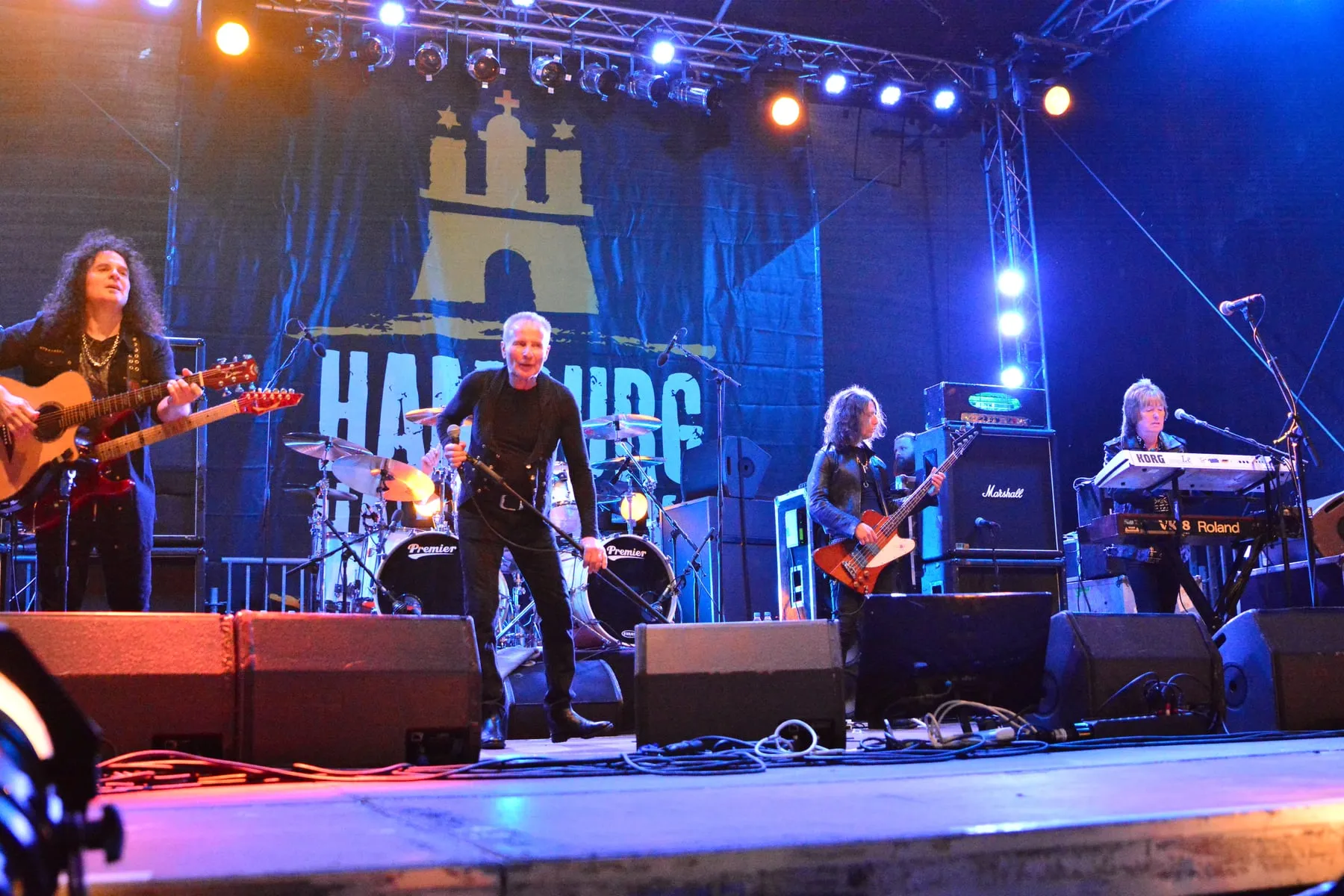
Photo by Frank Schwichtenberg , licensed under CC BY-SA 3.0 · Wikimedia Commons
Rank #237
UFO
British band whose Schenker-era LPs became NWOBHM blueprints.
From Wikipedia
UFO were an English rock band formed in London in 1968. They became a transitional group between early hard rock and heavy metal. The band's final line-up consisted of vocalist Phil Mogg, lead guitarist Vinnie Moore, rhythm guitarist and keyboardist Neil Carter, bass guitarist Rob De Luca, and drummer Andy Parker. They had gone through several line-up changes, leaving Mogg as the only constant member, and had disbanded three times. The band's "classic" line-up comprised Mogg, Parker, bassist Pete Way, keyboardist Paul Raymond, and former Scorpions guitarist Michael Schenker. In May 2018, Mogg announced that he would retire from UFO after one last tour as a member of the band in 2019; however, their farewell tour was set to conclude in 2022 before it was cancelled, due to Mogg's health issues. Mogg confirmed UFO's third disbandment in April 2024.
Members
- Michael Schenker
- Phil Mogg
Deep Dive
Overview
UFO were an English rock band formed in London in 1968, emerging from a transitional moment when hard rock was crystallizing into heavy metal. Fronted throughout their existence by vocalist Phil Mogg, the group became known for their technical prowess and genre-bending approach that incorporated elements of space rock alongside heavy riffing. The band’s most celebrated incarnation—featuring former Scorpions guitarist Michael Schenker—produced a sequence of albums in the mid-to-late 1970s that helped establish the template for the New Wave of British Heavy Metal, even as UFO itself remained more cosmopolitan and less dogmatic than their NWOBHM peers.
Formation Story
UFO coalesced in London in 1968, forming from the convergence of musicians drawn to both hard rock and experimental space-rock textures. Phil Mogg established himself as the vocal and artistic center of the project from the beginning, and would remain its only constant member through three separate disbandments and multiple lineup overhauls spanning more than five decades. The band’s earliest iterations reflected the eclectic tastes of late-1960s British rock, blending the heaviness of emerging metal with the cosmic, album-oriented approach of progressive and space-rock acts. This willingness to resist easy categorization became a defining characteristic, marking UFO as restless musicians rather than trend-followers.
Breakthrough Moment
UFO issued their self-titled debut, UFO 1, in 1970, followed a year later by UFO 2: Flying – One Hour Space Rock, establishing their identity across two early statements. However, the band’s true turning point came with Phenomenon in 1974, a record that captured critics’ attention and signaled a hardening of their sound toward the blues-inflected, technically demanding hard rock that would define their mature work. The arrival of Michael Schenker—a guitarist whose work with the Scorpions had already marked him as a virtuoso—transformed UFO into a formidable live and studio force. His integration into the classic lineup of Mogg, Schenker, bassist Pete Way, keyboardist Paul Raymond, and drummer Andy Parker positioned the band for their commercial and creative peak.
Peak Era
Between 1975 and 1982, UFO released a remarkable succession of studio albums that secured their place in hard rock and metal discourse: Force It (1975), No Heavy Petting (1976), Lights Out (1977), Obsession (1978), No Place to Run (1980), The Wild, the Willing and the Innocent (1981), and Mechanix (1982). These records showcased Schenker’s fluid, expressive lead work and the rhythm section’s ability to anchor complex arrangements, while Mogg’s ragged, committed vocal delivery gave the music an emotional edge that elevated them beyond pure technical display. Lights Out in particular became a touchstone, demonstrating the band’s capacity to write memorable songs without sacrificing instrumental ambition or structural invention. During this span, UFO established themselves as consummate professionals of the live circuit, with their concerts becoming legendary for precision and endurance.
Musical Style
UFO’s sound synthesized multiple influences into a coherent whole: the blues-inflected, guitar-driven architecture of early hard rock; the symphonic and textural ambitions of progressive rock; and the raw, driving energy of emerging heavy metal. Schenker’s contributions were instrumental in this synthesis—his lead work combined neo-classical phrasing, fluid legato technique, and a singing tone that made his guitar lines feel like an extension of Mogg’s vocal melody. Paul Raymond’s keyboards added density and atmosphere, whether through sweeping synth passages or tonal support for the rhythm section. Andy Parker’s drumming provided both thunderous power and detailed rhythmic sophistication, supporting complex song structures without ever sounding mechanical. The band’s material typically favored mid-to-uptempo grooves built on memorable riffs, though they were equally comfortable with balladic interludes and instrumental passages. Their songwriting avoided the formulaic structures of stadium rock, preferring songs that developed across multiple movements and dynamic shifts.
Major Albums
Phenomenon (1974)
UFO’s third album marked the solidification of their hard rock approach and introduced material that showcased the band’s tightening arrangement skills and compositional ambitions.
Force It (1975)
This record demonstrated UFO’s ascendance, combining Schenker’s increasingly confident guitar work with Mogg’s distinctive vocal phrasing and Pete Way’s driving bass lines into a cohesive statement.
Lights Out (1977)
Wide-ranging in scope, Lights Out stands as UFO’s commercial and artistic peak, balancing memorable songwriting with technical sophistication and capturing the band’s live energy on record.
Obsession (1978)
Following their most celebrated period, Obsession proved the band capable of sustained creativity, maintaining the quality and inventiveness of their mid-seventies run.
Mechanix (1982)
The final album of the classic Schenker era, Mechanix showed the band adapting to the changing textures of early-1980s rock while preserving their essential identity.
Signature Songs
- “Rock Bottom” — A showcase for Schenker’s expressive lead playing and Mogg’s ability to convey vulnerability within a rock context.
- “Lights Out” — The title track that became one of UFO’s most recognizable compositions, blending accessibility with instrumental depth.
- “Doctor Doctor” — A track that exemplified the band’s capacity to construct memorable hooks around driving rhythmic foundations.
- “Let It Roll” — Demonstrating UFO’s skill at creating dynamic crescendos that built from restrained verses to towering choruses.
Influence on Rock
UFO occupied a unique position in the early development of metal and hard rock. While they did not pioneer either genre, their combination of technical facility, songwriting sophistication, and refusal to be bound by genre conventions influenced musicians across the spectrum of rock and metal. Their balance of accessibility and complexity—the notion that a song could be both commercially viable and musically uncompromising—provided a model for bands emerging in the NWOBHM and beyond. The precision and tonal clarity of Schenker’s guitar work in particular became a touchstone for metal guitarists seeking alternatives to the heaviness-at-all-costs approach of some contemporaries. UFO’s longevity, even through the lean years of the 1980s and 1990s, demonstrated that serious musicians could sustain careers outside the mainstream on the basis of artistic integrity and a dedicated audience.
Legacy
UFO remained active performers and recording artists well into the 21st century, releasing new material as recently as 2017 with The Salentino Cuts. Phil Mogg’s determination to keep the band’s name alive through various incarnations and shifting lineups—with musicians including lead guitarist Vinnie Moore, keyboardist Neil Carter, bassist Rob De Luca, and drummer Andy Parker—ensured that UFO never entirely faded from rock discourse. Though the classic Schenker-era lineup fractured decades ago, the band’s mid-to-late seventies output remained in print and in rotation among hard rock and metal listeners, with Lights Out in particular sustaining a reputation as a canonical work. In 2018, Mogg announced plans for a farewell tour, though health issues delayed its conclusion. UFO’s trajectory from late-1960s experimentalists to 1970s hard rock architects to elder statesmen of the circuit illustrated the staying power of musicians committed to their craft across changing musical fashions.
Fun Facts
- Michael Schenker, the guitarist most associated with UFO’s classic period, was a member of the Scorpions before and after his time with the band, illustrating UFO’s position as a nexus for international hard rock talent.
- Phil Mogg remained the sole consistent member across the band’s three separate disbandments, demonstrating both his artistic commitment to the UFO concept and the challenges of maintaining group stability over fifty-plus years.
- The band’s early albums, including UFO 2: Flying – One Hour Space Rock, reflected an experimental approach to space rock that positioned them outside the purely metal-focused bands emerging simultaneously in early-1970s Britain.