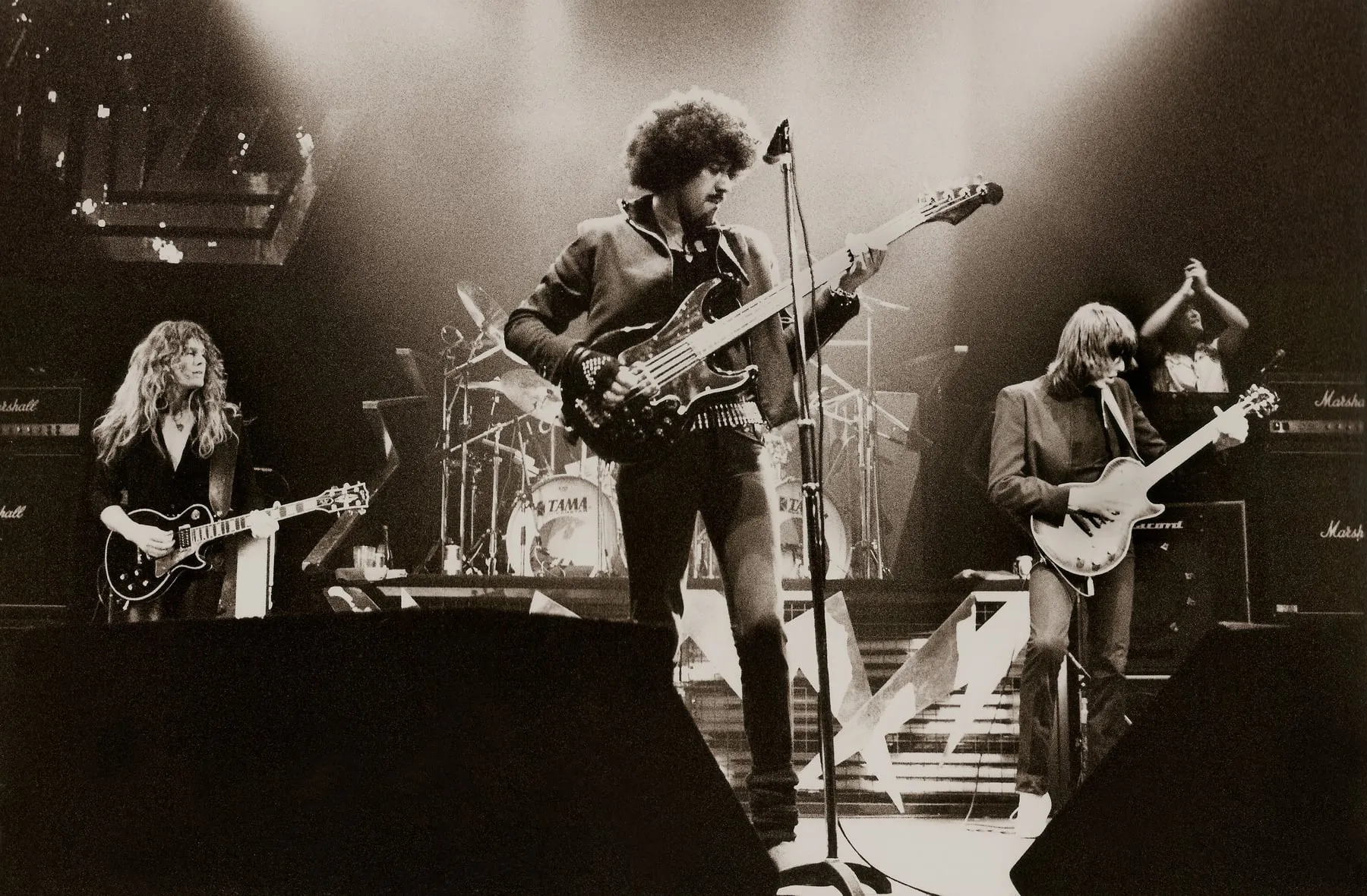
Photo by Harry Potts , licensed under CC BY-SA 2.0 · Wikimedia Commons
Rank #91
Thin Lizzy
Phil Lynott's Dublin band combining twin-guitar harmonies and storytelling.
From Wikipedia
Thin Lizzy are an Irish rock band formed in Dublin in 1969. The band initially consisted of bass guitarist, lead vocalist and principal songwriter Phil Lynott, drummer Brian Downey, guitarist Eric Bell and organist Eric Wrixon, although Wrixon left after a few months. Bell left at the end of 1973 and was briefly replaced by Gary Moore, who himself was replaced in mid-1974 by dual lead guitarists: Scott Gorham, who remained with the band until their break-up in 1983, and Brian Robertson, who remained with the band until 1978 when Moore re-joined. Moore left a second time and was replaced by Snowy White in 1980, who was himself replaced by John Sykes in 1982. The line-up was augmented by keyboardist Darren Wharton in 1980.
Members
- Brian Downey (1969–2013)
- Phil Lynott (1969–1983)
- Scott Gorham (1974–present)
- Darren Wharton (1980–present)
- Marco Mendoza (1996–2013)
- Ricky Warwick (2010–present)
- Damon Johnson (2011–present)
Studio Albums
- 1971 Thin Lizzy
- 1972 Shades of a Blue Orphanage
- 1973 Vagabonds of the Western World
- 1974 Nightlife
- 1974 Studio Sessions 1974
- 1975 Fighting
- 1976 Johnny the Fox
- 1976 Jailbreak
- 1977 Bad Reputation
- 1979 Black Rose: A Rock Legend
- 1980 Chinatown
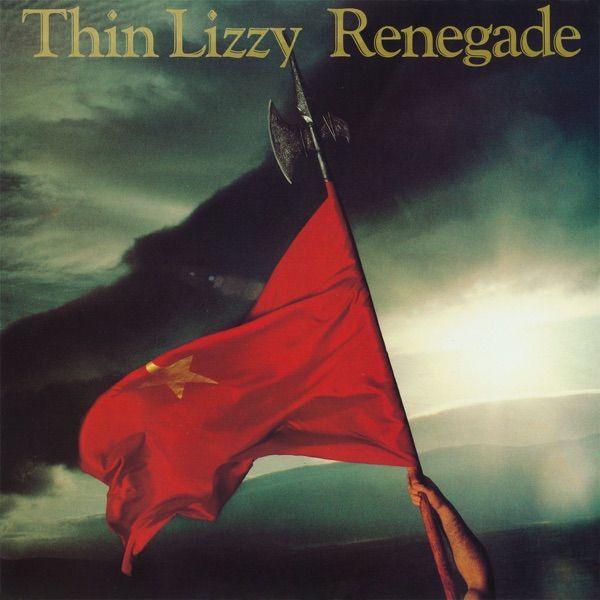
- 1981 Renegade
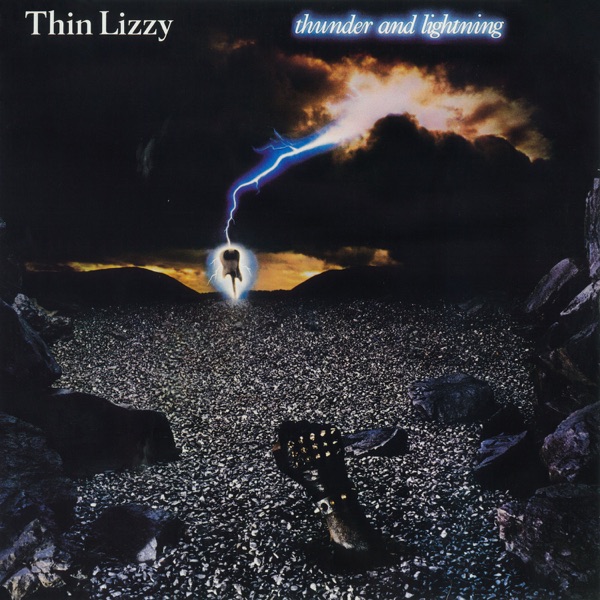
- 1983 Thunder and Lightning
- 2024 Live Rarities
- — Black Rose Sessions
Source: MusicBrainz
Deep Dive
Overview
Thin Lizzy are an Irish rock band formed in Dublin in 1969, built on the foundation of bass guitarist, lead vocalist, and principal songwriter Phil Lynott’s vision. The band became a cornerstone of 1970s hard rock through their distinctive use of dual lead guitars and Lynott’s narrative-driven songwriting, which drew equally from blues-rock roots and Celtic storytelling traditions. Over their initial fifteen-year run, Thin Lizzy evolved from a Dublin club fixture into an arena-filling act, their sound defined by intricate guitar interplay, Lynott’s charismatic vocals, and a repertoire that balanced hard-hitting rockers with character-driven songs.
Formation Story
Thin Lizzy emerged from Dublin’s rock scene in 1969 with an unconventional lineup. Phil Lynott, born in Dublin and steeped in blues and rock, took up bass and vocals as the band’s creative center. Drummer Brian Downey, the band’s rhythmic anchor, joined Lynott as the nucleus. Guitarist Eric Bell and organist Eric Wrixon completed the original four-piece. Wrixon departed within months, leaving the trio to establish Thin Lizzy as a guitar-driven unit. This early configuration recorded the band’s self-titled debut album in 1971, establishing the template of Lynott’s bass lines anchoring intricate arrangements and his storytelling lyrics.
Breakthrough Moment
Thin Lizzy’s breakthrough came gradually through the mid-1970s, accelerated by a shift in their guitar lineup. Eric Bell’s departure at the end of 1973 marked a turning point; Gary Moore’s brief stint was followed in mid-1974 by the arrival of dual lead guitarists Scott Gorham and Brian Robertson. This twin-guitar approach, combined with Lynott’s narrative songs and commanding stage presence, transformed Thin Lizzy into a formidable live draw. The albums Fighting (1975), Johnny the Fox (1976), and especially Jailbreak (1976) showcased the band’s matured sound and garnered both critical and commercial traction, establishing them as major players in the hard-rock landscape.
Peak Era
Thin Lizzy’s creative and commercial peak spanned the late 1970s, roughly 1976 to 1979. Johnny the Fox and Jailbreak demonstrated their ability to craft radio-friendly anthems without sacrificing musical sophistication; the band’s live reputation grew through constant touring. Bad Reputation (1977) and Black Rose: A Rock Legend (1979) cemented their status, the latter representing a high-water mark of their ambition and execution. During this period, the core lineup of Lynott, Downey, Gorham, and Robertson proved most stable and creatively fertile, delivering albums that balanced hard-rock dynamics with melodic sensibility and lyrical depth. By 1979, Thin Lizzy had achieved international standing, though their commercial reach in North America, despite their influence on emerging rock acts, never quite matched their dominance in the UK and Europe.
Musical Style
Thin Lizzy’s sound synthesized blues-rock, hard rock, and traditional heavy metal with uncommon intelligence. The signature element was their use of dual lead guitars playing in harmony and counterpoint—a technique popularized by earlier bands but perfected by Gorham and Robertson (and later Robertson’s successors). Lynott’s bass lines were melodic and prominent, often as memorable as the lead guitar hooks. His vocals ranged from spoken-word narrative passages to a warm, conversational sing, lending personality to songs that might otherwise have been standard rock fare. Lyrically, Lynott drew on Irish heritage, street-life observation, and character sketches; tracks often felt like short stories set to music. The band’s production grew more polished through the 1970s, moving from rawer early recordings toward the stadium-rock sheen of their later work, though without sacrificing the tight interplay that defined their appeal.
Major Albums
Jailbreak (1976)
This album marked Thin Lizzy’s creative peak and commercial breakthrough, featuring the title track as an enduring anthem and showcasing the full potential of the Gorham-Robertson twin-guitar partnership.
Johnny the Fox (1976)
Released the same year, Johnny the Fox demonstrated the band’s ability to craft memorable hooks and layered arrangements across a full album, solidifying their standing as major rock act.
Black Rose: A Rock Legend (1979)
Thin Lizzy’s most ambitious work, Black Rose combined their signature twin-guitar approach with orchestral arrangements and thematic ambition, representing the pinnacle of their 1970s output.
Fighting (1975)
The album that introduced the Gorham-Robertson lineup and marked the transition from their earlier incarnation to the twin-guitar sound that would define them.
Bad Reputation (1977)
A lean, focused hard-rock statement that balanced aggression with the narrative sophistication Lynott brought to every album.
Signature Songs
- Jailbreak — The title track became the band’s anthem and signature piece, showcasing their hard-hitting drive and narrative storytelling.
- The Boys Are Back in Town — A staple of their live sets, this track epitomized their ability to balance catchiness with genuine rock substance.
- Cowboy Song — A character-driven track highlighting Lynott’s gift for lyrical narrative within a hard-rock framework.
- Whiskey in the Jar — An earlier single that introduced the band to wider audiences with a folk-rock twist on a traditional melody.
- Don’t Believe a Word — A showcase for the twin-guitar interplay and Lynott’s charismatic vocal delivery.
- Emerald — An instrumental-heavy track demonstrating the band’s ability to weave Celtic influences into hard-rock composition.
Influence on Rock
Thin Lizzy’s twin-lead-guitar approach became a template for countless hard-rock and heavy-metal bands that followed. The combination of melodic sophistication with hard-rock dynamics influenced acts across the 1980s and beyond, from bands that adopted the dual-guitar approach to those who emulated Lynott’s integration of storytelling into rock song structure. Their bridge between blues-rock and metal—without fully committing to either—opened space for acts that valued both groove and melodic complexity. Lynott’s presence as a Black, Irish frontman in a predominantly white genre also signified a shift in rock’s cultural boundaries, though this aspect of his legacy received limited contemporary documentation.
Legacy
Thin Lizzy dissolved in 1983, their initial run concluded. Phil Lynott’s death in 1986 meant the band’s classic lineup could never fully reunite, yet their catalogue has remained in steady rotation among classic-rock audiences and has experienced periodic revival through reissues and retrospectives. Scott Gorham and Darren Wharton (keyboardist from 1980 onward) have helmed reunions and touring bands in subsequent decades, keeping the material in circulation. The band’s influence persists in hard-rock and metal circles, their albums recognized as touchstones of 1970s rock craft. Streaming platforms and modern reissues have introduced their work to subsequent generations, and their standing within rock history—particularly in Europe and among musicians—remains secure as exemplars of how hard rock could achieve both commercial appeal and artistic credibility.
Fun Facts
- Phil Lynott was born in Birmingham to an Irish mother and Trinidadian father, making his journey to Dublin and emergence as an Irish rock icon an unusual chapter in both Irish and rock history.
- The band’s staging incorporated theatrical elements and visual flair uncommon in hard rock of their era, with Lynott’s presence as a charismatic frontman a deliberate contrast to the often-detached metal aesthetic.
- Brian Robertson’s tenure was interrupted by brief absences; Gary Moore returned to the band in 1978 before being replaced again, a rotation that reflected both the band’s lineup instability and the appeal of their sound to multiple skilled guitarists.
- Black Rose: A Rock Legend was recorded with orchestral arrangements, signaling the band’s ambition to expand their sonic palette beyond the straightforward hard-rock template they had perfected.
Discography & Previews
Click any album to expand its track list. Each track plays a 30-second preview streamed from Apple Music. Tap the link icon next to a track to open it in Apple Music for full playback.

- 1 The Friendly Ranger at Clontarf Castle ↗ 3:02
- 2 Honesty Is No Excuse ↗ 3:41
- 3 Diddy Levine ↗ 7:06
- 4 Ray Gun ↗ 3:06
- 5 Look What the Wind Blew In ↗ 3:25
- 6 Eire ↗ 2:08
- 7 Return of the Farmer's Son ↗ 4:14
- 8 Clifton Grange Hotel ↗ 2:29
- 9 Saga of the Ageing Orphan ↗ 3:40
- 10 Remembering, Pt. 1 ↗ 6:00
- 11 Dublin ↗ 2:27
- 12 Remembering, Pt. 2 (New Day) ↗ 5:05
- 13 Old Moon Madness ↗ 3:53
- 14 Things Ain't Workin' Out Down at the Farm ↗ 4:33