
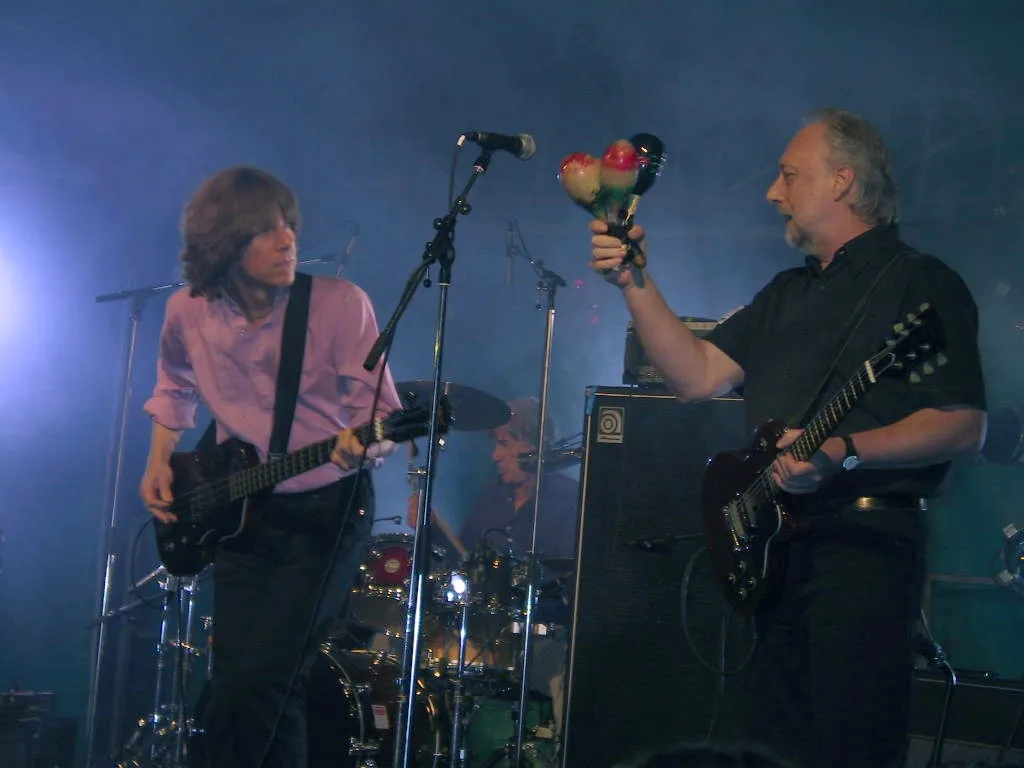
Photo by Corentin Lamy , licensed under CC BY-SA 3.0 · Wikimedia Commons
Rank #77
The Yardbirds
British R&B incubator that launched Clapton, Beck, and Page.
From Wikipedia
The Yardbirds are an English rock band formed in London in 1963. The band started the careers of three of rock's most famous guitarists: Eric Clapton (1963–1965), Jeff Beck (1965–1966) and Jimmy Page (1966–1968), all of whom ranked in the top five of Rolling Stone magazine's 2011 list of 100 greatest guitarists. The band's other members during 1963–1968 were vocalist/harmonica player Keith Relf, drummer Jim McCarty, rhythm guitarist Chris Dreja, and bassist Paul Samwell-Smith, with Dreja switching to bass when Samwell-Smith departed in 1966. The band had a string of hits in the mid-1960s, including "For Your Love", "Heart Full of Soul", "Evil Hearted You", "Still I'm Sad", "Shapes of Things", "Over Under Sideways Down", and "Happenings Ten Years Time Ago".
Members
- Chris Dreja
- Eric Clapton
- Jeff Beck
- Jim McCarty
- Jimmy Page
- Keith Relf
- Paul Samwell-Smith
Studio Albums
- 1965 Having a Rave Up
- 1965 For Your Love
- 1966 Yardbirds
- 1967 Little Games
- 2003 Birdland
Source: MusicBrainz
Deep Dive
Overview
The Yardbirds were an English rock band formed in London in 1963 that functioned as a launching pad for three of rock music’s most consequential guitarists: Eric Clapton, Jeff Beck, and Jimmy Page. The band’s five-year run yielded a string of radio hits in the mid-1960s and redefined how British musicians approached American blues and R&B. Though their own recorded output was relatively brief, the Yardbirds’ significance lies not merely in their commercial success but in their role as an incubator—a group where young, hungry musicians refined their craft and discovered the sonic innovations that would define their subsequent solo careers and influence rock music for decades.
Formation Story
The Yardbirds coalesced in London in 1963, drawing together vocalist and harmonica player Keith Relf, drummer Jim McCarty, rhythm guitarist Chris Dreja, bassist Paul Samwell-Smith, and guitarist Eric Clapton. The band’s name referenced a slang term and reflected their commitment to raw, blues-driven rock and roll. Their foundation was rooted in the British R&B revival of the early 1960s, a movement driven by a generation of English musicians who had discovered American blues records and sought to transpose that energy into their own work. The London scene provided both the audience and the artistic friction necessary for the Yardbirds to develop quickly from a pub cover band into something more ambitious.
Breakthrough Moment
The Yardbirds’ commercial breakthrough arrived with the 1965 release of “For Your Love,” a single that climbed the charts and introduced their name to a nationwide audience. That same year saw the release of two studio albums: Having a Rave Up and For Your Love, each capturing the band at different points in their sonic evolution. The twin album releases and the title track’s success established them as more than a local act; they were now contenders in the crowded mid-1960s British rock marketplace. The momentum was sustained through 1965 and into 1966 as subsequent singles—“Heart Full of Soul,” “Evil Hearted You,” and “Still I’m Sad”—consolidated their radio presence and proved their ability to craft memorable, hook-driven songs alongside their blues foundation.
Peak Era
The years 1966 to 1968 represented the Yardbirds’ artistic and commercial zenith. Paul Samwell-Smith’s departure in 1966 prompted Chris Dreja to shift from rhythm guitar to bass, while Jimmy Page joined on lead guitar, creating a potent two-guitar lineup. The 1966 album Yardbirds and the 1967 release Little Games captured a band increasingly willing to experiment. Singles such as “Shapes of Things” and “Over Under Sideways Down” revealed the band’s growing sophistication in arrangement and studio technique. The brief tenure of Jeff Beck, who followed Clapton and preceded Page, injected further creative restlessness into the group’s sound. By 1967 and 1968, the Yardbirds were among the most innovative voices in British rock, blending blues roots with psychedelic textures and studio experimentation. Yet the band’s commercial momentum was not sustainable; personnel shifts, changing tastes, and the emerging dominance of heavy rock and psychedelic acts meant that the Yardbirds’ window of national prominence was narrowing.
Musical Style
The Yardbirds’ sound was rooted in American blues and R&B but filtered through a distinctly British sensibility and an appetite for studio innovation. Early recordings emphasized electric guitar work, harmonica, and straightforward blues progressions, but as the band evolved—particularly during the Beck and Page years—they incorporated psychedelic production techniques, fuzz tones, and unconventional arrangements. Keith Relf’s vocals ranged from shouted R&B calls to more controlled, melodic deliveries as the songs demanded. The rhythm section of McCarty (drums) and first Samwell-Smith, then Dreja (bass) provided a tight, driving foundation that allowed the guitarists room to experiment with distortion, feedback, and textural effects. The band’s approach was not revolutionary in isolation, but their willingness to move rapidly between blues authenticity and studio experimentation—evident even within single albums—anticipated the direction that British rock would take as the 1960s progressed.
Major Albums
For Your Love (1965)
The Yardbirds’ second album in their breakthrough year, For Your Love contained the title track that became their signature hit and demonstrated a pop sensibility alongside their blues foundation. The album showcased Clapton’s lead work and established the band’s ability to balance radio appeal with musical credibility.
Having a Rave Up (1965)
Released the same year as For Your Love, Having a Rave Up captured the band in a more raw, blues-driven mode. The album title reflected the energy of their live performances and served as a document of their earlier, more purist blues-rock approach before studio sophistication became paramount.
Yardbirds (1966)
The self-titled 1966 album arrived during the Clapton-to-Beck transition and reflected a band in creative flux. The record balanced their evolving psychedelic interests with their blues core, capturing a snapshot of British rock at a moment of rapid stylistic change.
Little Games (1967)
Released with Jimmy Page on lead guitar, Little Games represented the band’s most adventurous studio work. The album incorporated layered arrangements, studio effects, and a more experimental approach to song structure while retaining blues and R&B as the underlying foundation.
Signature Songs
- “For Your Love” — The single that took the band from London clubs to national radio, built on a memorable hook and infectious pop-rock structure.
- “Heart Full of Soul” — A blues-driven mid-tempo hit showcasing Clapton’s fluid lead guitar work and Relf’s confident vocal delivery.
- “Shapes of Things” — A psychedelic-inflected track that demonstrated the band’s willingness to move beyond straight blues-rock convention.
- “Over Under Sideways Down” — An adventurous single featuring unconventional arrangement choices and serving as a showcase for studio experimentation.
- “Evil Hearted You” — A punchy blues number that became one of the band’s most recognizable radio hits during their peak years.
- “Still I’m Sad” — A slower, more introspective track that revealed depth beyond their faster, more raucous material.
Influence on Rock
The Yardbirds’ primary legacy is not their own recorded catalog but rather the guitarists who passed through the band and the precedent they set for using a successful group as a finishing school for soon-to-be major artists. Eric Clapton, having honed his blues vocabulary within the Yardbirds’ rigorous environment, would go on to define the blues-rock canon through Cream and his solo work. Jeff Beck’s brief tenure catalyzed his experimental approach, which would flourish in his subsequent solo career and influence heavy rock and jazz fusion. Jimmy Page’s three years with the band served as the crucible in which he developed the arrangements, production sensibilities, and instrumental vocabulary that became central to Led Zeppelin’s sound. Beyond the individual trajectories of these three guitarists, the Yardbirds demonstrated to the British rock industry that electric blues could be commercially viable without sacrificing artistic integrity, a lesson that profoundly shaped the British blues boom of the late 1960s and beyond.
Legacy
The Yardbirds’ active run ended in 1968, but their influence extended far beyond their dissolution. The band’s catalog remained in print through multiple reissues, and their role in rock history—as the training ground for Clapton, Beck, and Page—ensured sustained critical and popular interest. In rock criticism and historical surveys, the Yardbirds are consistently cited as one of the most important British blues-rock bands of the 1960s, not because they produced the most enduring albums (though their singles remained staples of radio and compilation albums) but because they were the crucible in which three generational guitar talents were forged. The band members’ decision to pursue solo and group projects outside the Yardbirds proved artistically fruitful; their departures reflected not failure but the band’s success in developing musicians capable of commanding major international careers. The Yardbirds’ 2003 studio album Birdland represented a return to recording after decades of hiatus, allowing surviving members to revisit their legacy and new audiences to hear interpretations of their musical legacy in a contemporary context.
Fun Facts
- Eric Clapton, Jeff Beck, and Jimmy Page all ranked within the top five of Rolling Stone magazine’s 2011 list of 100 greatest guitarists, a testament to the caliber of talent that passed through the band.
- The band’s rapid guitarist turnover—Clapton leaving in 1965, Beck joining in 1965 and departing in 1966, and Page arriving in 1966—meant that no two consecutive studio albums featured the same lead guitarist.
- The Yardbirds’ willingness to experiment in the studio prefigured the producer-centric approach that would dominate progressive rock; their songs often featured unconventional arrangements that surprised both radio audiences and the band’s own fanbase.
- Keith Relf’s dual role as vocalist and harmonica player positioned him as a bridge between American blues tradition (where harmonica was a staple) and British rock, a duality that became less common as rock music evolved.
Discography & Previews
Click any album to expand its track list. Each track plays a 30-second preview streamed from Apple Music. Tap the link icon next to a track to open it in Apple Music for full playback.

- 1 I'm a Man (feat. Eric Clapton) [2015 Remaster] ↗ 2:40
- 2 You're a Better Man Than I (2015 Remaster) ↗ 3:58
- 3 Evil Hearted You (2015 Remaster) ↗ 2:26
- 4 Still I'm Sad (2015 Remaster) ↗ 3:00
- 5 Heart Full of Soul (2015 Remaster) ↗ 2:28
- 6 The Train Kept a-Rollin' (2015 Remaster) ↗ 3:28
- 7 Smokestack Lightning (Live - 2015 Remaster) ↗ 5:35
- 8 Respectable (Live at the Marquee Club, 1964 - 2015 Remaster) ↗ 5:30
- 9 I'm a Man (feat. Eric Clapton) [Live at the Marquee Club, 1964 - 2015 Remaster] ↗ 4:31
- 10 Here 'Tis (feat. Eric Clapton) [Live at the Marquee Club, 1964 - 2015 Remaster] ↗ 5:10

- 1 For Your Love (feat. Eric Clapton) [2015 Remaster] ↗ 2:33
- 2 I'm Not Talking (2015 Remaster) ↗ 2:36
- 3 I Ain't Got You (2015 Remaster) ↗ 2:04
- 4 Putty in Your Hands (2015 Remaster) ↗ 2:22
- 5 Got to Hurry (feat. Eric Clapton) [2015 Remaster] ↗ 2:31
- 6 I Ain't Done Wrong (2015 Remaster) ↗ 3:37
- 7 I Wish You Would (feat. Eric Clapton) [2015 Remaster] ↗ 2:22
- 8 A Certain Girl (feat. Eric Clapton) [2015 Remaster] ↗ 2:21
- 9 Sweet Music (2015 Remaster) ↗ 2:34
- 10 Good Morning, Little Schoolgirl (2015 Remaster) ↗ 2:50
- 11 My Girl Sloopy (feat. Jeff Beck) [2015 Remaster] ↗ 5:35


- 1 Little Games (Mono) ↗ 2:29
- 2 Smile On Me (Mono) ↗ 3:22
- 3 White Summer (Mono) ↗ 3:54
- 4 Tinker, Tailor, Soldier, Sailor (Mono) ↗ 2:45
- 5 Glimpses (Mono) ↗ 4:26
- 6 Drinking Muddy Water (Mono) ↗ 2:55
- 7 No Excess Baggage (Mono) ↗ 2:36
- 8 Stealing Stealing (Mono) ↗ 2:32
- 9 Only the Black Rose (Mono) ↗ 2:55
- 10 Little Soldier Boy (Mono) ↗ 2:36

- 1 I'm Not Talking ↗ 2:45
- 2 Crying out for Love ↗ 4:36
- 3 The Nazz Are Blue ↗ 3:16
- 4 For Your Love ↗ 3:21
- 5 Please Don't Tell Me 'bout the News ↗ 4:00
- 6 Train Kept a Rollin' ↗ 3:38
- 7 Mr. Saboteur ↗ 4:55
- 8 Shapes of Things ↗ 2:38
- 9 My Blind Life ↗ 3:33
- 10 Over Under Sideways Down ↗ 3:17
- 11 Mr. You're a Better Man Than I ↗ 3:23
- 12 Mystery of Being ↗ 4:08
- 13 Dream Within a Dream ↗ 4:44
- 14 Happenings Ten Years Time Ago ↗ 3:23
- 15 An Original Man (A Song for Keith) ↗ 5:21