
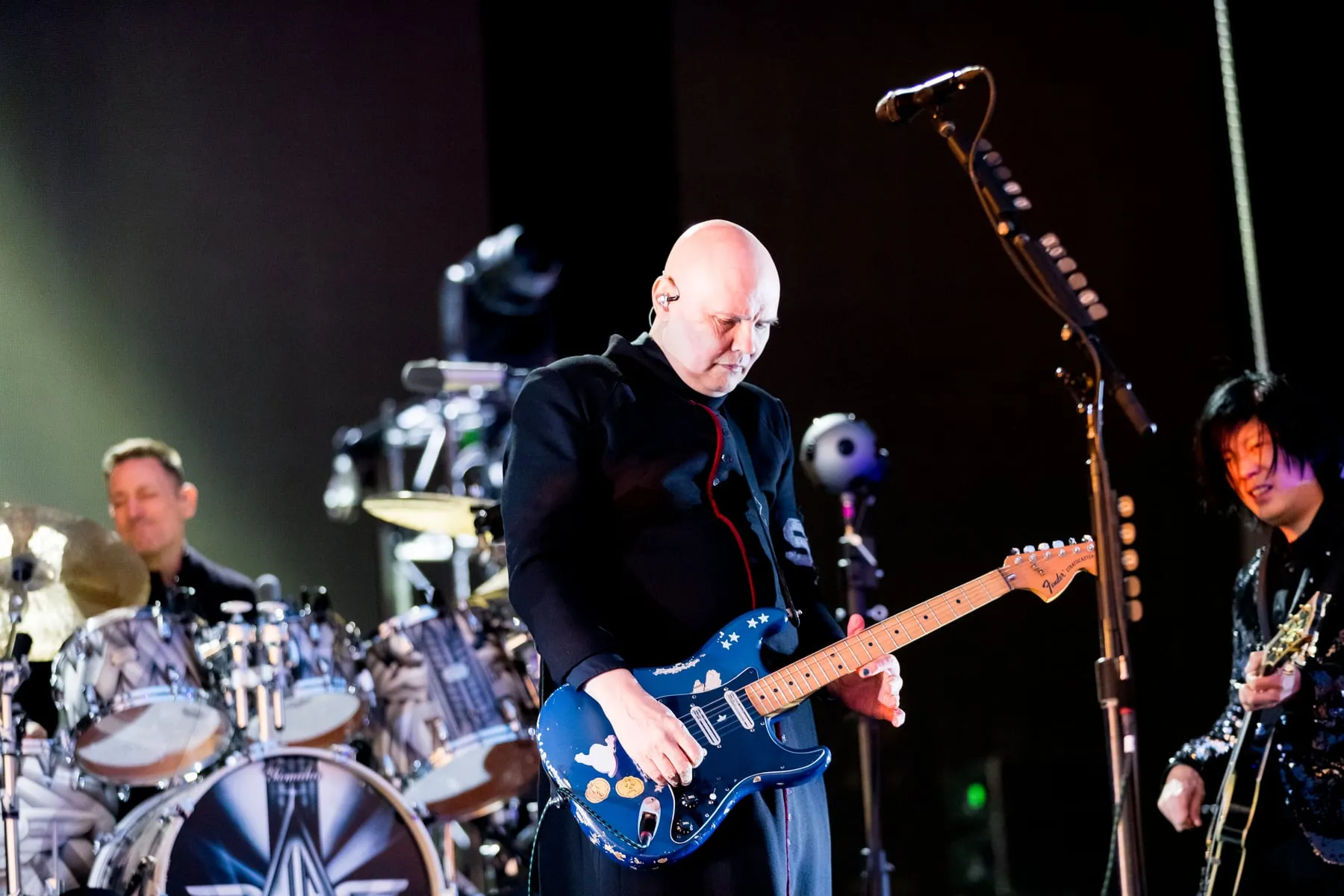
Photo by Sven Mandel , licensed under CC BY-SA 4.0 · Wikimedia Commons
Rank #51
The Smashing Pumpkins
Chicago dream-grunge band of double-album scale and shoegaze color.
From Wikipedia
The Smashing Pumpkins are an American alternative rock band formed in Chicago in 1988 by lead vocalist and guitarist Billy Corgan, guitarist James Iha, bassist D'arcy Wretzky and drummer Jimmy Chamberlin. The band has undergone several line-up changes since their reunion in 2006, with Corgan being the primary songwriter and sole constant member since its inception. The current lineup consists of Corgan, Iha, and Chamberlin. The band is known for its diverse, densely layered sound, which evolved throughout their career and has integrated elements of gothic rock, heavy metal, grunge, psychedelic rock, progressive rock, shoegaze, dream pop, and electronica.
Members
- Billy Corgan (1988–2000)
- D'arcy Wretzky (1988–1999)
- James Iha (1988–2000)
- Melissa Auf der Maur (1999–2000)
- Jeff Schroeder (2007–present)
- Mike Byrne (2009–2014)
- Nicole Fiorentino (2010–2014)
- Jimmy Chamberlin (2015–2016)
- Kiki Wong (2024–present)
Deep Dive
Overview
The Smashing Pumpkins are an American alternative rock band formed in Chicago in 1988, emerging from the same midwestern terrain that would later shape American rock’s engagement with British shoegaze and dream pop textures. Led throughout by Billy Corgan as vocalist, guitarist, and primary songwriter, the band became one of the 1990s’ most commercially successful and artistically ambitious acts, constructing elaborate, densely layered soundscapes that drew from gothic rock, heavy metal, grunge, psychedelic rock, progressive rock, and electronica. Their influence on alternative rock’s sonic palette and structural ambition remains undiminished despite multiple dissolutions and reunions.
Formation Story
The Smashing Pumpkins coalesced in Chicago in 1988 around Billy Corgan’s vision. The initial lineup included Corgan on lead vocals and guitar, James Iha on guitar, D’arcy Wretzky on bass, and Jimmy Chamberlin on drums. Chicago at that moment occupied an unusual position in American rock—neither the Pacific Northwest epicenter of grunge nor the East Coast stronghold of post-punk and noise rock, yet positioned to absorb and reprocess influences from both directions. Corgan’s ambitions extended beyond the three-chord directness dominating alternative rock in the late 1980s; he pursued ornate arrangements, orchestral layering, and emotional intensity rooted as much in gothic and psychedelic tradition as in contemporary indie rock.
Breakthrough Moment
The Smashing Pumpkins’ debut album Gish, released in 1991, introduced their signature sound to a wider audience but did not immediately yield mainstream success. The breakthrough came with the 1993 release of Siamese Dream, which found the band refining their approach and gaining substantial college radio and MTV rotation. The album’s critical success established them as significant voices in the American alternative rock landscape, capturing the attention of audiences invested in more ornate, emotionally complex alternative rock than the stripped-down grunge aesthetic dominating commercial radio. Siamese Dream positioned the band for the commercial explosion that would follow.
Peak Era
The mid-to-late 1990s marked the Smashing Pumpkins’ creative and commercial peak. In 1995, they released Mellon Collie and the Infinite Sadness, a double album of ambitious scope that epitomized their approach: tracks ranged from orchestral dream-pop reverie to heavy, distorted rock, with Corgan’s vocals and songwriting providing thematic coherence across the expanded canvas. The album’s commercial success was substantial, and it expanded the band’s audience beyond alternative rock’s traditional borders. This period, spanning from Siamese Dream through the late-1990s releases, saw the Smashing Pumpkins at their most confident in exploring genre hybridity and emotional extremes, establishing themselves as one of the decade’s defining rock acts.
Musical Style
The Smashing Pumpkins’ sound is characterized by dense, multi-layered instrumentation and production that eschews the minimalism and rawness prevalent in much 1990s rock. Corgan’s vocals, often plaintive and melancholic, sit atop arrangements that frequently include strings, synthesizers, and layered guitars creating walls of sound influenced by shoegaze and dream pop traditions. The rhythm section, anchored by Wretzky’s bass and Chamberlin’s drumming, provides foundation for these elaborate constructions, while Iha’s guitar work ranged from dreamy, textural playing to heavier, riff-driven passages. Over their career, the band integrated elements of progressive rock and psychedelia, with later work embracing electronica and experimentalism. The overall approach represented a deliberate alternative to the guitar-trio format popularized by grunge, instead recalling the orchestral ambitions of progressive rock and the textural innovations of shoegaze.
Major Albums
Siamese Dream (1993)
The album that established the Smashing Pumpkins’ aesthetic and secured their place in the alternative rock pantheon, combining vulnerable vocal performances with elaborate, layered arrangements and heavy guitar textures.
Mellon Collie and the Infinite Sadness (1995)
A double album spanning genres from orchestral dream-pop to heavy rock, showcasing Corgan’s songwriting ambitions and the band’s ability to sustain complex emotional narratives across an expansive track list.
Adore (1998)
A stylistically diverse album reflecting the band’s continued evolution, integrating electronic elements and demonstrating their willingness to move beyond established alternative rock conventions.
MACHINA/the machines of God (1999)
The final studio album of the original 1988–2000 era, combining heavy guitars with synthesizer-based textures and marking a shift toward harder rock elements.
Zeitgeist (2007)
Released following the band’s 2006 reunion, marking their return to active recording with a reformed lineup and establishing the template for their ongoing post-reunion output.
Monuments to an Elegy (2014)
A studio album featuring guitarist Jeff Schroeder alongside Corgan and Chamberlin, continuing the band’s pattern of experimentation while maintaining their signature architectural approach to rock songwriting.
Signature Songs
- “Cherub Rock” — A defining track from Siamese Dream that combined vulnerable Corgan vocals with distorted, heavy guitar work and became a cornerstone of the band’s live repertoire.
- “Today” — From Mellon Collie and the Infinite Sadness, exemplifying the band’s ability to shift from orchestral arrangement to propulsive rock momentum within a single composition.
- “1979” — A mid-tempo track from Mellon Collie that captured the band’s skill at crafting emotionally resonant songs with densely layered production.
- “Disarm” — Demonstrating the softer, more vulnerable side of the Pumpkins’ sound with minimal instrumentation and introspective songwriting.
- “Bullet with Butterfly Wings” — One of their most commercially successful and recognizable songs, combining heavy guitars with an anthemic chorus and defiant lyrical stance.
Influence on Rock
The Smashing Pumpkins’ primary influence on 1990s alternative rock lay in their demonstration that alternative rock could absorb diverse genre influences—shoegaze, dream pop, gothic rock, progressive rock, electronica—while maintaining mainstream commercial viability. Their success validated ambition in production and arrangement, encouraging other bands to move beyond the aesthetic limitations of grunge. Artists working in alternative rock during the late 1990s and 2000s absorbed the Pumpkins’ lesson that elaborate, textural production could coexist with emotional intensity and commercial appeal. The band’s architectural approach to song construction and willingness to expand albums into double-album statements also influenced how subsequent alternative rock bands conceived of the album form itself.
Legacy
Following their initial dissolution in 2000, the Smashing Pumpkins reunited in 2006 with Billy Corgan as the sole constant member, initiating a second chapter of the band’s history. Early reunion recordings like Zeitgeist (2007) and subsequent albums including Oceania (2012), Monuments to an Elegy (2014), SHINY AND OH SO BRIGHT, VOL. 1 / LP: NO PAST. NO FUTURE. NO SUN. (2018), CYR (2020), and ATUM: A Rock Opera in Three Acts (2022) maintained the band’s trajectory of experimentation and songwriting ambition. The band’s continued recording activity and touring presence into the 2020s—including the 2024 album Aghori Mhori Mei—demonstrated sustained engagement with their core artistic vision. The Smashing Pumpkins remain a significant reference point in discussions of 1990s alternative rock, their 1990s output frequently reappraised as among the decade’s most sophisticated rock achievements, and their ongoing work maintaining the band’s position within active rock discourse.
Fun Facts
- The band’s original bassist D’arcy Wretzky was with the Pumpkins from their 1988 formation through 1999, establishing the bass foundation for their most commercially significant era before Melissa Auf der Maur joined for the MACHINA sessions in 1999.
- Jeff Schroeder joined the band in 2007 as guitarist, contributing to albums from Zeitgeist onward and becoming a permanent fixture in the post-reunion lineup alongside Corgan and Chamberlin.
- The MACHINA recording cycle produced substantial amounts of unreleased material, with Machina II: The Final Album / Friends and Enemies of Modern Music emerging as a later release documenting the breadth of compositions from that period.
- Billy Corgan has remained the sole original member still active with the band since its 1988 inception, maintaining continuous creative control and songwriting responsibility throughout both the original era and the post-2006 reunion period.