
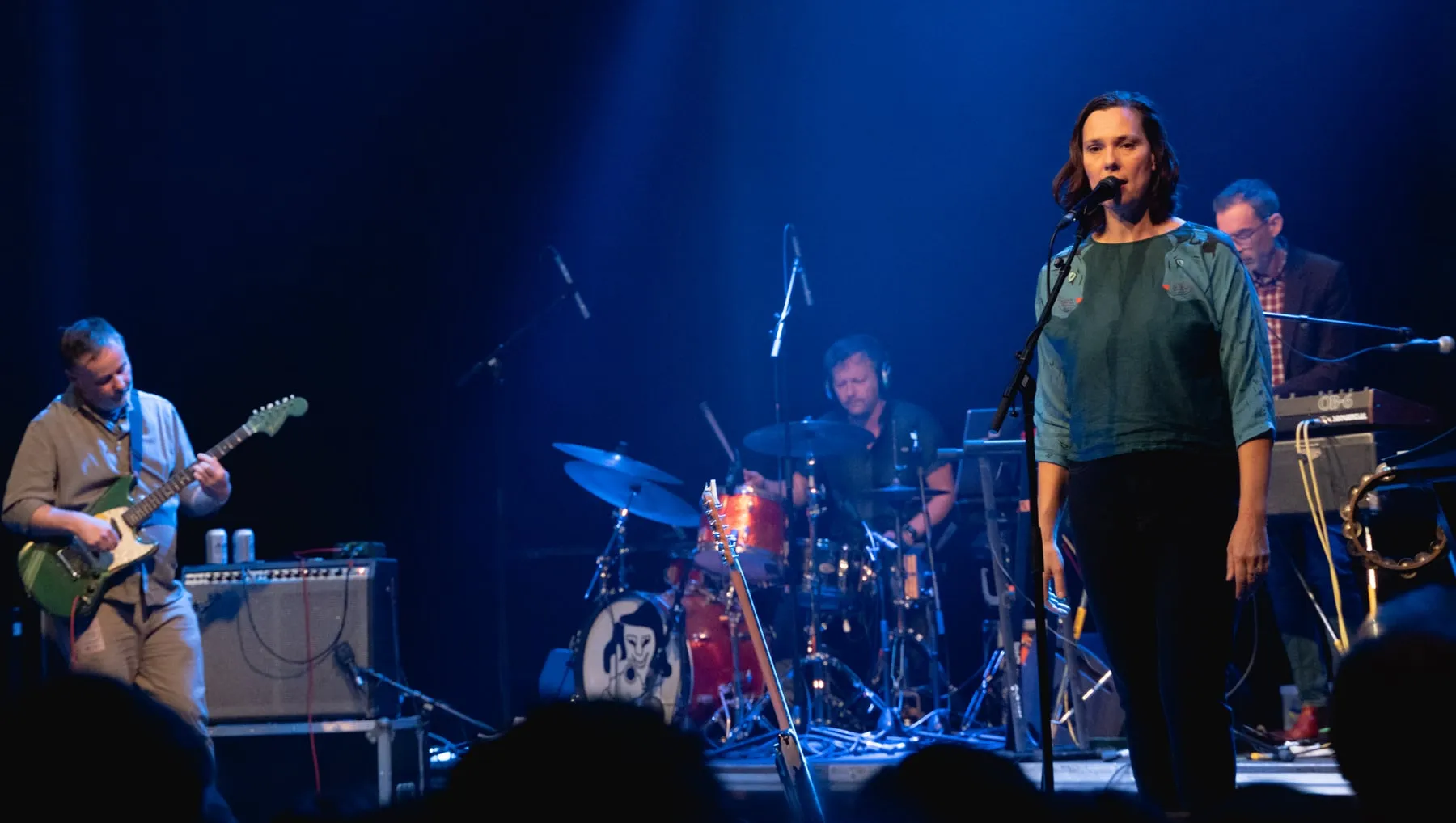
Photo by Raph_PH , licensed under CC BY 2.0 · Wikimedia Commons
Rank #275
Stereolab
Anglo-French band fusing Marxist lyricism with motorik grooves and lounge.
From Wikipedia
Stereolab are a British-French band formed in London in 1990. Led by the songwriting team of Tim Gane and Lætitia Sadier, the group's sound incorporates vintage electronic keyboards and repetitive motorik beats with female vocals sung in English and French, drawing influence from styles such as krautrock, lounge music, jazz, and 1960s French pop. Their lyrics have left-wing political and philosophical themes influenced by the Surrealist and Situationist movements.
Studio Albums
- 1992 Peng!
- 1993 Transient Random‐Noise Bursts With Announcements
- 1994 Mars Audiac Quintet
- 1996 Emperor Tomato Ketchup
- 1997 Dots and Loops
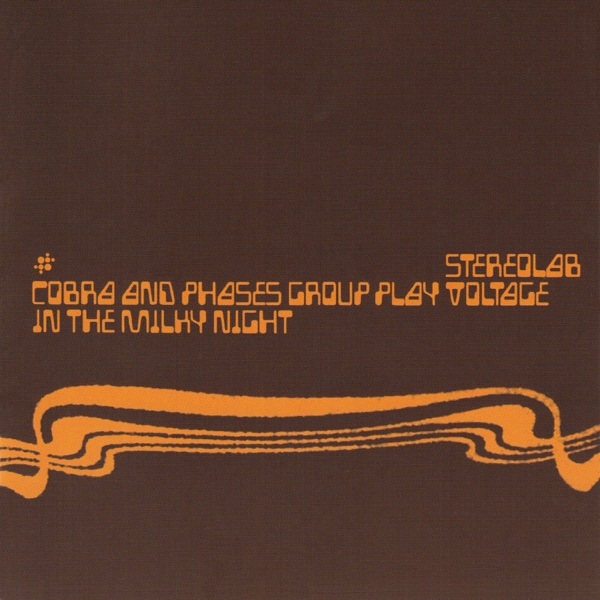
- 1999 Cobra and Phases Group Play Voltage in the Milky Night
- 2001 Sound‐Dust
- 2004 Margerine Eclipse
- 2007 Eaten Horizons or the Electrocution of Rock
- 2008 Chemical Chords
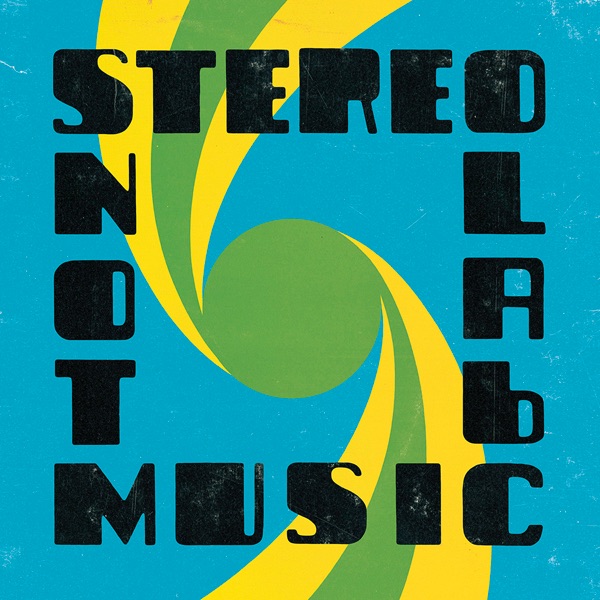
- 2010 Not Music
- 2025 Instant Holograms on Metal Film
Source: MusicBrainz
Deep Dive
Overview
Stereolabare a British-French avant-pop band formed in London in 1990 that have spent more than three decades exploring the intersection of krautrock motorik grooves, vintage electronic instrumentation, and lounge music aesthetics while anchoring their work in left-wing political and philosophical thought. Led by the songwriting partnership of Tim Gane and Lætitia Sadier, the band synthesized post-punk rigor with analog synthesizer textures and repetitive rhythmic cycles that drew from Weimar-era electronic experimentation and 1960s French pop while adding layers of Marxist critique, Surrealist imagery, and Situationist theory. Their position in the indie rock landscape of the 1990s and 2000s was singular: neither straightforward pop nor hermetic experimentalism, but a disciplined middle path that privileged melodic warmth and rhythmic momentum as vehicles for intellectual content.
Formation Story
Stereolab crystallized in London during 1990 as Tim Gane and Lætitia Sadier began collaborating on material that would become their first recordings. Gane, an English guitarist and keyboardist with roots in post-punk aesthetics, and Sadier, a French vocalist fluent in both English and her native language, formed the core creative partnership that would define the band’s trajectory. Their initial lineup assembled around this nucleus, establishing the group’s core identity as a London-based project with transatlantic sensibility. The duo’s shared fascination with electronic music history, particularly the motorik patterns developed by 1970s German krautrock bands, provided the foundational sonic template. Sadier’s multilingual vocals became a signature element from the outset, allowing the band to address lyrical themes drawn from European intellectual traditions while maintaining accessibility through English-language passages and French-language interjections that doubled as textural elements within arrangements.
Breakthrough Moment
Stereolabachieved early underground recognition with their debut album Peng! in 1992, but the release that crystallized their audience and critical profile came with Transient Random‐Noise Bursts With Announcements in 1993. This second album expanded their palette while refining their core aesthetic: interlocking synthesizer lines derived from vintage Farfisa and VCS 3 textures, Gane’s precise guitar work woven through propulsive drum programming, and Sadier’s vocals delivered with cool detachment over arrangements that favored hypnotic repetition over conventional song dynamics. The album’s title itself signaled the band’s commitment to conceptual rigor and their engagement with chance operations and sound art, borrowing terminology from electronic music theory. By the mid-1990s, Stereolab had secured a foothold within the expanded indie rock underground, gradually expanding their listenership through college radio play and the emerging alternative music press that recognized their sophisticated formal approach as distinct from the guitar-centric indie rock mainstream.
Peak Era
Stereolabarchived their most sustained commercial and critical success during the years spanning Emperor Tomato Ketchup (1996) through Sound‐Dust (2001). Emperor Tomato Ketchup arrived as their most assured and accessible work, demonstrating that the band could balance their maximalist electronic arrangements with hooks and vocal melodies that lodged themselves in listeners’ minds without sacrificing intellectual content. Dots and Loops (1997) and Cobra and Phases Group Play Voltage in the Milky Night (1999) consolidated this achievement, each expanding the band’s harmonic vocabulary while maintaining the motorik groove logic that had become their calling card. During this five-year window, Stereolab achieved the broadest distribution of their career, reaching beyond specialized indie audiences into larger alternative rock constituencies without diluting their fundamental approach. Sound‐Dust (2001) represented the apex of this arc, a lavishly produced statement that integrated orchestral textures, complex polyrhythmic structures, and Sadier’s increasingly sophisticated vocal arrangements within the band’s established electronic framework.
Musical Style
Stereolabdefined themselves through the careful synthesis of seemingly incompatible source materials: the repetitive, trance-inducing rhythm structures of 1970s German krautrock, the miniaturized electronic production techniques of 1960s lounge and exotica music, jazz harmonic sophistication, French chanson melodic sensibility, and the political engagement demanded by their Surrealist and Situationist philosophical frameworks. Gane’s production approach favored crystalline clarity and precise stereo imaging, allowing each synthesizer line, drum pulse, and vocal layer to occupy distinct sonic space within predominantly mid-tempo arrangements. Sadier’s vocal delivery emphasized cool, almost affectless expression, allowing her lyrics to function simultaneously as poetic statements and as sonic texture—her French-language passages frequently offered literal translation of English-language content, creating a doubled meaning that resisted simple lyrical explication. The band’s use of vintage Farfisa and Vox organs, paired with modernist drum machines and sequencers, created a deliberately retro-futuristic sound aesthetic that acknowledged electronic music history while remaining unmistakably contemporary. Rather than accelerating toward crescendos, their songs typically maintained steady-state intensity, allowing variations in timbre and harmonic movement to generate formal interest without resorting to dynamic peaks and valleys.
Major Albums
Emperor Tomato Ketchup (1996)
The album that expanded Stereolab’s reach beyond the underground, pairing their motorik foundations with increased melodic accessibility and lush orchestration while maintaining the band’s commitment to repetitive, hypnotic structures and left-wing lyricism.
Dots and Loops (1997)
A logical extension of Emperor Tomato Ketchup’s maximalism, featuring increasingly intricate harmonic arrangements and Sadier’s most developed vocal performances, deepening the band’s engagement with jazz-inflected harmony and orchestral color.
Cobra and Phases Group Play Voltage in the Milky Night (1999)
Releasing after a two-year gap, this album refined the band’s approach to album architecture, balancing instrumental passages against song-based compositions and introducing greater textural variety through expanded use of strings, horns, and synthesized orchestration.
Sound‐Dust (2001)
Representing the commercial and artistic peak of Stereolab’s major-label period, Sound‐Dust demonstrated the band’s capacity for sustained production sophistication, complex arrangements, and thematic coherence across an extended statement.
Margerine Eclipse (2004)
Following a three-year hiatus and the band’s shift to independent label Duophonic Records, this album found Stereolab recalibrating their sonic approach with stripped-down arrangements and renewed emphasis on compositional clarity.
Chemical Chords (2008)
A return to more elaborate instrumentation following the relative minimalism of Margerine Eclipse, showcasing the band’s continued engagement with orchestral textures and complex harmonic development.
Signature Songs
- Fluorescences — A quintessential motorik showcase that distilled the band’s krautrock obsessions into a propulsive, three-minute statement built around relentless drum machine pulse and layered synthesizer melodicism.
- Ping Pong — Exemplifying the band’s ability to embed political content within deceptively simple melodic frameworks, the track balanced Sadier’s French-language vocal segments against Gane’s precise guitar articulation.
- Les Demoiselles d’Avignon — Demonstrating the band’s sophisticated engagement with both modernist visual art history (via its Picasso reference) and complex harmonic language, the composition layered multiple melodic ideas within the motorik framework.
- Encinitas — A slower-tempo exploration of jazz-influenced chord progressions and orchestral texture that proved Stereolab’s range extended beyond their signature uptempo groove.
- Brute Booty Internash — A late-era composition that maintained the band’s commitment to mechanical rhythmic precision while introducing more elaborate harmonic sophistication and orchestral color.
Influence on Rock
Stereolaboccupied a position in late-twentieth-century indie rock that few bands achieved: simultaneously intellectually rigorous, formally innovative, and melodically engaging without adopting the histrionics or emotional extremism associated with alternative rock’s dominant figures. Their consistent engagement with motorik rhythmic templates and vintage electronic instrumentation influenced a generation of indie and electronic producers who recognized in their work a viable alternative to both the guitar-centric traditionalism of much indie rock and the synthetic maximalism of synth-pop heritage. Bands and producers working within lo-fi, chillwave, and math rock contexts found in Stereolab’s approach—particularly their use of repetition as a generative rather than minimalist principle—a template for intellectual pop music that rejected irony and sincerity as false dichotomies. Their integration of overtly political content into formally sophisticated pop structures challenged the notion that accessibility and ideological seriousness were incompatible, reopening conversations about popular music’s relationship to Marxist aesthetics, Situationist critique, and European avant-garde traditions that had remained largely dormant in English-language rock discourse since the 1980s.
Legacy
Stereolab’s continued activity through the 2000s and 2010s—releasing Eaten Horizons or the Electrocution of Rock in 2007, Chemical Chords in 2008, and Not Music in 2010—solidified their status as a band committed to sustained artistic development rather than nostalgia-based touring. The announcement of a new album, Instant Holograms on Metal Film, scheduled for 2025, marks their first major statement since 2010 and demonstrates the band’s capacity to remain generatively engaged with their fundamental aesthetic preoccupations after more than thirty years of activity. Their back catalog has maintained steady circulation through streaming platforms and collector markets, reaching audiences born after the band’s mid-1990s commercial peak who discover in their work a compelling alternative to contemporary pop and electronic music’s dominant tendencies. Tim Gane and Lætitia Sadier’s partnership, remaining central to the band’s identity across every lineup iteration, has proven one of indie rock’s most durable and creatively sustaining collaborations. Their influence on independent label infrastructure is particularly significant: the establishment of Duophonic Records as both a manufacturing and distribution platform in the early 2000s reflected their commitment to maintaining artistic autonomy while developing sustainable models for releasing challenging music outside major-label frameworks.
Fun Facts
- Stereolab’s lyrics frequently draw directly from Surrealist and Situationist theoretical texts, embedding philosophical concepts from 1960s European intellectual movements within melodic pop structures.
- The band’s use of vintage Farfisa organs—typically associated with 1960s lounge and easy-listening production—as a primary melodic instrument represented a deliberate reclamation of dismissed musical aesthetics as vehicles for serious artistic expression.
- Their tenure on independent labels including Drag City, 4AD, and Duophonic Records reflected a strategic approach to artistic independence that prioritized creative control over major-label advancement, ultimately allowing them longer developmental periods between releases.
- Lætitia Sadier’s bilingual vocal approach, switching between English and French passages within individual songs, transformed language itself into a compositional element rather than a transparent carrier of meaning.
Discography & Previews
Click any album to expand its track list. Each track plays a 30-second preview streamed from Apple Music. Tap the link icon next to a track to open it in Apple Music for full playback.


- 1 Three-Dee Melodie ↗ 5:02
- 2 Wow and Flutter ↗ 3:09
- 3 Transona Five ↗ 5:32
- 4 Des Etoiles Electroniques ↗ 3:20
- 5 Ping Pong ↗ 3:02
- 6 Anamorphose ↗ 7:33
- 7 Three Longers Later ↗ 3:29
- 8 Nihilist Assault Group ↗ 6:55
- 9 International Colouring Contest ↗ 3:48
- 10 The Stars Our Destination ↗ 2:59
- 11 Transporte Sans Bouger ↗ 4:20
- 12 L'Enfer Des Formes ↗ 3:53
- 13 Outer Accelerator ↗ 5:21
- 14 New Orthophony ↗ 4:35
- 15 Fiery Yellow ↗ 4:05

- 1 Metronomic Underground ↗ 7:55
- 2 Cybele's Reverie ↗ 4:41
- 3 Percolator ↗ 3:47
- 4 Les Yper-Sound ↗ 4:05
- 5 Spark Plug ↗ 2:29
- 6 Olv 26 ↗ 5:42
- 7 The Noise of Carpet ↗ 3:05
- 8 Tomorrow Is Already Here ↗ 4:57
- 9 Emperor Tomato Ketchup ↗ 4:37
- 10 Monstre Sacre ↗ 3:44
- 11 Motoroller Scalatron ↗ 3:48
- 12 Slow Fast Hazel ↗ 3:53
- 13 Anonymous Collective ↗ 4:33

- 1 Fuses ↗ 3:38
- 2 People Do It All the Time ↗ 3:42
- 3 The Free Design ↗ 3:48
- 4 Blips, Drips and Strips ↗ 4:28
- 5 Italian Shoes Continuum ↗ 4:34
- 6 Infinity Girl ↗ 3:54
- 7 The Spiracles ↗ 3:40
- 8 Op Hop Detonation ↗ 3:32
- 9 Puncture In the Radak Permutation ↗ 5:49
- 10 Velvet Water ↗ 4:21
- 11 Blue Milk ↗ 11:29
- 12 Caleidoscopic Gaze ↗ 8:09
- 13 Strobo Acceleration ↗ 3:54
- 14 The Emergency Kisses ↗ 5:54
- 15 Come and Play In the Milky Night ↗ 4:38

- 1 Black Ants In Sound-dust ↗ 1:56
- 2 Spacemoth ↗ 7:34
- 3 Captain Easychord ↗ 5:26
- 4 Baby Lulu ↗ 5:13
- 5 The Black Arts ↗ 5:12
- 6 Hallucinex ↗ 3:49
- 7 Double Rocker ↗ 5:32
- 8 Gus the Mynah Bird ↗ 6:09
- 9 Nought More Terrific Than Man ↗ 4:03
- 10 Nothing To Do With Me ↗ 3:36
- 11 Suggestion Diaboligue ↗ 7:53
- 12 Les Bon Bons Des Raisons ↗ 6:44

- 1 Vonal Declosion ↗ 3:32
- 2 Need To Be ↗ 4:49
- 3 Sudden Stars (EP Version) ↗ 4:40
- 4 Cosmic Country Noir ↗ 4:47
- 5 La Demuere ↗ 4:36
- 6 Margerine Rock ↗ 2:56
- 7 The Man With 100 Cells ↗ 3:47
- 8 Margerine Melodie ↗ 6:18
- 9 Hillbilly Motobike ↗ 2:22
- 10 Feel and Triple ↗ 4:53
- 11 Bop Scotch ↗ 3:59
- 12 Dear Marge ↗ 6:55

- 1 Everybody's Weird Except Me ↗ 3:34
- 2 Supah Jaianto ↗ 5:08
- 3 So Is Cardboard Clouds ↗ 3:50
- 4 Equivalences ↗ 2:23
- 5 Leleklato Sugar ↗ 3:05
- 6 Silver Sands (Emperor Machine Mix) ↗ 10:21
- 7 Two Finger Symphony ↗ 3:47
- 8 Delugeoisie ↗ 3:41
- 9 Laserblast ↗ 3:26
- 10 Sun Demon ↗ 3:18
- 11 Aelita ↗ 3:49
- 12 Pop Molecules (Molecular Pop) ↗ 2:04
- 13 Neon Beanbag (Atlas Sound Mix) ↗ 7:57

- 1 Mystical Plosives ↗ 0:56
- 2 Aerial Troubles ↗ 3:21
- 3 Melodie Is A Wound ↗ 7:37
- 4 Immortal Hands ↗ 6:25
- 5 Vermona F Transistor ↗ 4:37
- 6 Le Coeur Et La Force ↗ 4:21
- 7 Electrified Teenybop! ↗ 4:17
- 8 Transmuted Matter ↗ 4:16
- 9 Esemplastic Creeping Eruption ↗ 6:04
- 10 If You Remember I Forgot How To Dream Pt.1 ↗ 3:41
- 11 Flashes From Everywhere ↗ 5:35
- 12 Colour Television ↗ 5:33
- 13 If You Remember I Forgot How To Dream Pt.2 ↗ 2:57