
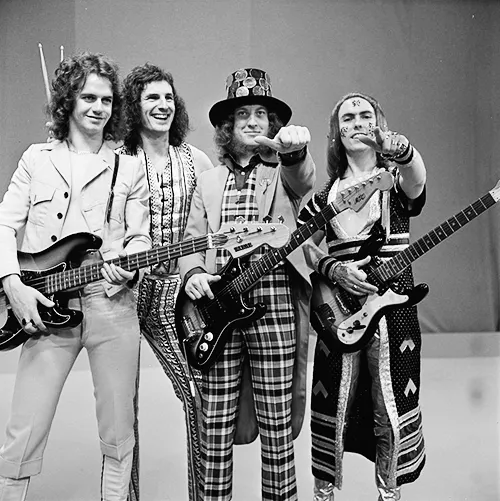
Photo by AVRO , licensed under CC BY-SA 3.0 nl · Wikimedia Commons
Rank #232
Slade
Wolverhampton glam-rock chant-makers who fueled British 70s pop.
From Wikipedia
Slade are an English rock band formed in Wolverhampton in 1963. They rose to prominence during the glam rock era in the early 1970s, achieving 17 consecutive top 20 hits, including six number ones, on the UK Singles Chart, and three number ones on the UK Albums Charts. The British Hit Singles & Albums names them the most successful British group of the 1970s based on sales of singles. They were the first act to have three singles enter the charts at number one; all six of the band's chart-toppers were written by Noddy Holder and Jim Lea. As of 2006, total UK sales stood at over 6,500,000. Their best-selling single, "Merry Xmas Everybody", has sold in excess of one million copies. According to the 1999 BBC documentary It's Slade, the band have sold more than 50 million records worldwide.
Members
- Dave Hill
- Don Powell
- Jim Lea
- Mal McNulty
- Noddy Holder
Deep Dive
Overview
Slade were an English rock band formed in Wolverhampton in 1966 who rose to dominate the British charts during the glam rock era of the early 1970s. Their impact was quantifiable and sustained: 17 consecutive top 20 hits, six number ones, and three number-one albums on the UK Charts, making them, by the accounting of The British Hit Singles & Albums, the most successful British group of the 1970s based on singles sales alone. With worldwide record sales estimated at over 50 million, Slade occupied a singular place in hard rock and pop history—a band equally comfortable with stadium anthems and novelty records, driven by the songwriting partnership of Noddy Holder and Jim Lea.
Formation Story
Slade crystallized from the Wolverhampton music scene in 1966, assembling the lineup that would define the band: Noddy Holder on vocals, Jim Lea on bass and keyboards, Dave Hill on guitar, and Don Powell on drums. Mal McNulty also appeared in the roster, contributing to the early band configuration. The Midlands industrial city provided the unlikely birthplace for one of Britain’s most flamboyant and commercially formidable rock acts. The group’s roots stretched back into the regional live circuit, where they developed the rough-edged, percussion-heavy approach that would later set them apart from the art-school glam acts of London.
Breakthrough Moment
Slade’s commercial breakthrough accelerated sharply in the early 1970s. Their 1972 album Slayed? marked a watershed: it captured the band’s evolved sound and set the template for the hit singles that followed. By 1974, with the release of Old, New, Borrowed and Blue, Slade had firmly planted themselves at the center of British pop culture. The era from 1972 to 1974 saw them transition from respected regional act to chart dominators, their single releases charting with remarkable consistency and their live performances becoming increasingly theatrical and audience-driven. All six of the band’s UK number-one singles were written by Holder and Lea, a songwriting monopoly that underscored their creative control during their peak.
Peak Era
The period from 1972 through the late 1970s represented Slade’s creative and commercial zenith. Albums like Slayed?, Old, New, Borrowed and Blue (1974), Nobody’s Fools (1976), and Whatever Happened to Slade (1977) anchored a run of chart success that few British acts have equaled. During these years, the band released their most memorable and durable material, achieving a rare balance between novelty appeal and genuine rock credibility. Their ability to craft singalong anthems with massive audience participation—chants, claps, and communal vocals—became their signature trademark. The band’s live shows during this period were spectacle and participation rolled into one, with Holder’s commanding stage presence and the band’s tight, rhythm-forward arrangements creating an almost tribal concert experience.
Musical Style
Slade’s sound was rooted in hard rock but filtered through a distinctly British sensibility and a glam-rock visual and textural approach. Holder’s vocals were raw and emphatic, rarely refined, always powerful; the band built arrangements around heavy, swinging drum patterns and thick, repetitive bass lines. Jim Lea’s multi-instrumental contributions—particularly his work on bass and keyboards—provided harmonic depth and a melodic counterweight to the sheer bluntness of the guitars and drums. Dave Hill’s guitar work favored simple, bludgeoning riffs and chunky chords over technical virtuosity. The result was a sound more akin to working-class British blues-rock than to the art-school pretension of many of their glam-rock contemporaries. Slade’s songs often employed call-and-response structures, audience chants, and stomping rhythms that made them irresistible in live and recorded contexts alike. Their musical DNA traced through post-war British rock and roll via the blues, but their production—loud, compressed, and deliberately rough-textured—was distinctly modern for the 1970s.
Major Albums
Slayed? (1972)
Captured the band’s fully formed hard-rock approach with the production clarity and songwriting maturity that launched them into consistent chart success; the album title’s question mark became iconic shorthand for the band’s humorous, unpretentious brand identity.
Old, New, Borrowed and Blue (1974)
The album that cemented Slade’s status as chart-toppers, featuring some of their most memorable singles and demonstrating their ability to sustain radio and arena appeal across an entire record.
Nobody’s Fools (1976)
Released at the band’s commercial peak, the album maintained their hard-rock foundation while pushing slightly deeper into songwriting sophistication and arrangement complexity.
Whatever Happened to Slade (1977)
Marked the tail end of their initial run of dominance, still achieving chart success but signaling a band beginning to reckon with the changing landscape of 1970s rock and pop.
Signature Songs
- “Merry Xmas Everybody” — Their best-selling single, a novelty Christmas anthem that has sold in excess of one million copies and remains a perennial UK radio staple.
- “Cum On Feel the Noize” — A hard-rock chant-along that became the template for stadium sing-alongs and demonstrated the band’s gift for turning simple, explosive phrases into communal experiences.
- “Mama Weer All Crazee Now” — Captured the swinging, rhythm-forward energy at the heart of Slade’s appeal and their ability to blur the line between glam spectacle and genuine rock credibility.
- “Take Me Bak ‘Ome” — A mid-chart mainstay that showcased Holder’s ability to deliver a hook with both humor and emotional directness.
Influence on Rock
Slade’s influence on hard rock and glam rock was immense but often understated, overshadowed by flashier contemporaries. Their songwriting approach—emphasizing simplicity, repetition, and audience participation—became a template that outlived the glam-rock era itself. The band demonstrated that commercial success and rock credibility need not be mutually exclusive, and their commitment to live performance as a participatory rather than observational experience influenced countless acts working in stadium rock, punk, and heavy metal in subsequent decades. Their production aesthetic—loud, compressed, deliberately raw—presaged approaches that would become standard in hard rock and heavy metal through the 1980s and beyond. Noddy Holder’s vocal style, rooted in pre-glam British rock shouting rather than refined singing, also offered an alternative template to the more theatrical or technically polished approaches of other glam-rock frontmen.
Legacy
Slade’s place in rock history rests primarily on their 1970s dominance, but their cultural footprint extended well beyond that decade. “Merry Xmas Everybody” has become a permanent fixture of British Christmas culture, achieving a kind of evergreen ubiquity that few rock songs have attained. The band’s total UK sales of over 6.5 million records as of 2006, combined with worldwide estimates exceeding 50 million, place them among the most commercially successful rock acts in history. Though their creative output after the late 1970s did not recapture their earlier chart dominance, the band remained active through periodic reunions and touring. Albums like Return to Base (1979), We’ll Bring the House Down (1981), and later recordings through the 2000s testified to their continued recording presence, even if the cultural moment that made them meteoric had passed. Modern streaming and nostalgia-driven reassessments have kept their catalog in active circulation, and their live reputation—forged during the 1970s—has ensured that legacy acts and festival appearances remain part of their ongoing presence in British rock culture.
Fun Facts
- Slade were the first act in British chart history to have three singles enter the charts simultaneously at number one.
- The band’s spelling and punctuation choices—notably the title Slayed? and album and song titles featuring apostrophes in place of vowels (“Cum On Feel the Noize”)—became part of their visual and branding identity, reflecting a playful approach to rock convention.
- The band recorded and released material across four different decades, from 1969’s Beginnings through 2002’s Cum On Let’s Party!, demonstrating unusual longevity for a glam-rock act.