
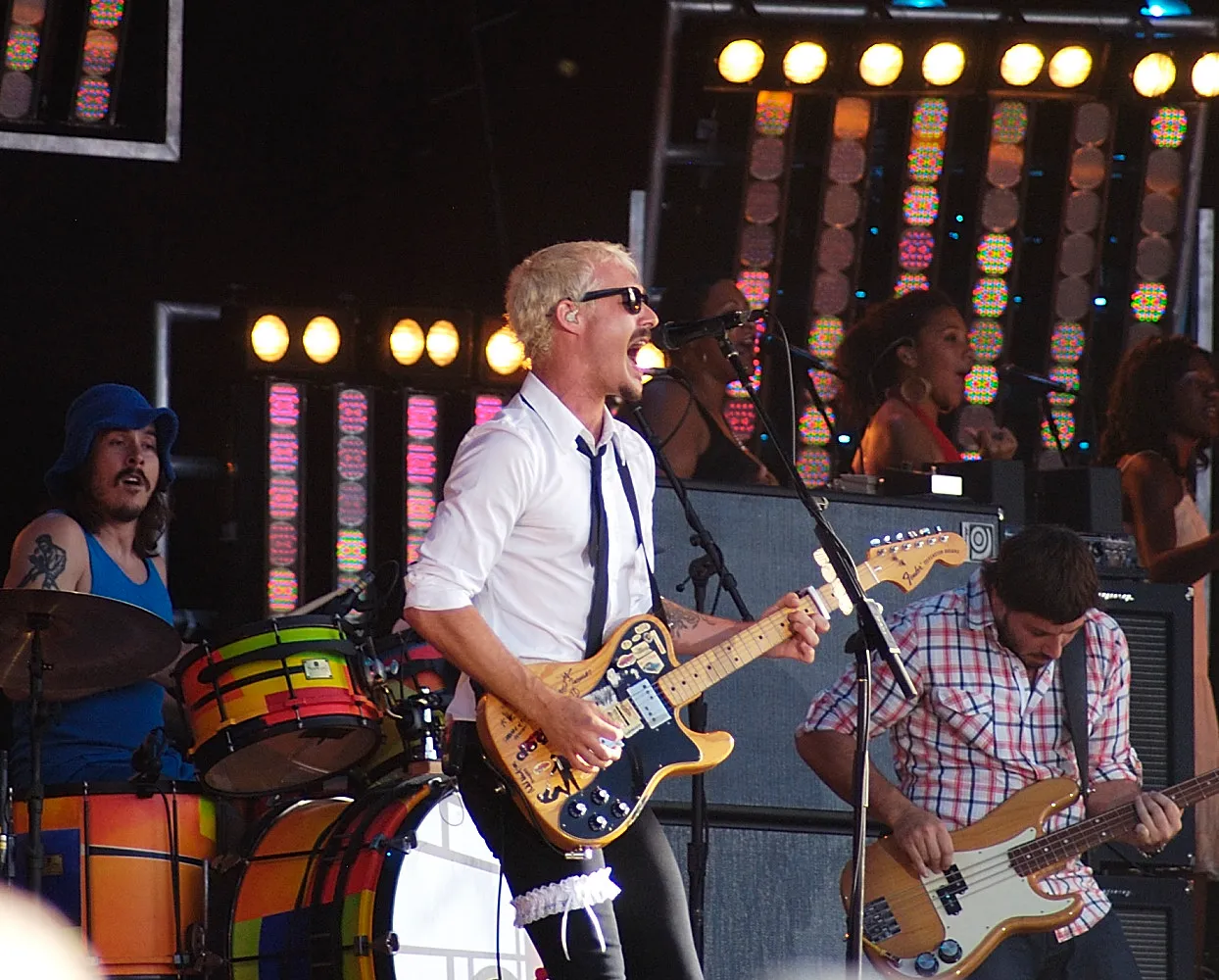
Photo by deep ghosh from Melbourne, VIC, Australia , licensed under CC BY 2.0 · Wikimedia Commons
Rank #304
Silverchair
Newcastle teen-grunge phenomenons who matured into ambitious art rock.
From Wikipedia
Silverchair were an Australian rock band, which formed in 1992 as Innocent Criminals in Newcastle, New South Wales, with Daniel Johns on vocals and guitars, Ben Gillies on drums, and Chris Joannou on bass guitar. The group got their big break in mid-1994 when they won a national demo competition conducted by SBS TV show Nomad and ABC radio station Triple J. The band was signed by Murmur and were successful in Australia and internationally. Silverchair has sold over 10 million albums worldwide.
Members
- Ben Gillies
- Chris Joannou
- Daniel Johns
- Nicolás Molina
Studio Albums
- 1995 Frogstomp
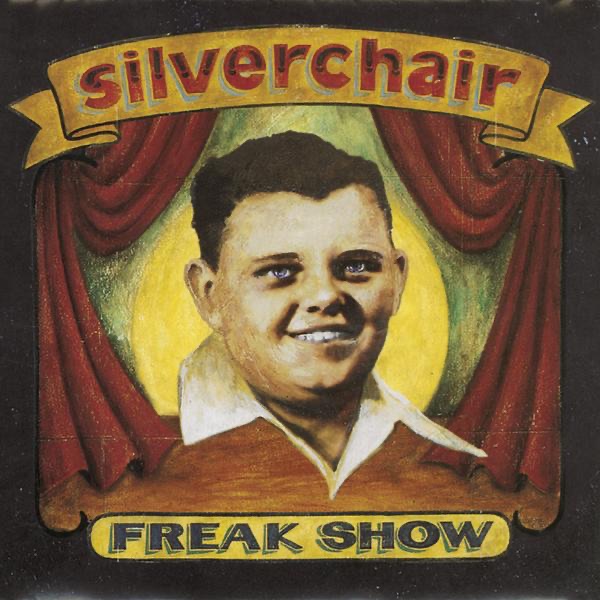
- 1996 Freak Show
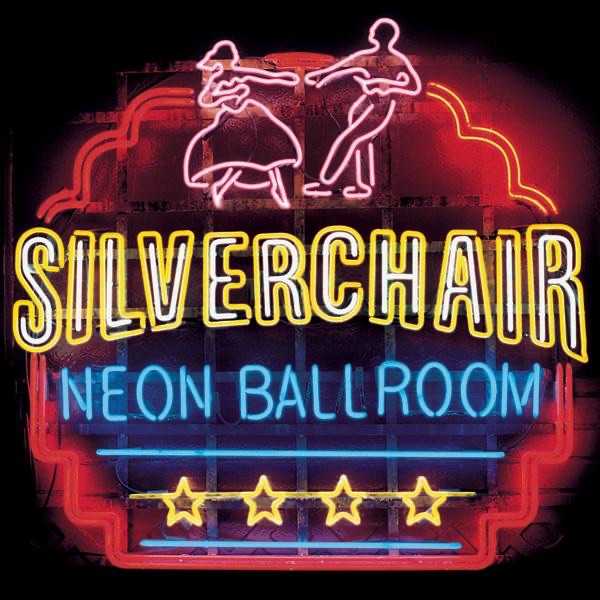
- 1999 Neon Ballroom
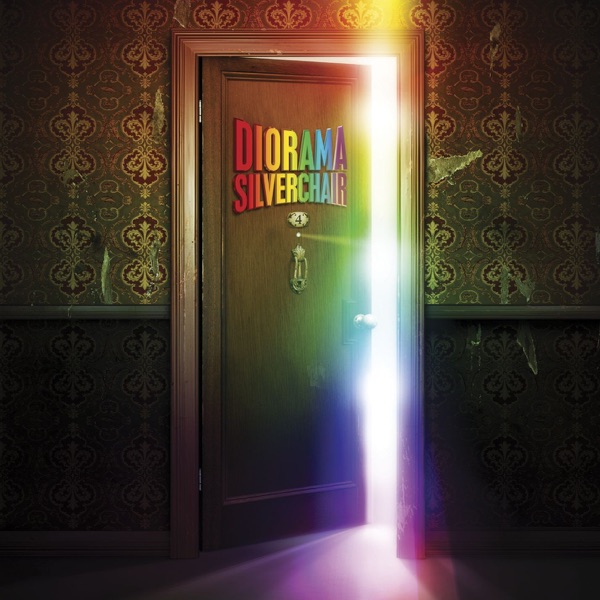
- 2002 Diorama
- 2007 Young Modern
Source: MusicBrainz
Deep Dive
Overview
Silverchair were an Australian rock band that emerged from Newcastle in 1992 and became one of the most prominent rock acts of their generation. Fronted by vocalist and guitarist Daniel Johns, the trio of Johns, drummer Ben Gillies, and bassist Chris Joannou initially trafficked in post-grunge and alternative rock, achieving rapid international success as teenagers before pivoting toward more ambitious, art-rock experimentation in their later work. Across five studio albums released between 1995 and 2007, the band sold over 10 million copies worldwide and established themselves as significant figures in rock music beyond the grunge phenomenon that birthed them.
Formation Story
Silverchair began as Innocent Criminals in 1992 in Newcastle, New South Wales, a port city with little established rock infrastructure. The founding lineup—Johns, Gillies, and Joannou—were all teenagers when they first formed the group. The name Innocent Criminals reflected the raw, youthful energy of their early demos, recorded in a regional scene far removed from the established music centers of Sydney and Melbourne. By the time they were ready to break through nationally, however, the band had repositioned itself as Silverchair, a name that would carry them through the remainder of their career.
Breakthrough Moment
Silverchair’s rapid ascent began in mid-1994 when they won a national demo competition conducted by SBS TV show Nomad and ABC radio station Triple J. This victory on one of Australia’s most influential youth media platforms led to a record deal with Murmur, a label that paired them with Epic Records and the broader Warner Music Group distribution network. The timing of their breakthrough positioned them perfectly: grunge had reached its commercial and cultural peak in North America, and Australian rock music was beginning to gain international attention. Their victory and subsequent signing made them the focus of intense industry and fan interest even before their debut album reached stores.
Peak Era
Silverchair’s most commercially successful period coincided with the release and touring behind their first two studio albums. Frogstomp, released in 1995 when Johns was still in his late teens, introduced their guitar-driven, angst-inflected sound to a global audience hungry for new voices in post-grunge rock. The album’s success was followed by Freak Show in 1996, which consolidated their position as one of the defining bands of the mid-1990s rock landscape. By the end of the 1990s, with the release of Neon Ballroom in 1999, Silverchair had begun to signal a shift away from straightforward grunge pastiche toward more experimental and layered arrangements, setting the stage for their later reinvention.
Musical Style
Silverchair’s sound drew heavily from the post-grunge and alternative rock traditions established by Seattle-based bands of the early 1990s, though Johns’ high, keening vocals and the band’s heavy reliance on guitar melody provided immediate differentiation. Early recordings emphasized distorted guitars, thunderous drums from Gillies, and Joannou’s anchoring bass work, creating a wall-of-sound aesthetic that prioritized emotional intensity over technical complexity. As the band matured through the 2000s—particularly on Diorama (2002) and Young Modern (2007)—their approach became increasingly ornate and production-conscious, incorporating layered instrumentation and studio effects that moved them further from grunge’s stripped-down aesthetic. The band’s evolution reflected a broader maturation in their songwriting and arrangements, trading the raw teenage angst of their early work for more sophisticated melodic and harmonic ambitions.
Major Albums
Frogstomp (1995)
Their debut album established Silverchair as major international rock figures, driven by Johns’ distinctive vocal delivery and the band’s immediate, hook-laden approach to grunge-influenced songwriting. The record’s commercial success cemented their position as the Australian equivalent of the American teen-grunge phenomenon.
Freak Show (1996)
Released just a year after their debut, Freak Show demonstrated that Silverchair were more than a one-album phenomenon, showcasing refinement in production and a broadened emotional palette while maintaining the raw guitar-driven foundation that defined their appeal.
Neon Ballroom (1999)
This third album marked a clear shift toward experimentation, with Johns and Gillies expanding their sonic palette beyond the post-grunge template and incorporating more diverse instrumental textures and production techniques.
Diorama (2002)
Released after a three-year gap, Diorama demonstrated Silverchair’s commitment to art-rock ambition, featuring intricate arrangements and a more contemplative approach to melody and structure that separated them from their grunge-era peers.
Young Modern (2007)
The band’s final studio album continued their art-rock trajectory, balancing accessibility with sophisticated compositional and production choices that showcased their technical and creative growth across more than a decade of recording.
Signature Songs
- “Tomorrow” — A defining track from Frogstomp that showcased Johns’ soaring vocal range and the band’s gift for immediate, emotionally resonant melodies.
- “Miss You Love” — A Freak Show standout that demonstrated the band’s ability to craft memorable hooks within their heavier sonic framework.
- “Abuse Me” — One of their most recognizable songs, balancing vulnerable lyrics with aggressive instrumentation.
- “Across the Night” — A track exemplifying their evolution toward more layered, production-conscious songwriting.
Influence on Rock
Silverchair arrived at a moment when post-grunge had become a dominant commercial force in rock music, and their success helped establish Australian rock as a significant export in the global marketplace. The band’s journey from teenage grunge sensations to ambitious art-rock experimenters influenced a generation of alternative rock musicians who saw the genre’s potential for evolution beyond its early-1990s template. Their willingness to move away from the grunge formula—rather than repeating it indefinitely—provided a model for bands seeking to maintain artistic credibility while retaining commercial viability. The technical proficiency and melodic sophistication of their later work helped expand the possibilities for post-grunge musicians navigating the transition into the 2000s.
Legacy
Silverchair dissolved in 2011, having released five studio albums and established themselves as one of the most commercially successful rock acts of their generation. With over 10 million albums sold worldwide, the band remains a significant presence in rock history, particularly within the post-grunge and Australian rock canons. Their early success as teenagers made them emblematic of the mid-1990s rock landscape, while their later artistic ambitions demonstrated a seriousness of purpose that extended their relevance beyond the era that initially spawned them. The band’s catalog has maintained steady streaming presence, and their influence on the relationship between commercial rock success and artistic progression continues to resonate.
Fun Facts
- Silverchair began as a three-piece and remained that composition through their entire career until the addition of Nicolás Molina in a later iteration of the group.
- Their victory on the Nomad/Triple J demo competition in 1994 was the catalyst that transformed them from a regional Newcastle band into international recording artists within months.
- Daniel Johns was still a teenager when Frogstomp achieved massive commercial success, making Silverchair one of the defining teen-rock phenomena of the 1990s.
- The band’s transition from Innocent Criminals to Silverchair represented their conscious effort to distance themselves from their initial identity and signal a new beginning as they prepared for major-label success.
Discography & Previews
Click any album to expand its track list. Each track plays a 30-second preview streamed from Apple Music. Tap the link icon next to a track to open it in Apple Music for full playback.

- 1 Israel's Son (Remastered) ↗ 5:18
- 2 Tomorrow (Remastered) ↗ 4:26
- 3 Faultline (Remastered) ↗ 4:19
- 4 Pure Massacre (Remastered) ↗ 4:59
- 5 Shade (Remastered) ↗ 4:02
- 6 Leave Me Out (Remastered) ↗ 3:03
- 7 Suicidal Dream (Remastered) ↗ 3:13
- 8 Madman (Remastered) ↗ 2:43
- 9 Undecided (Remastered) ↗ 4:37
- 10 Cicada (Remastered) ↗ 5:10
- 11 Findaway (Remastered) ↗ 2:58
- 1 Emotion Sickness ↗ 6:01
- 2 Anthem for the Year 2000 ↗ 4:08
- 3 Ana's Song (Open Fire) ↗ 3:42
- 4 Spawn (Again) ↗ 3:28
- 5 Miss You Love ↗ 4:01
- 6 Dearest Helpless ↗ 3:34
- 7 Do You Feel the Same ↗ 4:18
- 8 Black Tangled Heart ↗ 4:33
- 9 Point of View ↗ 3:35
- 10 Satin Sheets ↗ 2:24
- 11 Paint Pastel Princess ↗ 4:34
- 12 Steam Will Rise ↗ 5:18
- 1 Across the Night ↗ 5:39
- 2 The Greatest View ↗ 4:03
- 3 Without You ↗ 5:19
- 4 World Upon Your Shoulders ↗ 4:36
- 5 One Way Mule ↗ 4:14
- 6 Tuna In the Brine ↗ 5:40
- 7 Too Much of Not Enough ↗ 4:44
- 8 Luv Your Life ↗ 4:29
- 9 The Lever ↗ 4:21
- 10 My Favourite Thing ↗ 4:13
- 11 After All These Years ( + Hidden Track "Outro") ↗ 10:04

- 1 Young Modern Station ↗ 3:12
- 2 Straight Lines ↗ 4:18
- 3 If You Keep Losing Sleep ↗ 3:22
- 4 Reflections of a Sound ↗ 4:10
- 5 Thieving Birds, Pt. 1 / Strange Behaviour / Those Thieving Birds, Pt.2 ↗ 7:27
- 6 The Man That Knew Too Much ↗ 4:21
- 7 Waiting All Day ↗ 4:29
- 8 Mind Reader ↗ 3:07
- 9 Low ↗ 3:49
- 10 Insomnia ↗ 3:08
- 11 All Across the World ↗ 4:01