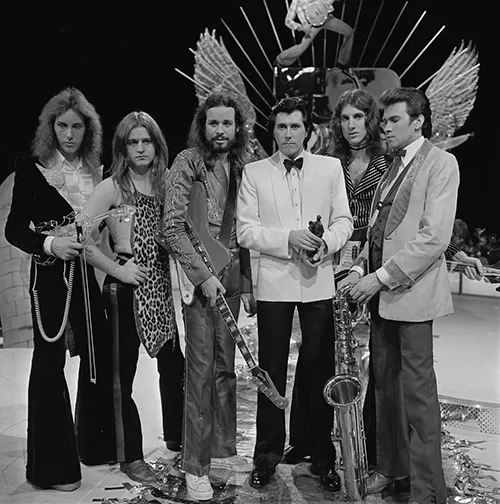
Photo by AVRO , licensed under CC BY-SA 3.0 nl · Wikimedia Commons
Rank #230
Roxy Music
Bryan Ferry's stylish art-rockers who pre-figured post-punk and synth pop.
From Wikipedia
Roxy Music were an English rock band formed in 1970 by Bryan Ferry and Graham Simpson (bass). By the time the band recorded their first album in early 1972, Ferry and Simpson were joined by Andy Mackay (saxophone/oboe), Phil Manzanera (guitar), Paul Thompson (drums) and Brian Eno (synthesizer). Simpson departed in mid-1972, from which point the bassist position in the band would be unstable, while Eno was replaced by Eddie Jobson (synthesizer/keyboards/violin) in mid-1973. By 1980, the band was reduced to a core trio of Ferry, Mackay and Manzanera, augmented by various backing musicians.
Members
- Andy Mackay
- Brian Eno
- Bryan Ferry
- Eddie Jobson
- Phil Manzanera
Studio Albums
- 1972 Roxy Music
- 1973 For Your Pleasure
- 1973 Stranded
- 1974 Country Life
- 1975 Siren
- 1979 Manifesto
- 1980 Flesh + Blood
- 1982 Avalon
Source: MusicBrainz
Deep Dive
Overview
Roxy Music were an English art rock band that emerged from London in the early 1970s as architects of a new aesthetic that fused high culture with rock music’s raw energy. Fronted by Bryan Ferry’s impeccable design sensibility and the volatile creative partnership between Ferry and synthesizer pioneer Brian Eno, Roxy Music synthesized glam rock’s theatrical excess, avant-garde experimentation, and sophisticated pop songwriting into a sound that anticipated both post-punk and synth-pop before either existed as distinct movements. Between 1972 and 1982, across eight studio albums, the band redefined what rock music could be sonically and visually, moving from the controlled chaos of their early period through increasingly refined and dance-oriented arrangements.
Formation Story
Roxy Music coalesced in London around Bryan Ferry and bassist Graham Simpson in 1971, crystallizing by early 1972 into a six-piece ensemble that would debut on record with a lineup comprising Ferry (vocals), Simpson (bass), Andy Mackay (saxophone and oboe), Phil Manzanera (guitar), Paul Thompson (drums), and Brian Eno (synthesizer). This original constellation represented an unusual merger of instrumental virtuosity and avant-garde sensibility. Simpson’s tenure proved brief; he departed mid-1972, leaving the bassist’s chair unsettled through the band’s most explosive early years. Eno, whose conceptual approach to the synthesizer as an instrument capable of texture rather than mere melodic statement would fundamentally shape the band’s identity, remained through the first three studio albums before being replaced by Eddie Jobson (synthesizer, keyboards, violin) in mid-1973.
Breakthrough Moment
Roxy Music’s debut album, released in 1972, announced the band’s arrival with a collision of glam rock theatricality, art-school intellectualism, and electronic innovation. The record’s success established them as serious innovators rather than mere fashion curiosities. They followed this initial impact swiftly: For Your Pleasure and Stranded, both released in 1973, consolidated their position at the forefront of British art rock. By the time Country Life appeared in 1974, Roxy Music had moved beyond novelty status to become a major touring and recording presence, their albums selling substantially and their influence rippling through emerging post-punk and new wave circles.
Peak Era
The period from 1972 through 1975—spanning their debut through Siren—represented Roxy Music at maximum creative intensity and commercial momentum. Each of these four albums pushed the band’s sound forward: the early records explored the tensions between Ferry’s immaculate vocals and song structures against Eno’s destabilizing electronic textures, while Country Life and Siren saw the band deepening their mastery of studio production and arrangement, with orchestral elements and increasingly sophisticated songwriting becoming hallmarks. This was the era in which Roxy Music’s influence on emerging new wave and art-rock acts became most visible, yet the band’s own work remained restlessly exploratory rather than formulaic.
Musical Style
Roxy Music’s sound drew from glam rock’s theatricality and fashion-consciousness but rooted itself in art-school experimentalism and jazz-informed musicianship. The band’s instrumental core—particularly Mackay’s reedy saxophone and oboe work, Manzanera’s textural guitar playing, and Thompson’s precise, swinging drumming—provided traditional rock grounding, but Eno’s synthesizer work, which emphasized tone color and sonic manipulation over conventional keyboard melody, destabilized and estranged the music from straightforward rock convention. Ferry’s vocals sat atop these arrangements with characteristic detachment; he sang with precision and an almost mannered restraint that aligned more with art-rock vocals than soul or rock-and-roll tradition. As the 1970s progressed and Jobson replaced Eno, the band’s sound shifted toward greater clarity and increasingly pop-oriented structures, a trajectory evident in the more streamlined arrangements of Manifesto (1979) and Flesh + Blood (1980). The band’s final album, Avalon (1982), reflected a mature aesthetic in which electronic textures had become fully integrated into Ferry’s songwriting framework rather than standing in opposition to it.
Major Albums
Roxy Music (1972)
The debut album introduced the band’s core identity: theatrical glam sensibility colliding with Eno’s experimental electronics and Ferry’s stylized vocals, setting the template for art rock innovation.
For Your Pleasure (1973)
The second album deepened the band’s orchestral arrangements and sonic adventurousness, featuring some of their most complex and layered compositions while maintaining pop accessibility.
Stranded (1973)
Released the same year as For Your Pleasure, Stranded refined the band’s sound toward greater sophistication and marked a key moment in the band’s early artistic crystallization.
Country Life (1974)
The band’s commercial and artistic peak, balancing elaborate arrangements with some of their most memorable songs, showcasing fuller orchestral integration and mature production.
Siren (1975)
The final album of the classic early period, Siren represented a summit of refined songwriting and production, moving the band toward increasingly pop-conscious approaches without sacrificing their art-rock ambitions.
Avalon (1982)
The band’s final studio album presented a fully integrated electronic-pop aesthetic, with synthesizers and keyboards central to Ferry’s songwriting rather than challenging it, marking a mature synthesis of their entire trajectory.
Signature Songs
- “Virginia Plain” — The debut single that announced the band’s arrival with wry sophistication and art-rock experimentalism.
- “For Your Pleasure” — A defining statement of glam-influenced sensuality from the 1973 album of the same name.
- “Ladytron” — An early showcase of Eno’s synthesizer work and the band’s fascination with electronic texture.
- “Street Life” — A track demonstrating the band’s jazz-inflected musicianship and sophisticated arrangement work.
- “Siren” — Title track exemplifying the refined pop sensibility of the mid-1970s period.
Influence on Rock
Roxy Music’s impact on subsequent rock and electronic music was profound and multifaceted. Their synthesis of glam rock’s visual drama with art-school conceptualism and electronic experimentation provided a crucial template for post-punk, new wave, and synth-pop acts throughout the late 1970s and 1980s. The band’s deployment of the synthesizer not as a gimmick but as a legitimate orchestral voice influenced how synthesizers would be integrated into rock music. Bryan Ferry’s aesthetic philosophy—the notion that rock music could be simultaneously intellectually rigorous and visually and sonically sophisticated—informed the entire art-rock lineage that followed. Their influence extended across the trajectory of electronic music and pop, with their later work directly presaging the synth-pop boom of the 1980s.
Legacy
Roxy Music disbanded in 1983, though Ferry and other members have conducted occasional reunions. The band’s eight studio albums remain in steady circulation and streaming presence, with their earliest work experiencing particular critical reassessment as foundational documents of post-punk and new wave’s emergence. Their catalog demonstrates a band that evolved substantially across its run—from the chaotic experimentalism of the early 1970s through the refined electronic pop of Avalon—without losing a coherent artistic vision. The band stands as crucial precursors to synth-pop and electronic rock, their influence visible in countless acts that emerged in their wake and continuing to resonate with contemporary musicians exploring the intersection of high art and popular music.
Fun Facts
- Brian Eno, despite his pivotal role in establishing Roxy Music’s signature sound, departed the band in 1973 to pursue a solo career and production work that would ultimately prove enormously influential in ambient and electronic music.
- The band experienced substantial lineup instability in the bassist position following Graham Simpson’s 1972 departure, forcing frequent adjustments to the band’s foundational rhythm work.
- By 1980, Roxy Music had contracted to a core trio of Bryan Ferry, Andy Mackay, and Phil Manzanera, supported by session and backing musicians, representing a significant shift from the elaborate ensembles of their early period.
- Eddie Jobson’s addition as keyboardist and violinist in 1973 brought a new virtuosic dimension to the band’s arrangements, though his role differed substantially from Eno’s more conceptual approach to electronics.
Discography & Previews
Click any album to expand its track list. Each track plays a 30-second preview streamed from Apple Music. Tap the link icon next to a track to open it in Apple Music for full playback.


