
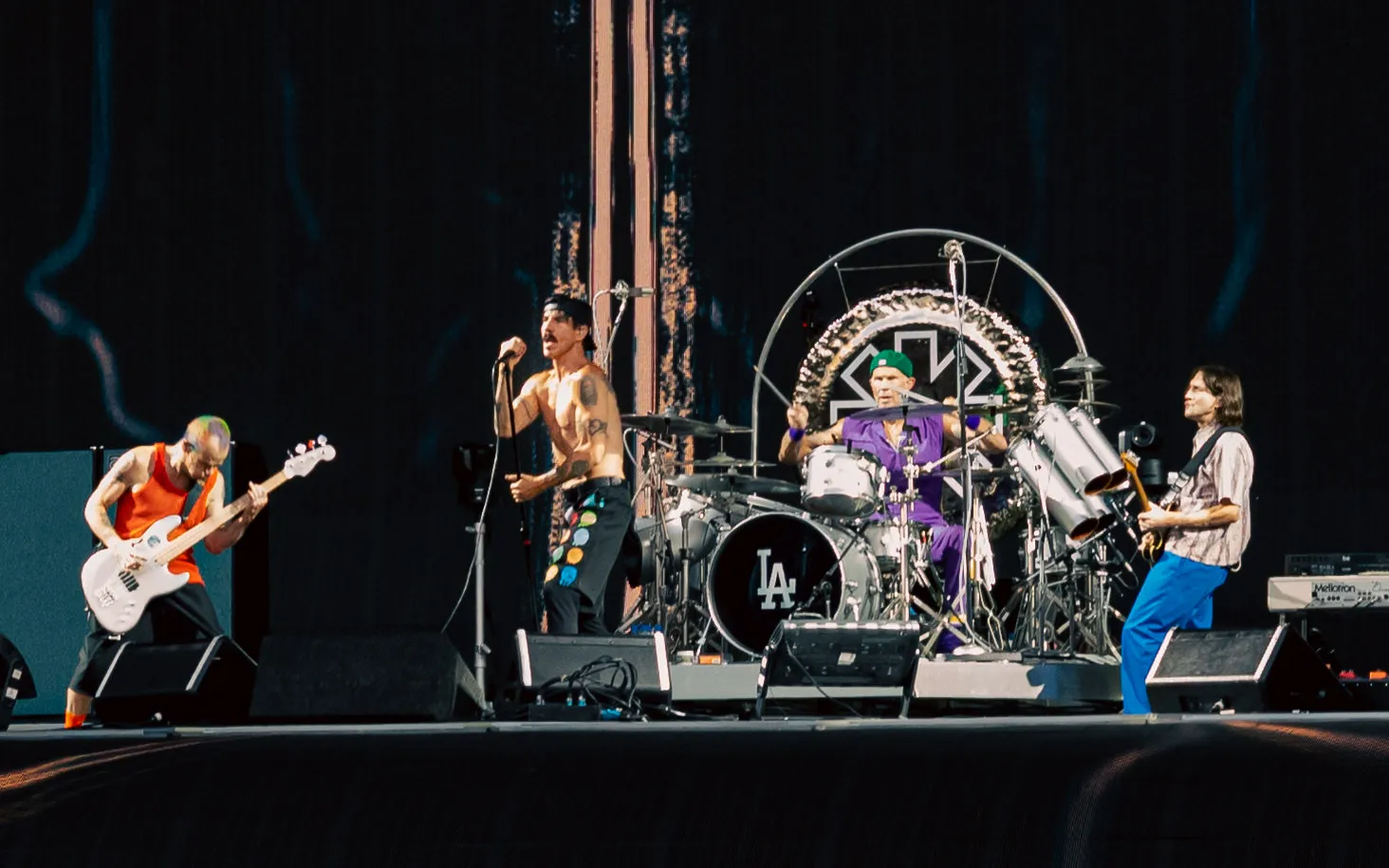
Photo by Kreepin Deth , licensed under CC BY-SA 4.0 · Wikimedia Commons
Rank #32
Red Hot Chili Peppers
L.A. funk-rockers turned long-running alternative rock institution.
From Wikipedia
The Red Hot Chili Peppers are an American rock band formed in Los Angeles in 1982, consisting of Flea (bass), Anthony Kiedis (vocals), Chad Smith (drums), and John Frusciante (guitar). Their music incorporates elements of alternative rock, funk, punk rock, hard rock, hip hop, and psychedelic rock, and has influenced genres including funk metal, rap metal, rap rock, and nu metal. With over 120 million records sold worldwide, the Red Hot Chili Peppers are one of the top-selling bands of all time. They hold the records for most number-one singles on the American Alternative Songs charts (15), most cumulative weeks at number one (91), and most top-ten songs on the Billboard Alternative Songs chart (28). They have won three Grammy Awards, were inducted into the Rock and Roll Hall of Fame in 2012, and in 2022 received a star on the Hollywood Walk of Fame.
Members
- Anthony Kiedis
- Chad Smith
- Dave Navarro
- Flea
- John Frusciante
- Josh Klinghoffer
Deep Dive
Overview
The Red Hot Chili Peppers emerged from Los Angeles in the early 1980s as a funk-rock outfit that would eventually become one of the most commercially successful rock bands in history. Over four decades, they sold more than 120 million records worldwide and fundamentally altered the landscape of alternative rock by grafting funk and rap-metal sensibilities onto guitar-driven rock, a fusion that rippled through the 1990s and beyond. The band’s lineup solidified around Anthony Kiedis (vocals), Flea (bass), John Frusciante (guitar), and Chad Smith (drums)—though the rhythm section remained the most stable core as guitarists rotated. Their influence extends beyond their own catalogue into entire subgenres: funk metal, rap metal, and rap rock all trace ancestry through their innovations.
Formation Story
The Red Hot Chili Peppers coalesced in Los Angeles in 1982, arriving as a response to the city’s fragmented musical landscape where punk, funk, and rap were colliding in underground venues. The founding nucleus drew on the bass-driven grooves of contemporary funk, the speed and attitude of punk, and the emerging hip-hop culture of the era. Los Angeles, with its multicultural neighborhoods and thriving independent music scene, provided both the sonic ingredients and the audience willing to embrace such an unlikely hybrid. The band released their self-titled debut in 1984, a raw, energetic introduction that signaled their intent but would require years of refinement and consistent touring to reach wider ears.
Breakthrough Moment
The Red Hot Chili Peppers’ ascent from cult act to mainstream presence crystallized in 1991 with Blood Sugar Sex Magik, an album that proved the band’s early fusion of funk, rap, and rock could sustain a full-length work of genuine depth and commercial appeal. The record marked a watershed moment: the band had developed the songwriting sophistication and production polish to attract radio playlists while retaining the raw physicality that had built their fanbase in clubs and on underground radio. Blood Sugar Sex Magik established the template that would define their next decade—accessible yet uncompromising funk-rock that refused to choose between danceability and guitar-driven intensity. By the mid-1990s, the Chili Peppers were a guaranteed draw on festival bills and MTV rotation, their position as gatekeepers between alternative rock and the rhythmic innovations of hip-hop culture increasingly secure.
Peak Era
The band’s most creatively fertile and commercially dominant period stretched from 1991 through the early 2000s. Californication (1999) achieved mainstream saturation while By the Way (2002) deepened their craft, and Stadium Arcadium (2006) demonstrated that they could sustain a double album with enough variation and songwriting substance to justify its scope. Throughout this span, John Frusciante’s return to the band as guitarist brought renewed melodic sophistication to their funk-rock template. Chart dominance became routine: the Chili Peppers eventually accumulated 15 number-one singles on the Billboard Alternative Songs chart, 91 cumulative weeks at number one, and 28 top-ten placements on the same chart—records that stand unmatched. This sustained success meant their every release received massive promotional support, sold millions of copies, and shaped the sound of rock radio for an entire generation.
Musical Style
The Red Hot Chili Peppers’ signature sound emerges from Flea’s propulsive, melodic bass playing anchoring grooves rooted in funk and R&B, over which guitarists (whether Frusciante, Dave Navarro, or their predecessors) layered riffs that oscillated between lyrical complexity and punk-derived directness. Anthony Kiedis’s vocal approach ranged from rapid-fire rap-inflected phrasing on uptempo cuts to more conventional melodic singing on ballads, a versatility that let the band stretch across radio formats. Rhythmically, Chad Smith’s drumming combined rock precision with funk syncopation, allowing the band to build grooves that invited motion without abandoning the impact of traditional rock percussion. The instrumentation was never merely decorative: each element served the song, whether through restraint or density. Over their career, production grew cleaner and more layered, moving from the raw immediacy of their debut through increasingly polished studio work, yet the essential funk-rock marriage remained constant. Psychedelic and jazz-fusion influences occasionally surfaced in their more exploratory passages, enriching a base sound that remained fundamentally rooted in groove.
Major Albums
Blood Sugar Sex Magik (1991)
The album that announced the Red Hot Chili Peppers as more than a novelty act, Blood Sugar Sex Magik balanced funk-metal density with genuine songwriting depth, establishing the template that would sustain them for the next two decades and proving the viability of rap-rock fusion to a major-label audience.
Californication (1999)
This album represented the band’s most radio-friendly approach without sacrificing instrumental interplay, becoming a cultural touchstone of the late 1990s and demonstrating their capacity to write arena-sized songs that retained rhythmic sophistication and melodic durability.
By the Way (2002)
A more introspective entry into the Chili Peppers’ catalogue, By the Way showcased John Frusciante’s refined guitar work and a band comfortable enough in their commercial position to explore textural nuance and more complex song structures.
Stadium Arcadium (2006)
The band’s ambitious double album, Stadium Arcadium tested whether they could sustain a 28-track journey without losing focus, mixing funk-rock staples with more experimental passages and affirming their place as a legacy act capable of reinvention.
I’m With You (2011)
Released after a four-year gap and marking a lineup change with Josh Klinghoffer on guitar, I’m With You proved the Red Hot Chili Peppers’ core identity transcended any single member, maintaining groove-oriented songwriting and mainstream appeal.
Unlimited Love (2022)
John Frusciante’s return to the guitar seat after nearly two decades away heralded a artistic refresh, with Unlimited Love receiving critical attention as evidence that the band had regained creative momentum in their fifth decade.
Signature Songs
- Scar Tissue — A stripped-down, introspective number that showcased the softer side of the Chili Peppers’ songwriting, becoming one of their most recognizable tracks across all demographics.
- Give It Away — A funk-rap fusion centerpiece built on Flea’s melodic bass line, defining the band’s early-1990s breakthrough and establishing their reputation for rhythm-first composition.
- Under the Bridge — An introspective meditation on Los Angeles and addiction that became a modern rock staple, proving the band’s capacity for genuine vulnerability alongside technical display.
- Californication — The title track epitomized the band’s ability to write radio-friendly grooves without diluting their funk-rock core, becoming inseparable from the band’s mainstream identity.
- By the Way — A propulsive funk-rock vehicle showcasing how the band could build tension and release through purely instrumental means before the vocal melody arrives.
- Stadium Arcadium — A six-minute epic that validated the band’s ambition during their commercial peak, combining psychedelic texturing with their foundational groove-rock approach.
Influence on Rock
The Red Hot Chili Peppers fundamentally altered the trajectory of rock music by proving that funk and rap elements were not merely novelties layered atop traditional rock but could become primary structural forces. Their success in the 1990s legitimized funk-metal and rap-rock as viable commercial genres, opening radio playlists to bands that might otherwise have been segregated by format. The chart dominance of tracks built on syncopated bass grooves and rap-influenced vocals—territory the Chili Peppers essentially pioneered for mainstream rock audiences—influenced countless acts that followed, from direct imitators to artists who simply absorbed the lesson that rhythmic innovation mattered as much as melodic hooks. Their fusion also served as a bridge between rock and hip-hop audiences at a moment when those worlds were beginning to blur culturally, helping normalize cross-genre pollination in popular music. The band’s model of sustained touring, album cycles, and festival presence established a template for longevity that other acts studied.
Legacy
The Red Hot Chili Peppers’ place in rock music was formalized by their 2012 induction into the Rock and Roll Hall of Fame, an honor reflecting their sales figures, cultural impact, and the durability of their musical innovations. In 2022, nearly four decades after formation, they received a star on the Hollywood Walk of Fame—a recognition that few bands achieve and a marker of their penetration into mainstream consciousness. With over 120 million records sold worldwide, they remain among the top-selling bands of all time, and their songs maintain consistent streaming presence as new listeners encounter tracks that define much of the melodic architecture of 1990s rock radio. Their history includes the revolving-door membership that has sometimes been contentious—most notably John Frusciante’s departure and eventual return—yet this instability never derailed their core commercial momentum. Recent albums such as Unlimited Love (2022) and Return of the Dream Canteen (2022) proved the band remains active and capable of generating major-label support in an era when rock music commands a smaller share of the charts, a testament to their remaining cultural currency.
Fun Facts
- The band’s four-decade career, beginning in 1982 and extending to the present, makes them one of the longest-running rock bands with the same core membership identity.
- John Frusciante’s departure in 1997 was followed by a nearly two-decade absence before his return to the band, marking one of rock music’s more significant reunions.
- Their record of 15 number-one singles on the Alternative Songs chart stands unmatched by any other artist or band, reflecting their dominance of the alternative-rock format during its commercial peak and beyond.
- The band’s Los Angeles origins and consistent residence in Southern California throughout their career has made them cultural ambassadors of the region, with songs like “Under the Bridge” serving as musical postcards of the city.