
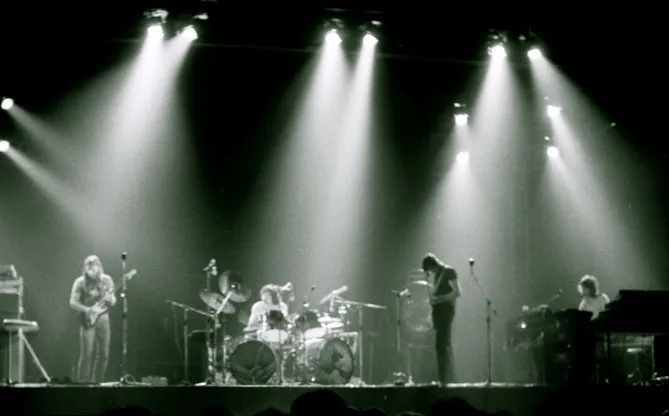
Photo by PinkFloyd1973.jpg : TimDuncan derivative work: Mr. Frank ( talk ) , licensed under CC BY 3.0 · Wikimedia Commons
Rank #4
Pink Floyd
Architects of progressive rock concept albums and immersive live experiences.
From Wikipedia
Pink Floyd are an English rock band formed in London in 1965 by Syd Barrett, Nick Mason (drums), Roger Waters and Richard Wright, with David Gilmour joining at the end of 1967. Gaining an early underground following as one of the first British psychedelic groups, they were distinguished by their extended compositions, sonic experiments, philosophical lyrics, and elaborate live performances, becoming a leading progressive rock band.
Members
- Bob Klose (1964–1965)
- Roger Waters (1965–1985)
- Syd Barrett (1965–1968)
- David Gilmour (1967–2014)
- Richard Wright (1985–2014)
Deep Dive
Overview
Pink Floyd stands as one of rock’s most architecturally ambitious and sonically innovative bands. Formed in London in 1965, they emerged from the British psychedelic underground and evolved into the primary architects of progressive rock’s concept album tradition. Their work synthesized extended instrumental compositions, philosophical and often abstract lyrics, ambitious studio production techniques, and theatrical live performances into a unified artistic vision that redefined what a rock band could attempt. By the 1970s and 1980s, they had become one of the most commercially successful and culturally influential rock acts, their albums functioning as complete artistic statements rather than collections of singles.
Formation Story
Pink Floyd coalesced in London in 1964–1965 around bassist and vocalist Roger Waters, keyboardist Richard Wright, and drummer Nick Mason. Syd Barrett, a guitarist and vocalist, joined the group in 1965, completing the classic early lineup that would record their first two albums. The band’s name, derived from two blues musicians, signaled their roots in American blues while their early repertoire drew from contemporary psychedelic and experimental rock emerging in Britain during the mid-1960s. The addition of guitarist David Gilmour in late 1967 marked a pivotal shift, coinciding with compositional and stylistic changes that would move the band away from Barrett’s more conventionally structured songs toward longer, more exploratory works.
Breakthrough Moment
Pink Floyd’s early success came through their association with London’s underground psychedelic scene and the influential UFO Club, where they became known for extended improvisations and sonic experimentation. However, their sustained commercial breakthrough occurred with the 1973 release of The Dark Side of the Moon, an album that transcended the band’s existing audience and achieved mainstream popularity. The album’s unified thematic architecture—exploring themes of mental illness, mortality, and existential anxiety—combined with its accessible yet sophisticated production, established Pink Floyd as major international artists. The success of The Dark Side of the Moon validated their approach to concept albums and demonstrated that extended, philosophically ambitious rock music could achieve both critical and commercial success.
Peak Era
The period from 1973 to 1979 represented Pink Floyd’s most creatively productive and commercially dominant span. During this five-year window, they released The Dark Side of the Moon (1973), Wish You Were Here (1975), Animals (1977), and The Wall (1979)—four consecutive albums that defined the possibilities of progressive rock concept albums. Each represented a distinct artistic statement while maintaining the band’s core aesthetic of extended compositions, layered production, and thematic cohesion. The Wall in particular achieved massive commercial success, functioning simultaneously as a double album, a film, and a touring stage production, cementing Pink Floyd’s status as more than a conventional rock band but rather a total artistic enterprise.
Musical Style
Pink Floyd’s sound evolved significantly across their career, yet certain characteristics remained consistent. In their earliest phase, with Syd Barrett as primary composer, they synthesized blues rock foundations with psychedelic production techniques—heavily treated guitars, backward recordings, and studio experimentation unusual for rock music in 1967. Following Gilmour’s arrival, the band developed a more spacious, architecturally organized approach to composition. Richard Wright’s keyboard work—ranging from delicate piano passages to dense synthesizer layers—provided textural variety and harmonic sophistication. Roger Waters’ bass playing favored melodic, almost guitar-like lines rather than traditional rhythm section function. Nick Mason’s drumming typically anchored the music without dominating, allowing the band’s other elements to develop. By the 1970s, their sound incorporated elements of space rock and experimental art rock, with lengthy instrumental passages, dramatic dynamic shifts, and production techniques that treated the recording studio itself as an instrument. Synthesizers became increasingly central to their arrangements, and their lyrics moved from psychedelic imagery toward more abstract, philosophical, and often darkly thematic material.
Major Albums
The Piper at the Gates of Dawn (1967)
Pink Floyd’s debut album introduced their emerging psychedelic approach to rock composition. Featuring both Syd Barrett’s more conventionally structured pop-influenced songs and extended instrumental explorations, the album established the band’s willingness to experiment with studio production and songwriting form. Despite its brevity compared to their later work, it introduced the sonic adventurousness that would characterize their career.
The Dark Side of the Moon (1973)
Perhaps rock’s most celebrated concept album, The Dark Side of the Moon presented a unified thematic exploration presented across a seamless suite of compositions. The album’s commercial and critical success validated progressive rock’s artistic ambitions and transformed Pink Floyd into international superstars. Its influence on the concept album form proved immense, establishing templates that subsequent artists would both emulate and respond to.
Wish You Were Here (1975)
This album functioned as a meditation on absence and loss, partly inspired by former member Syd Barrett’s departure and decline. Its title track became one of rock’s most recognizable compositions, while the album maintained the band’s commitment to extended, architecturally complex arrangements. The album demonstrated Pink Floyd’s ability to balance accessibility with artistic sophistication.
The Wall (1979)
The Wall represented Pink Floyd’s most ambitious undertaking—a double album organized around a narrative concept exploring psychological isolation and social alienation. Its success extended beyond music into visual performance, with the construction of an actual wall during concert presentations. The album’s cultural impact indicated Pink Floyd’s position not merely as a recording act but as a complete artistic enterprise.
Signature Songs
While Pink Floyd favored extended compositions over singles, certain pieces became particularly identified with the band. The title track from Wish You Were Here achieved widespread recognition through its accessible melody and emotional directness. The Dark Side of the Moon’s individual movements, particularly “Time” and “Brain Damage,” became frequently performed selections. The Wall’s “Comfortably Numb” emerged as perhaps their most famous composition, balancing memorable melodic content with David Gilmour’s distinctive guitar work.
Influence on Rock
Pink Floyd’s influence fundamentally reshaped progressive rock and concept album traditions. By demonstrating that extended, thematically unified albums could achieve both commercial success and artistic credibility, they opened possibilities for subsequent prog rock bands. Their integration of elaborate production techniques, philosophical lyrics, and visual presentation established standards for ambitious rock music. Bands across multiple genres—from progressive metal to alternative rock—trace lineage through Pink Floyd’s innovations in album architecture and studio experimentation. Their work legitimized rock music as a medium for extended artistic statements rather than merely songs arranged for radio play.
Legacy
Pink Floyd’s cultural impact extended far beyond the 1970s and 1980s. Their albums maintained continuous commercial availability and streams, with successive generations discovering their work. The Dark Side of the Moon in particular achieved a remarkably enduring presence in popular culture, referenced and parodied across decades. The band continued recording and performing into the 2010s, with 2014’s The Endless River representing their final studio album. Their elaborate touring productions influenced rock concert presentation, establishing the template for large-scale theatrical rock shows. Pink Floyd’s association with both musical sophistication and existential themes established them as more than entertainment act but as cultural commentators whose work engaged serious ideas through extended artistic form.
Fun Facts
- Syd Barrett’s departure in 1968 marked one of rock’s most significant early examples of a principal songwriter leaving an established band, setting a precedent for numerous subsequent rock defections and fragmentations.
- The band’s use of the studio itself as an instrument—employing techniques like the Mellotron, treated vocals, and elaborate multitrack arrangements—positioned them among electronic music’s early serious practitioners, predating electronic rock’s widespread adoption.
- The Wall’s live performances required construction of an actual physical wall during concerts, making Pink Floyd one of the first rock bands to incorporate substantial stagecraft elements into their presentations, influencing subsequent rock spectacle.
- Richard Wright remained with Pink Floyd from 1965 through 1985, then rejoined in 1987 for A Momentary Lapse of Reason, making him the band’s longest-serving consistent member across their entire active period.