
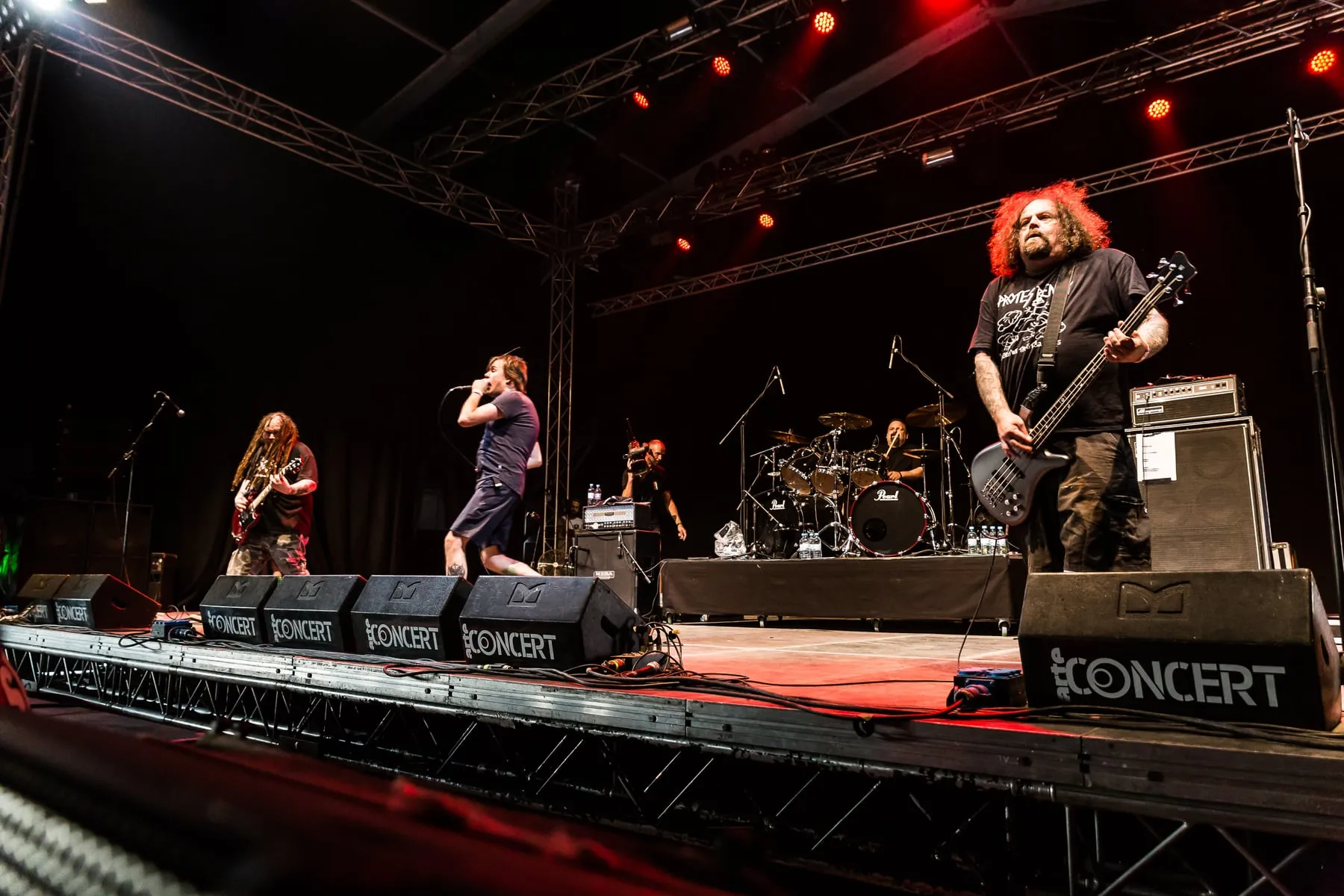
Photo by S. Bollmann , licensed under Attribution · Wikimedia Commons
Rank #256
Napalm Death
Birmingham grindcore originators whose blast beats redefined extremity.
From Wikipedia
Napalm Death are an English grindcore band formed in Meriden, West Midlands, in 1981. The band currently consists of Barney Greenway on vocals, Shane Embury on bass guitar, John Cooke on lead guitar and Danny Herrera on drums. None of the founding band members remain in the band. From 1989 to 2004, Napalm Death were a five-piece band after they added Jesse Pintado and Mitch Harris as replacements for guitarist Bill Steer. Following Pintado's departure, the band reverted to a four-piece. Mitch Harris left the band in 2014 to focus on his personal life. Since Mitch's indefinite hiatus, guitarist John Cooke can be seen on guitar during live shows.
Members
- Barney Greenway
- Danny Herrera
- Mitch Harris
- Shane Embury
Deep Dive
Overview
Napalm Death are an English grindcore band that emerged from Meriden in the West Midlands in 1981 and fundamentally altered the landscape of extreme metal. Formed at the intersection of hardcore punk’s raw aggression and death metal’s sonic brutality, Napalm Death pioneered the grindcore genre—a style defined by blast beats played at punishing speeds, heavily distorted bass, guttural or shrieked vocals, and song lengths measured in seconds rather than minutes. Their influence extends far beyond their native UK; they established template and terminology that would define extreme metal for decades to come.
Formation Story
Napalm Death came together in 1981 in the West Midlands industrial belt, where the punk and metal underground intersected with particular intensity. The early lineup drew from the region’s thriving DIY scene, blending the anarchic energy of hardcore punk with the technological extremity that metal musicians were beginning to explore. The band’s name itself—adopted early in their existence—signaled their artistic intention: to weaponize sound as a critique of political and social decay. From their inception, Napalm Death operated outside mainstream commercial expectations, building an audience through independent labels and an underground network of tape traders, fanzines, and word-of-mouth.
Breakthrough Moment
Napalm Death’s debut album Scum arrived in 1987 on the independent Earache Records label and immediately announced the arrival of a radically new sound. The record’s hyper-compressed production, featuring drums played with inhuman speed and precision, and vocals that ranged from barked shouts to deep growls, made Scum a watershed moment in underground metal. Its follow-up, From Enslavement to Obliteration (1988), reinforced their emerging dominance of the grindcore niche and drew wider attention from metal journalists and musicians worldwide. By the end of the 1980s, Napalm Death had become the defining band of their genre, referenced by peers and followers as the reference point for extremity in metal.
Peak Era
The 1990s represented Napalm Death’s most creatively ambitious and commercially successful period. With the addition of Jesse Pintado and Mitch Harris as replacement guitarists in 1989, the band shifted from a three-piece to a five-piece formation, adding textural and structural complexity to their sound. Harmony Corruption (1990) demonstrated a band broadening its palette while maintaining its core identity, followed by Utopia Banished (1992), Fear, Emptiness, Despair (1994), and Diatribes (1995). This stretch of four albums across five years saw Napalm Death at their creative peak, balancing accessibility with uncompromising extremity. By the mid-1990s, they had achieved a rare feat for a grindcore band: widespread recognition within metal circles and occasional exposure in mainstream music media, all without diluting their artistic vision.
Musical Style
Grindcore, as defined and executed by Napalm Death, fuses the raw aesthetics of 1980s British hardcore punk with the distortion, aggression, and technical precision of emergent death metal. The genre’s signature element—the blast beat, an extremely fast, continuous double-bass drum pattern combined with high-hat cymbals struck at equal speed—became Napalm Death’s calling card. Drummer Danny Herrera’s relentless precision on the kit provided the rhythmic foundation upon which bassist Shane Embury constructed heavily distorted, often syncopated bass lines that frequently operated independently of the drums. Guitarist work, particularly following the arrival of Harris and Pintado, ranged from tremolo-picked passages to angular, dissonant chords, frequently delivered at tempos that made the instrument itself seem to strain against its physical limitations. Vocalist Barney Greenway, who joined during the band’s later evolution, brought a distinctive roar and clarity of delivery that elevated grindcore vocals beyond mere noise, making lyrics audible and impactful. Song structures remained intentionally fragmented, with compositions often shifting abruptly between sections, rarely exceeding three minutes and frequently shorter, creating an aesthetic of controlled chaos.
Major Albums
Scum (1987)
Napalm Death’s debut remains the foundational grindcore document, establishing the blast-beat methodology and lo-fi aesthetic that would define the genre’s emergence. Its unpolished production paradoxically enhanced its impact, making the music feel urgent and unmediated.
From Enslavement to Obliteration (1988)
The follow-up consolidated Scum’s innovations while introducing greater variation in songwriting and vocal delivery, signaling a band already evolving beyond their debut’s shock value.
Harmony Corruption (1990)
Marking the band’s transition to five-piece status, this album balanced grindcore’s raw extremity with increased songwriting sophistication, featuring layered guitar work and more developed song structures without sacrificing intensity.
Fear, Emptiness, Despair (1994)
Released during their peak commercial moment, this album demonstrated Napalm Death’s ability to craft compelling, complex compositions within the grindcore framework, with production clarity that preserved the genre’s claustrophobic power.
Inside the Torn Apart (1997)
A marker of continued creative restlessness, this release saw the band further refining their approach, introducing tempo variations and song pacing that demonstrated grindcore’s capacity for dynamic range.
Enemy of the Music Business (2000)
Entering the new millennium, Napalm Death maintained their uncompromising vision while exploring increased melodic and structural possibilities, proving the genre’s longevity beyond novelty status.
Signature Songs
- “You Suffer” — A 1.3-second blast of fury that became grindcore’s most famous moment, redefining listener expectations for song length.
- “Siege Mentality” — A showcase for the band’s ability to combine visceral aggression with discernible songwriting beneath the extremity.
- “Suffer the Children” — Demonstrating the band’s knack for pairing socially conscious lyrics with unrelenting musical assault.
- “Mind the Gap” — A mid-period track exemplifying how Napalm Death evolved beyond pure speed into compositional sophistication.
Influence on Rock
Napalm Death’s impact on extreme music extends far beyond grindcore proper. Their demonstration that extreme speed, distortion, and unconventional song structures could serve artistic and political expression rather than mere technical display influenced generations of musicians across metal subgenres and into noise rock and industrial music. Countless death metal, black metal, and metalcore bands incorporated blast-beat methodology directly inherited from Napalm Death’s template. Beyond metal, their ethos of sonic extremity as political statement resonated with industrial and experimental musicians exploring similar thematic territory. The band proved that underground, uncompromising art could achieve recognition without major-label backing, fundamentally shaping how independent extreme music developed from the 1990s onward.
Legacy
Though no founding members remain in Napalm Death’s current lineup, the band’s creative lineage remains intact through continuous output and touring. The stability of core members Barney Greenway, Shane Embury, and Danny Herrera from the 1990s onward provided long-term continuity, with albums continuing into the 2020s—including 2025’s Savage Imperial Death March. Napalm Death’s ability to remain creatively active and musically relevant across four decades distinguishes them among extreme metal acts. Their consistent presence on festival bills and their influence on contemporary extreme music scenes worldwide testifies to their enduring significance. Archives and retrospectives regularly identify Scum and From Enslavement to Obliteration as foundational documents in metal history, while their continued recording and touring presence ensures that Napalm Death remain a reference point rather than a historical artifact.
Fun Facts
- Napalm Death’s second album, From Enslavement to Obliteration, was recorded and released within twelve months of their debut, demonstrating remarkable prolific output during their early years.
- The band experienced a complete membership overhaul by the early 1990s, with none of the founding members remaining by the time of their artistic and commercial peak, yet maintained creative continuity through this radical transition.
- Following Jesse Pintado’s departure, Napalm Death reverted to a four-piece configuration, proving the band’s flexibility in adapting personnel changes without abandoning their core sound.
- Mitch Harris left the band in 2014 after more than two decades to focus on his personal life, a departure handled with minimal public acrimony—relatively unusual in metal circles where lineup changes frequently generate controversy.