
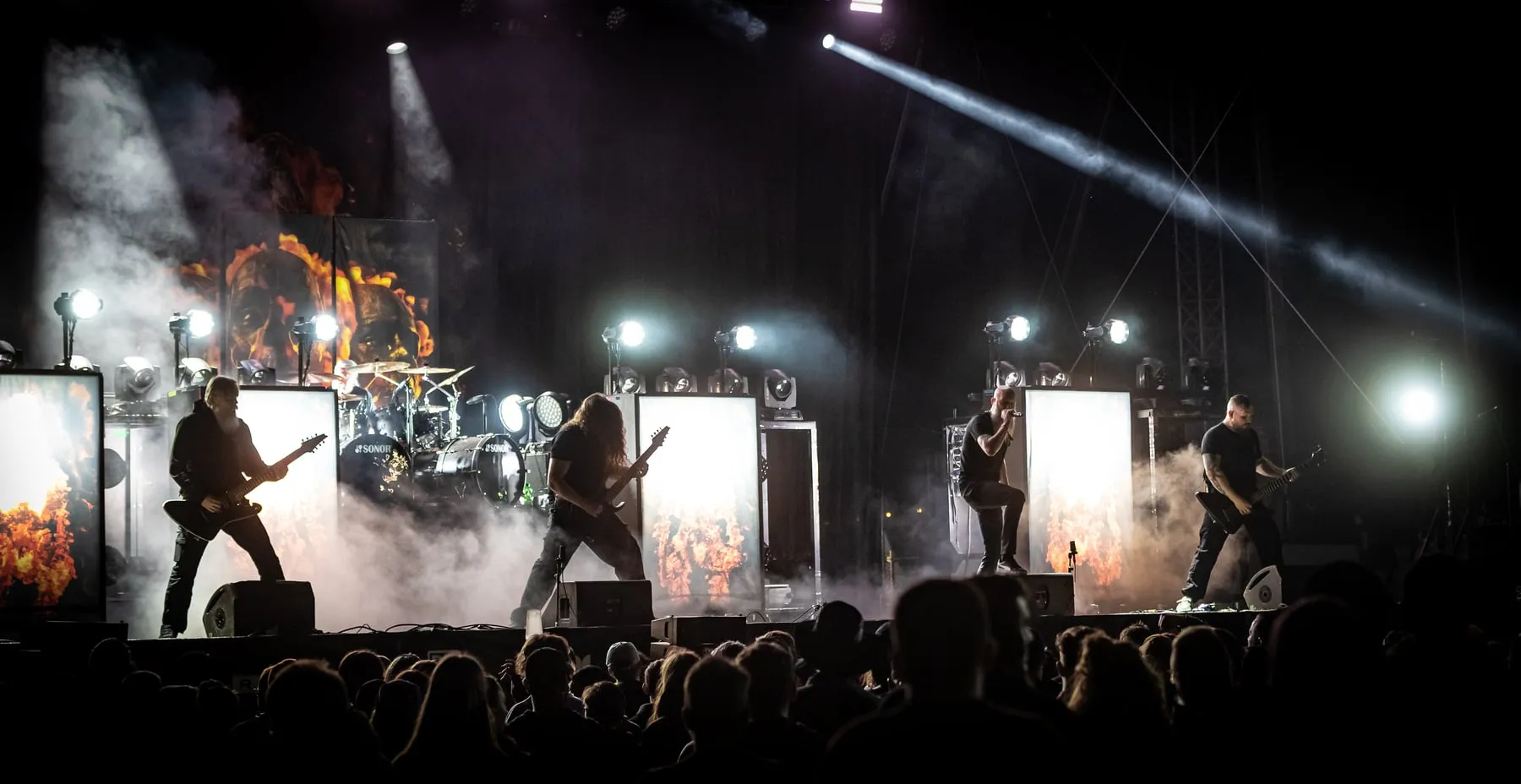
Photo by Andreas Lawen, andreas.lawen@wikipedia.de , licensed under CC0 · Wikimedia Commons
Rank #176
Meshuggah
Umeå polyrhythm masters whose sound spawned djent.
From Wikipedia
Meshuggah is a Swedish extreme metal band formed in Umeå in 1987. Since 2004, the band's lineup consists of founding members Jens Kidman and Fredrik Thordendal, alongside rhythm guitarist Mårten Hagström, drummer Tomas Haake and bassist Dick Lövgren. Since its formation, the band has released nine studio albums, six EPs and eight music videos. Their latest studio album, Immutable, was released in April 2022 via Atomic Fire Records.
Members
- Jens Kidman
Studio Albums
- 1991 Contradictions Collapse
- 1995 Destroy Erase Improve
- 1998 Chaosphere
- 2002 Nothing
- 2005 Catch Thirtythree
- 2008 obZen
- 2012 Koloss
- 2016 The Violent Sleep of Reason
- 2022 Immutable
Source: MusicBrainz
Deep Dive
Overview
Messuggah is a Swedish extreme metal band formed in Umeå in 1987, operating continuously for over three decades as one of the most architecturally complex and uncompromising acts in heavy music. The band occupies a singular position in rock and metal history: they did not follow the djent trend but instead created the foundational sound from which it emerged. Meshuggah’s primary contribution to metal lies in their systematic deconstruction of rhythm itself—layering polyrhythmic guitar patterns, irregular time signatures, and mathematical precision into compositions that sound both organic and alien.
Formation Story
Messuggah crystallized in Umeå, a city in northern Sweden with limited exposure to major metal infrastructure, in 1987. Founding member Jens Kidman provided vocals from the outset, establishing the band’s core identity. The band began performing and recording in relative isolation from metal’s major commercial centers, which allowed them to develop a sound entirely their own rather than in direct competition with already-established trends. This geographic and commercial distance proved liberating: the members could experiment with rhythmic concepts and instrumental complexity without pressure to conform to prevailing thrash or death metal templates.
Breakthrough Moment
Messuggah’s early studio work—particularly Destroy Erase Improve (1995) and Chaosphere (1998)—demonstrated a band committed to technical rigor and harmonic dissonance. However, it was Nothing (2002) that positioned them as architects of a genuinely new sonic language. Released when nu-metal and metalcore were fragmenting into multiple substyles, Nothing presented a complete alternative: songs built on interlocking polyrhythms, tuned-down guitars functioning as percussion instruments, and Kidman’s vocals cutting through with dispassionate intensity. The album’s complexity and the band’s uncompromising aesthetic began attracting musicians and listeners worldwide who felt alienated by mainstream metal’s accessibility.
Peak Era
Messuggah entered their most influential creative period from 2005 onward, beginning with Catch Thirtythree and continuing through obZen (2008), Koloss (2012), and The Violent Sleep of Reason (2016). These albums refined and expanded their polyrhythmic vocabulary without sacrificing density or conviction. obZen, in particular, reached listeners well beyond traditional metal audiences, generating significant critical attention and establishing Meshuggah as unavoidable reference points in discussions of metal’s technical and conceptual frontiers. The band’s touring schedule intensified during this span, transforming their reputation from cult innovators into influential figures shaping metal’s direction in real time.
Musical Style
Messuggah’s sound rests on the interaction of multiple rhythmic layers functioning simultaneously and often in conflict. Fredrik Thordendal and Mårten Hagström deploy heavily distorted guitars tuned far below standard pitch, using palm-muted riffing and precisely articulated note sequences that function more like rhythmic scaffolding than traditional melody. Drummer Tomas Haake executes intricate patterns that frequently dissociate from the guitars’ perceived downbeat, creating the sensation of controlled chaos. Bassist Dick Lövgren anchors arrangements while adding harmonic and rhythmic depth. Kidman’s vocals occupy space as another rhythmic layer rather than serving traditional melodic functions. The overall effect is avant-garde metal—compositions structured with mathematical precision yet producing an unsettling, organic physicality when performed. This approach drew influence from progressive metal’s compositional ambitions while rejecting melody-driven songwriting in favor of texture and rhythmic displacement.
Major Albums
Destroy Erase Improve (1995)
Their second full-length demonstrated the band’s commitment to complex rhythmic frameworks and marked a significant leap in technical execution and songwriting maturity from their debut.
Chaosphere (1998)
Building on the polyrhythmic foundations of Destroy Erase Improve, this album introduced increasingly dissonant harmonic movement and reinforced Meshuggah’s status as metal’s leading rhythmic innovators.
Nothing (2002)
A watershed moment that synthesized their previous experimentation into a cohesive artistic vision, Nothing reached audiences beyond underground metal circles and established the sonic template that would influence a generation of musicians.
obZen (2008)
Releasing at the moment when djent was crystallizing as a recognizable subgenre, obZen represented Meshuggah’s most widely recognized work, balancing accessibility with uncompromising rhythmic and harmonic complexity.
The Violent Sleep of Reason (2016)
Demonstrating continued artistic growth after over a decade of influence, this album proved Meshuggah remained creatively vital and unwilling to rest on established formulas.
Signature Songs
- Bleed — An unrelenting exercise in polyrhythmic brutality, structured around a single detuned riff that operates in deliberate conflict with the drums.
- New Millennium Cyanide Christ — A towering composition that showcases the band’s capacity to sustain rhythmic tension across extended passages without traditional chorus structures.
- Dancers to the Dark — Demonstrates Meshuggah’s ability to extract visceral impact from mathematical precision and dissonant harmonic movement.
- Rational Gaze — A signature exploration of the band’s signature approach to converting rhythm into compositional foundation.
Influence on Rock
Messuggah did not invent djent—the subgenre emerged from multiple sources—but they created the essential architectural blueprint. Their approach to polyrhythmic composition, extended-range tuning, and the use of distorted guitars as rhythmic instruments rather than melodic carriers defined djent’s aesthetic core. Bands including Periphery, TesseracT, and Animals as Leaders built on foundations Meshuggah established. Beyond djent’s confines, Meshuggah influenced progressive metal, mathcore, and avant-garde metal more broadly, proving that extreme complexity and commercial irrelevance were not inevitable bedfellows. Musicians across metal and experimental rock adopted their techniques—polyrhythmic layering, unconventional time signatures, and the conception of timbre as a compositional parameter—as standard approaches rather than esoteric experiments.
Legacy
Messuggah’s relevance has only deepened since the early 2000s. Their nine studio albums remain in continuous circulation, with streaming platforms introducing their catalog to listeners born long after their formation. The band continued touring extensively and released Immutable in April 2022 via Atomic Fire Records, confirming their status as an active creative force rather than a heritage act. Their influence on metal’s technical and compositional approaches remains pervasive: any discussion of metal’s mathematical, polyrhythmic, or avant-garde directions necessarily references Meshuggah’s foundational contributions. The band’s refusal to compromise their artistic vision—maintaining a consistent lineup since 2004 consisting of Jens Kidman, Fredrik Thordendal, Mårten Hagström, Tomas Haake, and Dick Lövgren—reinforced their credibility and allowed for deep artistic evolution across decades.
Fun Facts
- Meshuggah emerged from Umeå, a relatively small Swedish city far from major metal infrastructure, which allowed them to develop their distinctive polyrhythmic approach outside direct competition with established metal scenes.
- The band’s consistent touring and recording despite minimal mainstream commercial success established them as uncompromising artists willing to build influence through merit and persistence rather than radio-friendly adaptation.
- Their 2004 lineup solidification has remained unbroken for two decades, an unusual stability among experimental and technically demanding metal bands.
Discography & Previews
Click any album to expand its track list. Each track plays a 30-second preview streamed from Apple Music. Tap the link icon next to a track to open it in Apple Music for full playback.

- 1 Paralyzing Ignorance ↗ 4:27
- 2 Erroneous Manipulation ↗ 6:20
- 3 Abnegating Cecity ↗ 6:28
- 4 Internal Evidence ↗ 7:26
- 5 Qualms of Reality ↗ 7:02
- 6 We'll Never See the Day ↗ 6:02
- 7 Greed ↗ 7:05
- 8 Choirs of Devastation ↗ 3:59
- 9 Cadeverous Mastication ↗ 7:29
- 10 Humiliative ↗ 5:17
- 11 Sickening ↗ 5:46
- 12 Ritual ↗ 6:16
- 13 Gods of Rapture ↗ 5:09

- 1 Future Breed Machine ↗ 5:49
- 2 Beneath ↗ 5:38
- 3 Soul Burn ↗ 5:18
- 4 Transfixion ↗ 3:34
- 5 Vanished ↗ 5:05
- 6 Acrid Placidity ↗ 3:16
- 7 Inside What's Within Behind ↗ 4:31
- 8 Terminal Illusions ↗ 3:47
- 9 Suffer in Truth ↗ 4:20
- 10 Sublevels ↗ 5:14
- 11 Vanished (Demo) ↗ 5:34
- 12 Suffer in Truth (Demo) ↗ 4:27
- 13 Inside What's Within Behind (Demo) ↗ 4:11
- 14 Gods of Rapture (Live) ↗ 4:54
- 15 Aztec Two-Step ↗ 10:44


- 1 Broken Cog ↗ 5:35
- 2 The Abysmal Eye ↗ 4:56
- 3 Light the Shortening Fuse ↗ 4:28
- 4 Phantoms ↗ 4:54
- 5 Ligature Marks ↗ 5:13
- 6 God He Sees in Mirrors ↗ 5:28
- 7 They Move Below ↗ 9:36
- 8 Kaleidoscope ↗ 4:07
- 9 Black Cathedral ↗ 2:01
- 10 I Am That Thirst ↗ 4:40
- 11 The Faultless ↗ 4:48
- 12 Armies of the Preposterous ↗ 5:16
- 13 Past Tense ↗ 5:46