
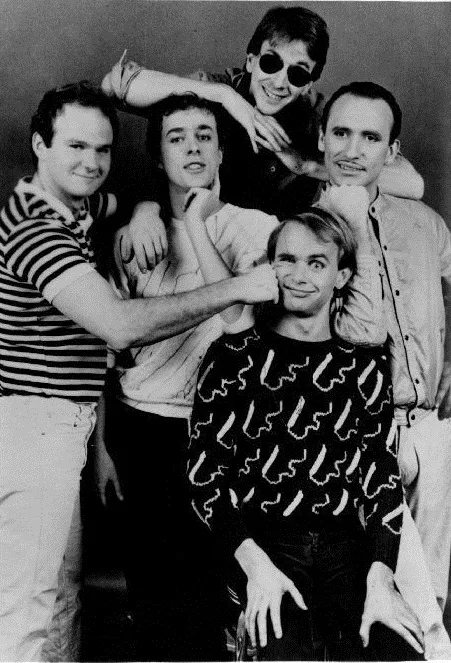
Photo by MTV , licensed under Public domain · Wikimedia Commons
Rank #318
Men at Work
Melbourne band whose 'Down Under' became Australia's unofficial anthem.
From Wikipedia
Men at Work are an Australian rock band formed in Melbourne in 1979. They were best known for breakthrough hits such as "Down Under", "Who Can It Be Now?", "Be Good Johnny", "Overkill", "It's a Mistake", and "High Wire". Its founding member and frontman is Colin Hay, who performs on lead vocals and guitar. After playing as an acoustic duo with Ron Strykert from 1978 to 1979, Hay formed the group with Strykert playing bass guitar with Jerry Speiser on drums. They were soon joined by Greg Ham on flute, saxophone and keyboards, and John Rees on bass guitar, with Strykert switching back to lead guitar. The group was managed by Russell Depeller, a friend of Hay, whom he met at La Trobe University. This line-up achieved national and international success during the early to mid-1980s.
Members
- Colin Hay
Studio Albums
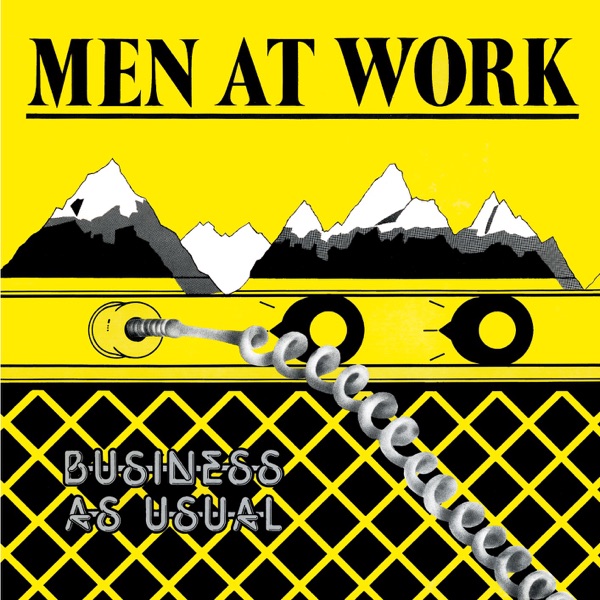
- 1981 Business As Usual
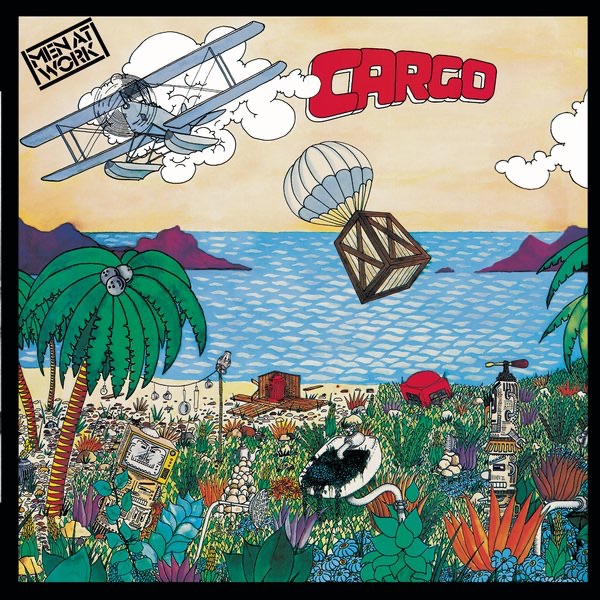
- 1983 Cargo
- 1985 Two Hearts
Source: MusicBrainz
Deep Dive
Overview
Men at Work are an Australian rock band that emerged from Melbourne in the late 1970s and achieved rapid international prominence in the early 1980s. Built around the songwriting and vocal talents of Colin Hay, the band blended new wave sensibilities with pop-rock accessibility and rhythmic experimentation, producing a string of commercially successful singles that defined the sound of early-1980s radio. Their debut album, Business As Usual, introduced “Down Under” to the world—a song that became Australia’s most recognizable musical export and remains embedded in global popular culture.
Formation Story
Colin Hay and Ron Strykert began performing together as an acoustic duo in 1978, developing their songwriting and musical partnership before expanding their sound. The two musicians attended La Trobe University in Melbourne, where they met Russell Depeller, who would become the band’s manager. By 1979, Hay and Strykert had assembled a full band, bringing in drummer Jerry Speier to anchor the rhythm section. This three-piece core was completed by the addition of Greg Ham on flute, saxophone, and keyboards, and John Rees on bass guitar. With Strykert shifting to lead guitar, the lineup was finalized—a configuration that would carry the band through their most creatively fertile years. The band drew on the energy of the broader new wave movement while maintaining a distinctly Australian sensibility informed by pop, rock, and rhythmic experimentation.
Breakthrough Moment
Men at Work’s rise to prominence came with remarkable speed following the 1981 release of Business As Usual. The album became a commercial juggernaut, driven by the single “Down Under,” which combined whistled melodies, flute lines from Ham, and Hay’s wry vocal delivery over an infectious reggae-influenced groove. The song’s narrative wit—sketching a collision between Australian and American cultural attitudes—resonated globally, and by 1982 the track had become one of the year’s dominant radio hits. “Who Can It Be Now?” followed as another breakthrough single, introducing even more listeners to the band’s precise production aesthetic and ear for melody. Business As Usual climbed to number one on the Australian charts and achieved substantial chart performance internationally, establishing Men at Work as serious contenders on the global pop-rock landscape at a moment when synthesizer-driven new wave and radio-friendly rock were at peak commercial prominence.
Peak Era
The band’s peak commercial and creative period spanned the early to mid-1980s, encompassing the release and touring cycle of Business As Usual through the follow-up album Cargo in 1983. During these years, Men at Work maintained regular presence on mainstream radio and MTV, capitalizing on the success of their debut with singles including “Be Good Johnny,” “Overkill,” “It’s a Mistake,” and “High Wire.” The band’s ability to craft hook-laden songs with memorable choruses and distinct instrumental voices—particularly Ham’s interweaving of wind and keyboard parts—kept them visible in the marketplace even as new wave’s broader cultural moment began to shift. By the mid-1980s, however, the band’s commercial momentum had begun to wane, culminating in the release of Two Hearts in 1985 before the group dissolved in 1986. The window in which Men at Work commanded mainstream attention was therefore concentrated but intense, producing a catalog of enduring pop-rock touchstones.
Musical Style
Men at Work occupied a distinctive niche within the early-1980s pop-rock and new wave landscape, blending new wave’s emphasis on precise production and melodic hooks with pop sensibilities and reggae rhythmic influences. The band’s signature sound relied heavily on Greg Ham’s multi-instrumental contributions—his flute and saxophone lines provided textural and melodic complexity that distinguished their arrangements from synthesizer-dominated new wave competitors. Colin Hay’s vocal approach was marked by conversational phrasing and occasional ironic detachment, often delivered over rhythmic grooves that drew as much from reggae and world music as from conventional rock patterns. The production aesthetic was clean and carefully detailed, with each instrumental element clearly audible within the mix; this clarity allowed the band’s compositional craft and arranging ingenuity to register fully on radio and record. Jerry Speier’s drumming provided propulsive, syncopated foundations that emphasized rhythmic sophistication over the straight-ahead rock patterns of classic rock or the programmed aesthetics of pure synthesizer pop.
Major Albums
Business As Usual (1981)
The band’s debut stands as their definitive artistic and commercial statement, establishing the template that would carry them through their initial success. The album’s production clarity, melodic invention, and instrumental sophistication made it a radio staple, with multiple charting singles and a listening experience that rewarded repeated exposure.
Cargo (1983)
The follow-up demonstrated that Men at Work could sustain their early momentum, delivering another collection of precisely crafted pop-rock songs with strong commercial appeal. Cargo consolidated the band’s place as more than a one-album phenomenon, producing additional chart success and establishing their touring credentials.
Two Hearts (1985)
The band’s final studio album arrived as their commercial fortunes had begun to decline, yet it remained a continuation of their established songwriting approach and production values. Two Hearts represented the group’s last opportunity to define themselves in the marketplace before their dissolution.
Signature Songs
- “Down Under” — The definitive Men at Work track and Australia’s most globally recognized popular song of the era, built on a reggae-inflected groove and whistled melody.
- “Who Can It Be Now?” — A propulsive new wave-inflected single showcasing the band’s gift for rhythm-driven hooks and conversational vocal delivery.
- “It’s a Mistake” — A radio staple that exemplified the band’s ability to combine intricate production with immediate melodic appeal.
- “Be Good Johnny” — A song demonstrating the band’s narrative storytelling and instrumental sophistication.
- “Overkill” — A track that showcased the band’s emphasis on precise arrangement and rhythmic nuance.
- “High Wire” — A later single that maintained the band’s pop-rock formula during their later period.
Influence on Rock
Men at Work’s influence operated primarily at the level of pop-rock production and cross-genre synthesis rather than as direct progenitors of major movements. Their willingness to incorporate reggae rhythms, world music textures, and instrumental color into commercially accessible new wave frameworks demonstrated one viable path through early-1980s pop-rock, offering an alternative to both the synthesizer dominance of bands like Duran Duran and the guitar-driven approach of contemporaries in the new wave and post-punk spaces. The band’s international success, particularly the global dominance of “Down Under,” helped establish that Australian rock could achieve massive worldwide exposure—a template that subsequent Australian rock and pop acts would navigate and often define themselves against.
Legacy
Men at Work’s cultural and musical legacy remains firmly anchored to the early 1980s, a period from which their music has proven remarkably durable in terms of radio play, streaming presence, and cultural memory. “Down Under” in particular achieved status as Australia’s unofficial musical anthem, appearing in documentaries, sporting events, and cultural celebrations in ways that few pop songs of any era accomplish. The band’s dissolution in 1986 ended their initial run before they could navigate the stylistic shifts of the mid-to-late 1980s, leaving their discography as a pristine artifact of a specific moment in pop-rock history. The official band website and ongoing streaming presence of their catalog have maintained their accessibility to successive generations discovering early-1980s pop, ensuring that while Men at Work have not spawned major musical descendants or influenced rock’s primary lineages, they remain recognizable touchstones of the period they helped define.
Fun Facts
- Russell Depeller, the band’s manager, was introduced to Colin Hay through their mutual attendance at La Trobe University in Melbourne, establishing a connection between the band’s formation and their specific geographic and educational origins.
- Greg Ham’s multi-instrumental proficiency—shifting between flute, saxophone, and keyboards within individual songs—gave Men at Work a textural complexity uncommon among purely guitar-based or synthesizer-dependent bands of the new wave era.
- The band’s rapid rise from regional Australian act to global commercial presence occurred within approximately two years of Business As Usual’s release, one of the swifter trajectories of 1980s pop-rock.
- Men at Work recorded during the height of MTV’s influence and the music video’s emergence as a primary promotional tool, with their videos receiving significant rotation during the early years of the channel’s operation.
Discography & Previews
Click any album to expand its track list. Each track plays a 30-second preview streamed from Apple Music. Tap the link icon next to a track to open it in Apple Music for full playback.
- 1 Dr. Heckyll & Mr. Jive ↗ 4:45
- 2 Overkill ↗ 3:49
- 3 Settle Down My Boy ↗ 4:10
- 4 Upstairs In My House ↗ 4:07
- 5 No Sign of Yesterday ↗ 6:34
- 6 It's a Mistake ↗ 4:47
- 7 High Wire ↗ 3:04
- 8 Blue for You ↗ 3:56
- 9 I Like To ↗ 4:03
- 10 No Restrictions ↗ 4:35
- 11 Shintaro (Non LP B-Side) ↗ 2:53
- 12 Till the Money Runs Out (Non LP B-Side) ↗ 3:06
- 13 Upstairs At My House (Live) ↗ 3:14
- 14 Fallin' Down (Live) [Non LP B-Side] ↗ 7:56
- 15 The Longest Night (Live) [Previously Unreleased] ↗ 4:04
