
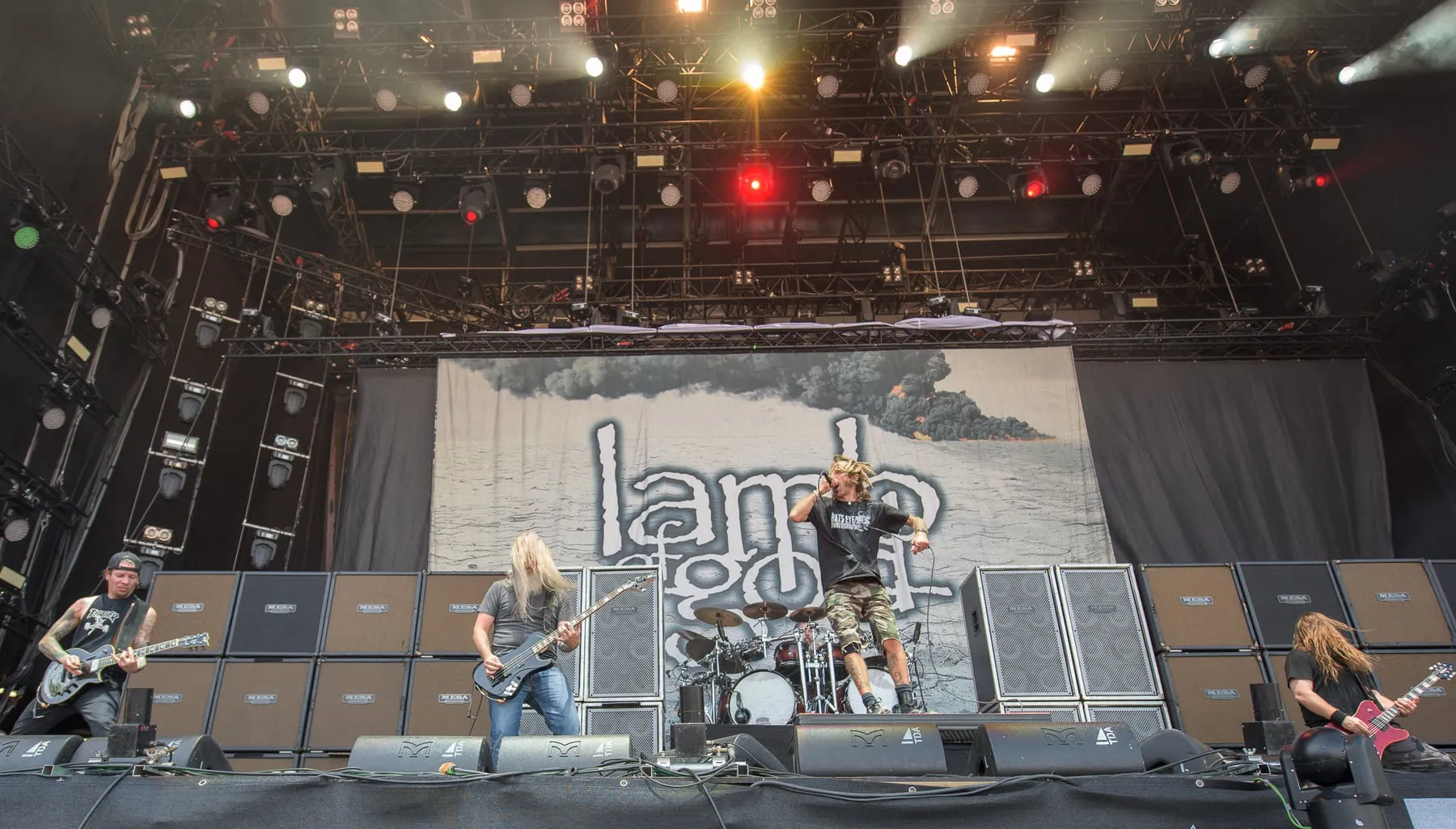
Photo by Stefan Brending ( 2eight ) , licensed under CC BY-SA 3.0 · Wikimedia Commons
Rank #174
Lamb of God
Richmond groove-metal heavyweights who carry post-Pantera weight forward.
From Wikipedia
Lamb of God is an American heavy metal band from Richmond, Virginia. Formed in 1994 as Burn the Priest, the group consists of bassist John Campbell, vocalist Randy Blythe, guitarists Mark Morton and Willie Adler, and drummer Art Cruz. The band is considered a significant member of the new wave of American heavy metal movement.
Members
- Randy Blythe
Studio Albums
- 2000 New American Gospel
- 2003 As the Palaces Burn
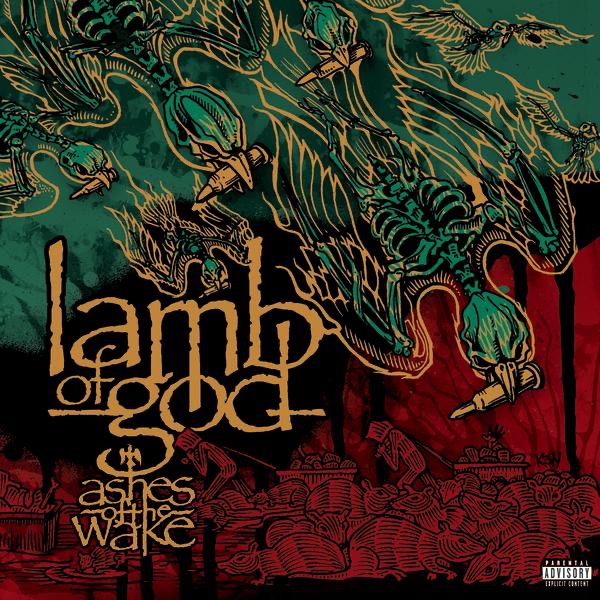
- 2004 Ashes of the Wake
- 2006 Sacrament
- 2009 Wrath
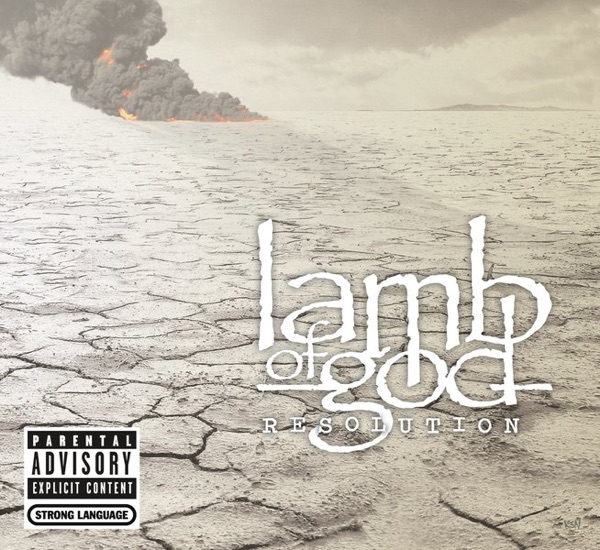
- 2012 Resolution
- 2015 VII: Sturm und Drang
- 2020 Lamb of God
- 2022 Omens
- 2026 Into Oblivion
Source: MusicBrainz
Deep Dive
Overview
Lamb of God is an American heavy metal band from Richmond, Virginia, formed in 1994 under the name Burn the Priest. The group—consisting of bassist John Campbell, vocalist Randy Blythe, guitarists Mark Morton and Willie Adler, and drummer Art Cruz—has established itself as a cornerstone of the new wave of American heavy metal movement. Operating primarily within groove metal and metalcore frameworks, Lamb of God bridges the post-Pantera heaviness of the 1990s with the structural and vocal intensity of 2000s metalcore, occupying a singular space between generations of hard rock aggression.
Formation Story
Lamb of God took shape in Richmond, Virginia, in 1994, initially operating under the moniker Burn the Priest. The band’s early years were rooted in Richmond’s local metal scene, a region that had fostered diverse heavy music since the preceding decade. By the time they would adopt the Lamb of God name and enter their recording phase, the lineup solidified around the core unit that would define their sound: Randy Blythe’s uncompromising vocal delivery, the dual-guitar architecture of Mark Morton and Willie Adler, John Campbell’s foundational bass work, and the rhythm section anchoring the composition. Richmond’s position as a serious metal hub—neither a coastal megacity nor a secondary market—shaped the band’s independent streak and direct connection to grassroots touring.
Breakthrough Moment
Lamb of God’s first studio album, New American Gospel, arrived in 2000 and marked their entrance into the recorded metal landscape. The record demonstrated a synthesis of groove-oriented riffing and metalcore vocal aggression that stood apart from the post-grunge malaise and rap-rock trends dominating mainstream rock radio at the turn of the decade. Within the metal underground and among fans of heavier music, New American Gospel signaled the arrival of a band with both the songwriting precision and raw conviction to build a lasting discography. The album’s reception within metal circles established Lamb of God as more than a local fixture, beginning the process of touring and word-of-mouth momentum that would accelerate through the 2000s.
Peak Era
The period from 2003 to 2009—spanning As the Palaces Burn (2003), Ashes of the Wake (2004), Sacrament (2006), and Wrath (2009)—represented Lamb of God’s most commercially and creatively concentrated run. During these six years, the band refined its formula of mid-to-high-tempo grooves underpinned by driving double bass drums, heavy riffage alternating between harmonic complexity and pure impact, and Blythe’s vocals ranging from barked rhythmic declamation to extended distorted screams. Each record demonstrated incremental evolution: Ashes of the Wake deepened the metalcore integration, Sacrament expanded sonic scope, and Wrath consolidated the band’s technical confidence without sacrificing visceral power. The band’s touring schedule during this period—festivals, arena support slots, and extended headlining runs—cemented their status within the new wave of American heavy metal as reliable delivery mechanisms for uncompromising metal in an era when the category faced commercial contraction.
Musical Style
Lamb of God’s sound anchors itself in groove metal’s syncopated riffing and rhythmic emphasis while incorporating metalcore’s structural and vocal techniques. The twin guitars of Morton and Adler typically operate in a hierarchy: one voice carries a primary melodic or rhythmic motif while the other adds harmonic weight or counter-rhythmic layering, creating density without redundancy. Blythe’s vocal approach—primarily screamed or harshly sung rather than melodically pitched—functions as a textural and emotional instrument, his delivery reinforcing the songs’ propulsive force rather than carrying traditional melody lines. Lyrically, the band has typically addressed themes of personal struggle, disillusionment, and social observation without didactic preaching. The production aesthetic across their records favors clarity and punch: drums are articulate and present, bass lines are audible as independent compositional elements (a departure from some metal subgenres where bass merely doubling kick drums), and guitars occupy a wide stereo field. This approach allows the rhythmic precision—essential to groove metal’s appeal—to remain legible even in moments of maximum heaviness.
Major Albums
New American Gospel (2000)
Lamb of God’s debut showcased their foundational sound: groove-oriented riffing married to metalcore vocal intensity, establishing the template they would refine across two subsequent decades. The record’s reception within the underground metal community proved vital to the band’s initial momentum.
As the Palaces Burn (2003)
This album deepened the integration of metalcore aesthetics—faster, more syncopated sections and expanded vocal range—while maintaining the groove-metal backbone, representing a creative step forward in songwriting complexity.
Ashes of the Wake (2004)
Released one year after Palaces, this record demonstrated the band’s ability to sequence a complete statement, balancing accessibility with uncompromising heaviness across a coherent album arc.
Sacrament (2006)
A landmark record that showcased Lamb of God’s evolving production approach and increased sonic ambition, further establishing their credentials as a major force within heavy metal at a moment when the genre faced limited mainstream radio presence.
Wrath (2009)
Capturing the band at peak technical precision and creative confidence, Wrath synthesized their preceding catalogue into a statement of singular heaviness and rhythmic sophistication.
Resolution (2012)
Following a creative consolidation, Resolution marked an era transition, exploring evolved songwriting approaches while maintaining the band’s core gravitational pull toward explosive rhythm and vocal intensity.
Signature Songs
- “Ruin” — A signature track exemplifying the band’s fusion of melodic sensibility and overwhelming heaviness, Blythe’s vocal performance delivers both rhythmic and emotional impact.
- “Palaces” — The title piece from As the Palaces Burn, demonstrating the band’s ability to construct narrative arc within metal frameworks.
- “Contractor” — Showcasing the band’s groove-metal foundation and their skill at building tension through rhythmic syncopation and dynamic contrast.
- “In Your Words” — A composition displaying the band’s range within heaviness, balancing aggressive sections with moments of relative restraint to maximize impact.
Influence on Rock
Lamb of God’s longevity and touring ethic positioned them as a bridge figure between post-Pantera groove metal and modern metalcore aesthetics during a period when heavy music faced fragmentation and commercial uncertainty. By demonstrating that uncompromising metal could sustain a career through direct engagement with regional touring, festival presence, and consistent output, they influenced a generation of metalcore and heavy metal bands emerging in the 2000s. Their refusal to moderate their aesthetic for mainstream acceptability—a stance echoed in their lyrical directness—contributed to a broader metal culture that validated artistic integrity over chart positioning. The band’s model of sustained medium-level success through underground community building and touring became a template for metal acts navigating a fragmented music industry.
Legacy
Lamb of God’s active status since 1994—spanning three decades through the 2020s—places them among the enduring figures of American heavy metal. Their discography across ten studio albums demonstrates both consistency and willingness to evolve, with releases continuing into the mid-2020s including Omens (2022) and the forthcoming Into Oblivion (2026). Within the new wave of American heavy metal movement, they maintain a position of credibility and relevance, their touring schedule and festival appearances indicating sustained cultural presence. The band’s association with the Richmond metal scene contributed to elevating that region’s profile within broader heavy music communities, attracting touring acts and fan attention to a geographical center that, while not a traditional coastal megacity, established itself through serious artistic commitment.
Fun Facts
- The band’s original name, Burn the Priest, was abandoned in favor of Lamb of God prior to wider recording distribution, repositioning the group’s identity for broader recognition.
- Lamb of God has maintained remarkable lineup stability across most of their career, with core members remaining consistent through multiple decades of touring and recording.
- Richmond, Virginia’s metal community benefited significantly from Lamb of God’s success and touring presence, the band functioning as a cultural ambassador for their home region within broader heavy music networks.
- The band’s association with multiple record labels—including Epic Records, Nuclear Blast, and Legion Records—reflects both their commercial scaling and strategic repositioning across different segments of the metal industry.
Discography & Previews
Click any album to expand its track list. Each track plays a 30-second preview streamed from Apple Music. Tap the link icon next to a track to open it in Apple Music for full playback.

- 1 Black Label ↗ 4:52
- 2 A Warning ↗ 2:24
- 3 In the Absence of the Sacred ↗ 4:37
- 4 Letter to the Unborn ↗ 2:57
- 5 The Black Dahlia ↗ 3:20
- 6 Terror and Hubris In the House of Frank Pollard ↗ 5:38
- 7 The Subtle Arts of Murder and Persuasion ↗ 4:10
- 8 Pariah ↗ 4:25
- 9 Confessional ↗ 4:02
- 10 O.D.H.G.A.B.F.E. ↗ 5:14
- 11 Nippon (Japanese Release Track) ↗ 3:54
- 12 New Willenium ("The Black Dahlia" Demo Version) ↗ 3:05
- 13 Half-Lid ("A Warning" Demo Version) ↗ 2:27
- 14 Flux ("Pariah" Demo Version) ↗ 4:24


- 1 Walk with Me In Hell ↗ 5:11
- 2 Again We Rise ↗ 4:30
- 3 Redneck ↗ 3:41
- 4 Pathetic ↗ 4:31
- 5 Foot to the Throat ↗ 3:14
- 6 Descending ↗ 3:35
- 7 Blacken the Cursed Sun ↗ 5:28
- 8 Forgotten (Lost Angels) ↗ 3:06
- 9 Requiem ↗ 4:11
- 10 More Time to Kill ↗ 3:37
- 11 Beating On Death's Door ↗ 5:07
- 12 Walk with Me In Hell (Live at House of Vans, Chicago, IL - February 2020) ↗ 5:21
- 13 Descending (Live at House of Vans, Chicago, IL - February 2020) ↗ 3:49
- 14 Redneck (Live at House of Vans, Chicago, IL - February 2020) ↗ 4:50

- 1 The Passing ↗ 1:58
- 2 In Your Words ↗ 5:25
- 3 Set to Fail ↗ 3:46
- 4 Contractor ↗ 3:22
- 5 Fake Messiah ↗ 4:33
- 6 Grace ↗ 3:55
- 7 Broken Hands ↗ 3:53
- 8 Dead Seeds ↗ 3:41
- 9 Everything to Nothing ↗ 3:50
- 10 Choke Sermon ↗ 3:21
- 11 Reclamation ↗ 7:06
- 12 Now You've Got Something to Die For (European Festivals) [Live] ↗ 3:42
- 1 Straight for the Sun ↗ 2:27
- 2 Desolation ↗ 3:54
- 3 Ghost Walking ↗ 4:31
- 4 Guilty ↗ 3:24
- 5 The Undertow ↗ 4:47
- 6 The Number Six ↗ 5:22
- 7 Barbarosa ↗ 1:36
- 8 Invictus ↗ 4:13
- 9 Cheated ↗ 2:36
- 10 Insurrection ↗ 4:51
- 11 Terminally Unique ↗ 4:21
- 12 To the End ↗ 3:49
- 13 Visitation ↗ 3:59
- 14 King Me ↗ 6:37
- 15 Digital Sands ↗ 4:02
- 16 Vigil (Live) ↗ 5:38


