
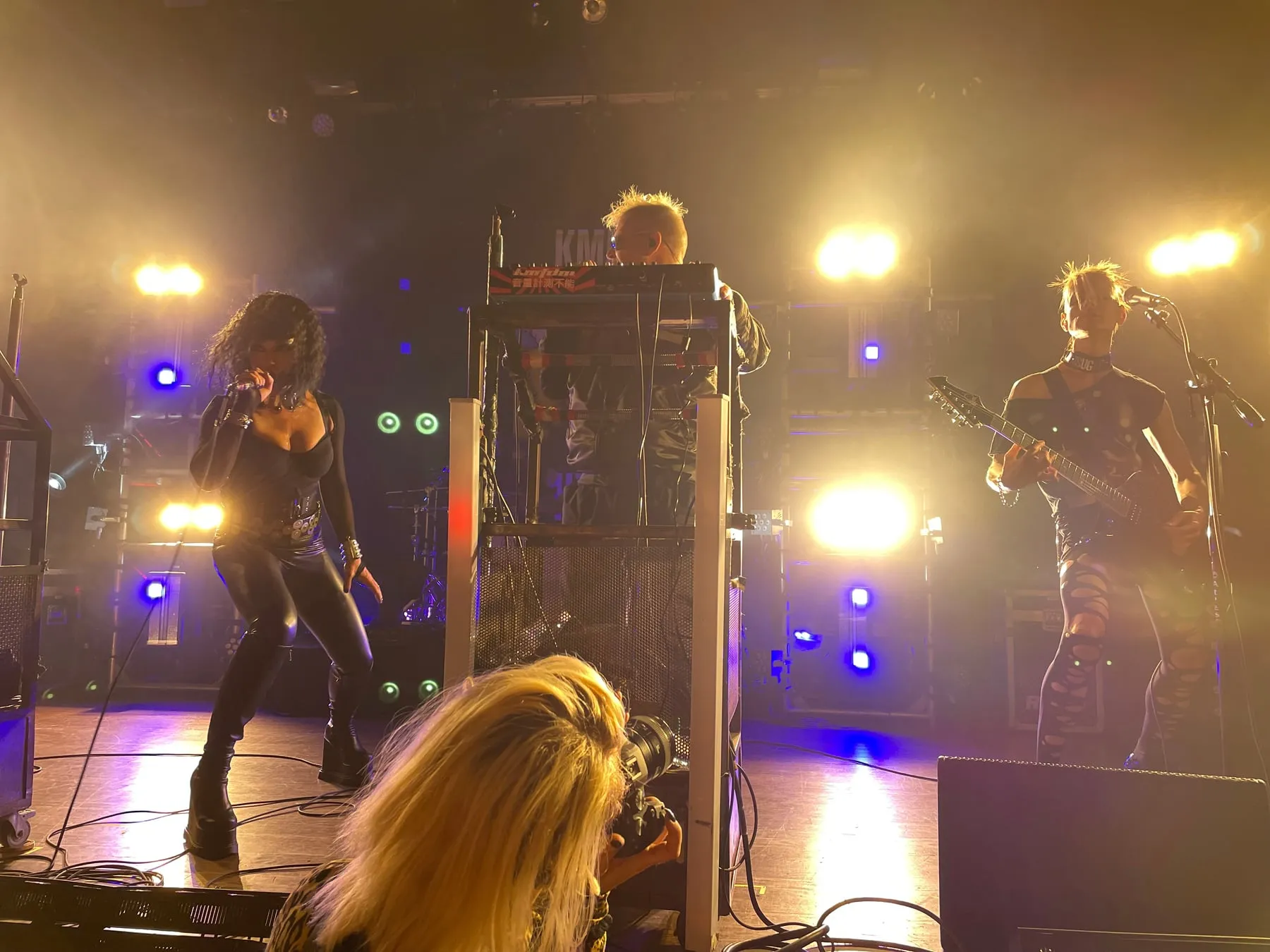
Photo by ARMcgrath , licensed under CC BY-SA 4.0 · Wikimedia Commons
Rank #195
KMFDM
Hamburg-Chicago industrial provocateurs of relentless output.
From Wikipedia
KMFDM is a multinational industrial rock band from Hamburg led by Sascha Konietzko, who founded the band in 1984 as a performance art project.
Members
- Andy Selway
- Bill Rieflin
- En Esch
- Günter Schulz
- Jules Hodgson
- Lucia Cifarelli
- Mark Durante
- Raymond Watts
- Sascha Konietzko
- Steve White
- Tim Skold
Studio Albums
- 1984 Opium
- 1986 What Do You Know, Deutschland?
- 1988 Don’t Blow Your Top
- 1989 UAIOE
- 1990 Naïve
- 1992 Money
- 1993 Angst
- 1995 Nihil
- 1996 Xtort
- 1997 [symbols]
- 1999 Adios
- 2002 Attak
- 2003 WWIII
- 2005 Hau Ruck
- 2007 Tohuvabohu
- 2009 Blitz
- 2009 Skold vs. KMFDM
- 2011 WTF?!
- 2013 Kunst
- 2014 Our Time Will Come
- 2017 Hell Yeah
- 2018 Hamburg 1984
- 2019 Paradise
- 2020 Apart
- 2022 Hyëna
- 2024 Let Go
- 2026 ENEMY
Source: MusicBrainz
Deep Dive
Overview
KMFDM is a multinational industrial rock band founded in Hamburg in 1984 by Sascha Konietzko as a performance art project. Spanning four decades with output that rarely pauses, KMFDM emerged from the post-punk and industrial ferment of the 1980s and became one of the most prolific and visually provocative acts in the industrial metal underground. Their music combines electronics, aggressive guitar work, and rhythmic intensity in service of confrontational themes and imagery, positioning them at the intersection of Einsturzende Neubauten-influenced European industrial experimentation and American heavy metal physicality.
Formation Story
Sascha Konietzko established KMFDM in Hamburg in 1984 initially as a conceptual and performance-based project, reflecting the experimental ethos of the city’s post-punk and art-rock scenes. The project’s early incarnation, captured on the debut album Opium (1984), revealed a band interested in wedding noise-based electronic textures to rhythmic frameworks borrowed from both industrial and dance music. Over the following years, the core membership shifted and expanded as Konietzko recruited collaborators including En Esch, whose vocal presence would become integral to the band’s identity. By the late 1980s, the ensemble had solidified enough to establish a recognizable approach: synth-driven arrangements layered with distorted guitars, mechanical percussion, and vocals that ranged from melodic to harsh and declamatory.
Breakthrough Moment
KMFDM’s profile expanded significantly with the 1990 album Naïve, which reached a wider industrial audience in North America. The band’s commitment to constant touring and recording, supported by relationships with independent labels such as Wax Trax! Records, built a loyal following throughout the 1990s. The 1993 album Angst and 1995’s Nihil solidified their standing as one of the most visually and sonically uncompromising acts in industrial rock, with Nihil in particular gaining recognition for its dense, layered production and sustained intensity. Their relentless release schedule—often multiple albums per year—set KMFDM apart from peers and cemented a reputation for output that prioritized creative momentum over extended periods between records.
Peak Era
The 1995–2000 period represented KMFDM’s most commercially visible and artistically ambitious phase in the industrial rock mainstream. Nihil (1995), Xtort (1996), the experimentally titled [symbols] (1997), and Adios (1999) showcased the band’s increasing comfort with both electronic sophistication and raw sonic aggression. During this era, KMFDM cultivated a visual aesthetic as extreme as their sound—provocative imagery and conceptual album presentations became hallmarks. The band’s willingness to tour extensively and engage with the industrial rock audience through live performance established them as a reliable circuit draw, maintaining relevance through MTV-hostile content and uncompromising artistic direction.
Musical Style
KMFDM’s sound is rooted in the collision between European industrial experimentalism and American heavy metal physicality. The band’s instrumentation typically pairs synthesizers and drum machines with distorted guitars and bass, creating a texture that is simultaneously cold and visceral. Sascha Konietzko’s production approach favors dense layering and the integration of found sound and vocal samples alongside traditional song structures. En Esch and later vocalists including Raymond Watts contribute voices that range from deadpan spoken-word delivery to aggressive shouts, avoiding the operatic extremes of some metal contemporaries in favor of an almost deadened affect that heightens the music’s mechanical qualities. The rhythm section emphasizes mechanical precision—drum machines and programmed percussion dominate rather than serving as a supplement—while guitar work functions more as textural pressure and tonal coloration than as lead melodic voice. This approach places KMFDM closer to bands like Einsturzende Neubauten and Throbbing Gristle than to conventional metal structures, though the sheer volume and aggression tap into a metal sensibility.
Major Albums
Naïve (1990)
Marked KMFDM’s entry into broader industrial consciousness, with a tighter production and clearer song structures than previous work, establishing the band’s signature approach of layered electronics and harsh vocals.
Nihil (1995)
A landmark of 1990s industrial rock, Nihil consolidated the band’s aesthetic with lush yet aggressive production, thematic cohesion, and songwriting that balanced accessibility with uncompromising content and presentation.
Xtort (1996)
Released in the aftermath of Nihil’s success, Xtort demonstrated KMFDM’s refusal to rest on momentum, pushing further into experimental territory while maintaining the band’s core sonic identity.
Attak (2002)
A return to unfiltered industrial intensity after several albums, Attak reaffirmed KMFDM’s commitment to provocative content and relentless sonic assault without concession to mainstream taste.
Hell Yeah (2017)
One of the band’s strongest releases in the 2010s, Hell Yeah balanced the accumulated experience of three decades with reinvigorated energy and contemporary production clarity.
Signature Songs
- “A Drug Against War” — An anti-war statement that became one of KMFDM’s most recognizable tracks, exemplifying the band’s lyrical directness and mechanical-yet-menacing production.
- “Godlike” — A showcase for the band’s ability to construct hook-oriented industrial songs without sacrificing their core aesthetic or message.
- “Peace Sells… But Who’s Buying?” — A cover that underscored KMFDM’s willingness to recontextualize heavy metal material through their industrial lens.
- “Never Trust a Golden God” — Demonstrates the band’s skill at marrying intricate electronic arrangements with direct, confrontational vocals.
- “Death Machines” — A thematic centerpiece reflecting the band’s interest in mechanization, dehumanization, and technological anxiety.
Influence on Rock
KMFDM’s four-decade run has positioned them as influential figures in the industrial rock underground, demonstrating that commercially unviable aesthetic choices and relentless output could sustain a career outside mainstream rock structures. Their approach to drum machines, synth layers, and distorted guitars became a template for subsequent industrial metal acts. The band’s visual and conceptual provocations—never backing away from controversial imagery or themes—established a model for industrial rock as a space for political and social critique, albeit often muddled or deliberately ambiguous. Bands emerging from the industrial and electronic metal scenes of the 2000s and 2010s, including post-industrial and electronic-leaning heavy acts, inherited both KMFDM’s sonic vocabulary and their commitment to uncompromising artistic vision regardless of commercial consequence.
Legacy
KMFDM’s legacy rests primarily on longevity and consistency rather than mainstream breakthrough. Their insistence on continuous recording and touring—a schedule that would exhaust most acts by the 2000s—has maintained their presence in the industrial rock ecosystem without diminishing their catalogue or reputation. The band’s refusal to soften their approach for broader audiences, combined with their intellectual investment in provocation as artistic method, has secured them a place in the history of post-punk and industrial music as uncompromising provocateurs. Streaming platforms and digital distribution have extended their reach beyond the physical record market of earlier decades, allowing newer audiences to discover their deep catalogue. As of 2024, with the recent album Let Go and a forthcoming 2026 release ENEMY, KMFDM continues the pattern of regular output established in 1984.
Fun Facts
- KMFDM’s name is an acronym that Sascha Konietzko has allowed to remain deliberately mysterious, resisting attempts to assign it a fixed meaning and thus maintaining an air of conceptual provocation.
- The band’s international membership—drawing members from the United States, United Kingdom, and continental Europe—reflects the borderless nature of the industrial rock underground and Konietzko’s commitment to collaboration across geographical lines.
- KMFDM released multiple albums in single calendar years on several occasions (notably 2009, with both Blitz and the collaborative Skold vs. KMFDM), maintaining a release pace that rivals many prolific genres outside rock music.
- The band’s relationship with Wax Trax! Records, a legendary independent label, placed them alongside Nine Inch Nails, Ministry, and Skinny Puppy in a shared ecosystem that defined 1990s industrial rock in North America.
Discography & Previews
Click any album to expand its track list. Each track plays a 30-second preview streamed from Apple Music. Tap the link icon next to a track to open it in Apple Music for full playback.


- 1 Welcome ↗ 0:17
- 2 Naive ↗ 5:24
- 3 Die Now, Live Later ↗ 5:01
- 4 Piggybank ↗ 6:36
- 5 Achtung! ↗ 4:17
- 6 Friede ↗ 4:38
- 7 Liebesleid (Edit) ↗ 4:58
- 8 Go to Hell ↗ 4:58
- 9 Virus (Dub) ↗ 6:25
- 10 Disgust (Live) ↗ 2:53
- 11 Godlike (Chicago Trax Version) ↗ 3:19
- 12 Go to Hell (F**k MTV Mix) ↗ 5:46
- 13 Virus (Pestilence Mix) ↗ 5:08
- 14 Godlike (Doglike Mix) ↗ 5:39
- 15 Liebesleid (Infringement Mix) ↗ 4:38
- 16 Die Now, Live Later (Born Again Mix) ↗ 4:42

- 1 Money ↗ 5:30
- 2 Vogue ↗ 4:07
- 3 Help Us, Save Us, Take Us Away ↗ 6:03
- 4 Bargeld ↗ 7:15
- 5 Spiritual House ↗ 5:23
- 6 Sex On the Flag (Jezebeelzebuttfunk Mix) [Jezebeelzebuttfunk Mix] ↗ 4:25
- 7 I Will Pray ↗ 6:01
- 8 We Must Awaken ↗ 5:02
- 9 Under Satan (Dub) ↗ 4:14
- 10 Vogue (2000) ↗ 3:00
- 11 Money (Deutschmark Mix) [Deutschmark Mix] ↗ 3:40


- 1 HELL YEAH ↗ 5:06
- 2 FREAK FLAG ↗ 4:50
- 3 OPPRESSION 1 / 2 ↗ 0:42
- 4 TOTAL STATE MACHINE ↗ 4:24
- 5 OPPRESSION 2 / 2 ↗ 0:31
- 6 MURDER MY HEART ↗ 4:28
- 7 RIP THE SYSTEM V. 2.0 ↗ 4:50
- 8 SHOCK ↗ 4:34
- 9 FAKE NEWS ↗ 4:20
- 10 Rx 4 THE DAMNED ↗ 3:41
- 11 BURNING BRAIN ↗ 4:41
- 12 ONLY LOVERS ↗ 4:02
- 13 GLAM, GLITZ, GUTS & GORE ↗ 5:03


