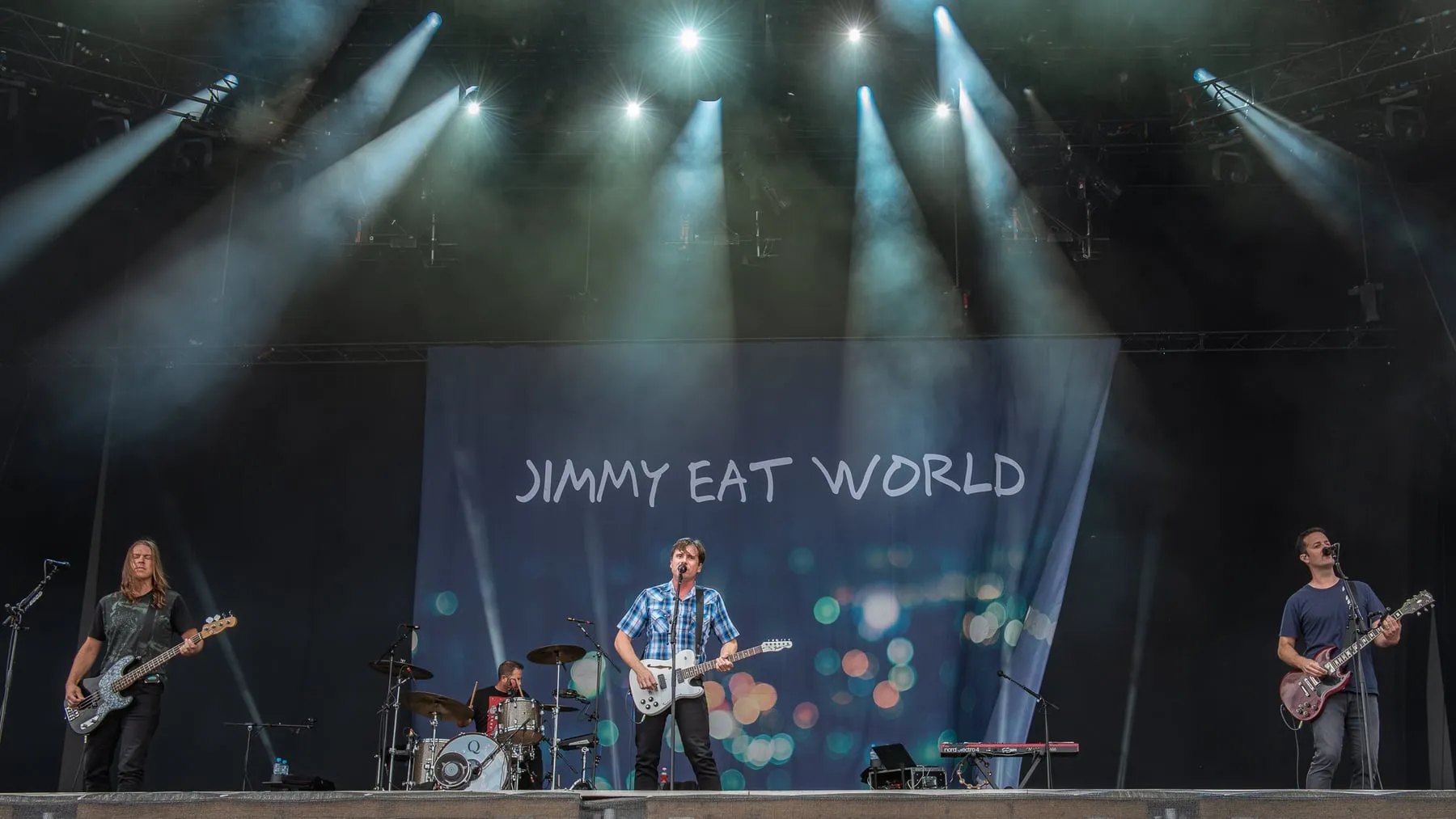
Photo by Stefan Brending ( 2eight ) , licensed under CC BY-SA 4.0 · Wikimedia Commons
Rank #157
Jimmy Eat World
Mesa, Arizona band whose 'Bleed American' became emo's mainstream entry.
From Wikipedia
Jimmy Eat World is an American rock band formed in Mesa, Arizona, in 1993. The band is composed of vocalist and lead guitarist Jim Adkins, rhythm guitarist and backing vocalist Tom Linton, bassist Rick Burch, and drummer Zach Lind. They have released ten studio albums, all but the first featuring the current line-up.
Members
- Jim Adkins
Studio Albums
- 1994 Jimmy Eat World
- 1996 Static Prevails
- 1999 Clarity
- 2001 Bleed American
- 2004 Futures
- 2007 Chase This Light
- 2010 The Lowdown
- 2010 Invented
- 2013 Damage
- 2016 Integrity Blues
- 2019 Surviving
- — Clarity Demos
Source: MusicBrainz
Deep Dive
Overview
Jimmy Eat World is an American rock band formed in Mesa, Arizona, in 1993. Composed of vocalist and lead guitarist Jim Adkins, rhythm guitarist Tom Linton, bassist Rick Burch, and drummer Zach Lind, the group stands as one of emo’s most commercially successful acts. Their 2001 album Bleed American became a mainstream touchstone for the genre during the 2000s, translating the emotional intensity of emo into radio-friendly pop-rock structures that reached audiences far beyond the underground punk and alternative scenes from which the band emerged.
Formation Story
Jimmy Eat World began in Mesa, Arizona, in 1993, coalescing from the local Arizona rock scene during the early 1990s. The founding lineup of Jim Adkins, Tom Linton, Rick Burch, and Zach Lind crystallized the core membership that would remain consistent through the majority of the band’s career. Mesa, a city in the Phoenix metropolitan area, provided the geographic and cultural foundation for the band’s development, placing them outside the more established alternative rock centers of the era while maintaining connection to the broader independent rock network.
Breakthrough Moment
Jimmy Eat World’s breakthrough arrived with Bleed American in 2001, an album that repositioned the band from regional act to national force. The album’s commercial and critical success marked a turning point in emo’s mainstream visibility, introducing a generation of rock listeners to the genre’s emotional vocabulary through accessible melodies and relatable lyrical themes. Bleed American demonstrated that emo music could achieve both artistic credibility and popular reach, a balance that had eluded many of the genre’s earlier practitioners. The album’s impact extended throughout the 2000s, establishing Jimmy Eat World as standard-bearers for American rock during a period when emo dominated alternative radio and MTV.
Peak Era
The years following Bleed American represented Jimmy Eat World’s most commercially and creatively prominent period. Futures (2004) and Chase This Light (2007) sustained the band’s momentum, each album consolidating their position within the mainstream rock landscape. During this stretch, the band moved with confidence between introspective songwriting and arena-ready production, maintaining their core audience while continuing to gain converts. These albums showcased the band’s ability to evolve sonically while preserving the emotional directness that made Bleed American resonate, a trait that proved essential to their longevity as the broader emo movement fractured and transformed throughout the late 2000s.
Musical Style
Jimmy Eat World’s sound blends emo’s signature emotional transparency with the melodic accessibility of power pop and pop-punk. The band’s approach centers on Jim Adkins’ earnest vocal delivery layered over bright guitar figures, prominent bass lines, and disciplined drumming that emphasizes clarity and punch rather than experimental complexity. Their songwriting balances personal vulnerability with hooks designed for memorability—verses that confess intimate struggles give way to choruses built for repetition and audience sing-along. The band emerged from and helped codify the emo-pop subgenre, a space where the genre’s introspective impulses met commercial production values. Tom Linton’s rhythm guitar work provides harmonic and textural foundation while Jim Adkins’ lead playing ranges from jangly indie-rock picking to more muscular rock posturing depending on the song’s emotional arc.
Major Albums
Static Prevails (1996)
The band’s second album established their foundational sound, incorporating power-pop influences and sharpening the emotional directness that would define their later work.
Clarity (1999)
Clarity arrived on the eve of emo’s mainstream acceleration, showcasing more introspective songwriting and atmospheric production that presaged the band’s commercial refinement on Bleed American.
Bleed American (2001)
The album that transformed Jimmy Eat World from regional band to mainstream presence, Bleed American perfected the intersection of emo sincerity and pop-rock accessibility that made the genre viable for mass audiences.
Futures (2004)
A focused follow-up to Bleed American, Futures demonstrated the band’s ability to sustain commercial and artistic momentum while deepening their exploration of personal and interpersonal themes.
Chase This Light (2007)
This album maintained Jimmy Eat World’s commercial standing during the late 2000s emo boom, balancing their signature emotional transparency with polished, radio-friendly production.
Invented (2010)
Released in 2010, Invented showed the band continuing to refine their approach while the broader emo landscape shifted toward revival and deconstruction of the genre’s 2000s dominance.
Signature Songs
- “Middle” — The album track from Bleed American that encapsulates the band’s gift for matching everyday anxiety to memorable melody.
- “Sweetness Follows” — From Clarity, a song exemplifying the band’s earlier, more introspective approach to emo songwriting.
- “Hear You Me” — Another Bleed American standout that showcases Adkins’ vocal range and the band’s ballad sensibility.
- “Chase This Light” — The title track from their 2007 album, demonstrating their sustained ability to craft immediate, emotionally resonant hooks.
- “The Middle” — A key track in establishing the band’s mainstream identity during the 2000s alternative rock landscape.
Influence on Rock
Jimmy Eat World’s greatest influence lies in their demonstration that emo music could sustain a career in the mainstream marketplace without compromising its emotional core. Bleed American became a template for subsequent emo acts aiming at commercial success: tight production, relatable lyrics, and melodies engineered for radio rotation and streaming playlists. The band’s commercial viability in the 2000s legitimized emo as a major commercial force, paving the way for bands to pursue larger audiences without being relegated to underground or college radio. Their sustained presence across multiple album cycles during the 2000s emo boom provided evidence that the genre was not a passing trend but a durable form of American rock expression.
Legacy
Jimmy Eat World’s position within rock history rests primarily on Bleed American’s role in emo’s mainstream breakthrough. The band’s capacity to remain active and recording across multiple decades—with studio albums continuing through 2019—demonstrates the durability of their audience and approach. Their influence extended beyond commercial metrics; the songwriting templates and production values they established became reference points for how emo could be executed at a professional level. The band’s longevity and steady output across the 2010s kept them connected to rock audiences even as emo’s dominant period receded and the genre underwent various reassessments and revivalisms among new generations of listeners.
Fun Facts
- Jimmy Eat World recorded Clarity demos that were later documented, reflecting the band’s willingness to preserve different iterations of their material.
- The band has recorded for multiple major labels including DreamWorks Records, RCA Records, and Capitol Records, navigating the shifting landscape of major-label rock music across two decades.
- Mesa, Arizona, though geographically distant from traditional rock centers like Los Angeles or New York, produced one of the era’s most commercially successful and artistically consistent rock bands.
- The band’s core lineup of Adkins, Linton, Burch, and Lind remained remarkably stable from their formation in 1993 through their most commercially successful period and beyond.
Discography & Previews
Click any album to expand its track list. Each track plays a 30-second preview streamed from Apple Music. Tap the link icon next to a track to open it in Apple Music for full playback.

- 1 Thinking, That's All ↗ 2:51
- 2 Rockstar ↗ 3:48
- 3 Claire ↗ 3:40
- 4 Call It In the Air ↗ 3:01
- 5 Seventeen ↗ 3:33
- 6 Episode IV ↗ 4:30
- 7 Digits ↗ 7:29
- 8 Caveman ↗ 4:35
- 9 World Is Static ↗ 3:56
- 10 In the Same Room ↗ 4:58
- 11 Robot Factory ↗ 3:58
- 12 Anderson Mesa ↗ 5:16
- 13 77 Satellites ↗ 3:04
- 14 What Would I Say to You Now ↗ 2:35

- 1 Table for Glasses ↗ 4:22
- 2 Lucky Denver Mint ↗ 3:50
- 3 Your New Aesthetic ↗ 2:41
- 4 Believe In What You Want ↗ 3:08
- 5 A Sunday ↗ 4:33
- 6 Crush ↗ 3:12
- 7 12.23.95 ↗ 3:44
- 8 Ten ↗ 3:48
- 9 Just Watch the Fireworks ↗ 7:02
- 10 For Me This Is Heaven ↗ 4:07
- 11 Blister ↗ 3:30
- 12 Clarity ↗ 4:03
- 13 Goodbye Sky Harbor ↗ 16:13
- 14 Christmas Card ↗ 2:54
- 15 Sweetness (Demo) ↗ 3:39