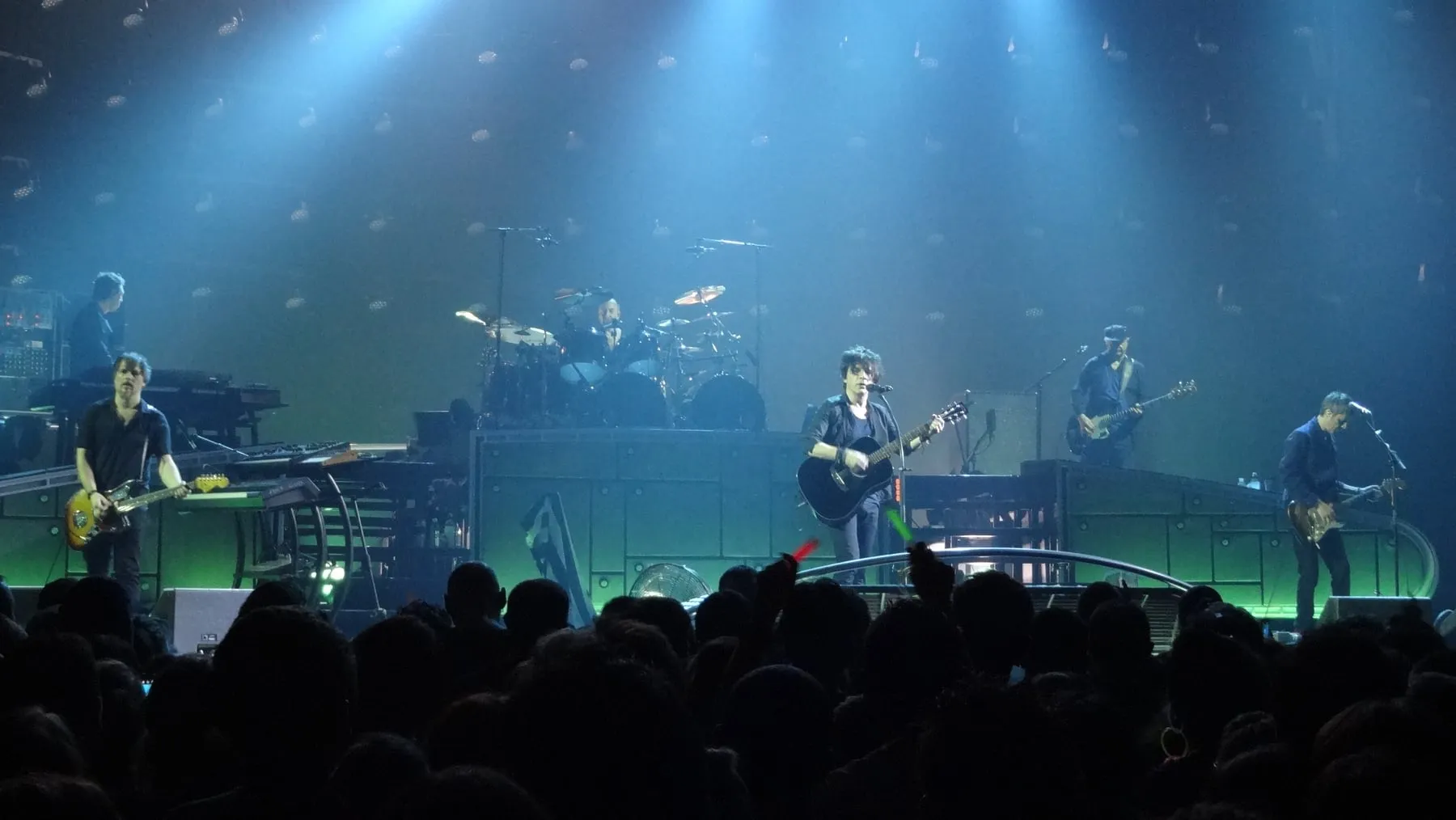
Photo by Jejecam , licensed under CC BY-SA 3.0 · Wikimedia Commons
Rank #277
Indochine
Paris New Wave veterans, France's biggest enduring rock band.
From Wikipedia
Indochine is a French rock and new wave band formed in Paris in 1981. It achieved significant success in the 1980s across the Francophone world, Europe, and Latin America with hit songs L'Aventurier and Canary Bay. After releasing several critically praised but commercially disappointing albums in the 1990s, the band experienced a resurgence with the 2002 album Paradize. To date, Indochine has sold over 10 million albums and singles worldwide.
Members
- Dimitri Bodiansky (1981–1989)
- Dominique Nicolas (1981–1995)
- Nicola Sirkis (1981–present)
- Stéphane Sirkis (1982–1999)
- Marc Éliard (1992–present)
- Boris Jardel (1998–present)
- François Soulier (2002–2015)
- Olivier Gérard (2002–present)
- François Matuszenski (2005–2015)
- Ludwig Dahlberg (2015–present)
Studio Albums
- 1982 L’Aventurier
- 1983 Le Péril jaune
- 1985 3
- 1987 7000 danses
- 1990 Le Baiser
- 1993 Un jour dans notre vie
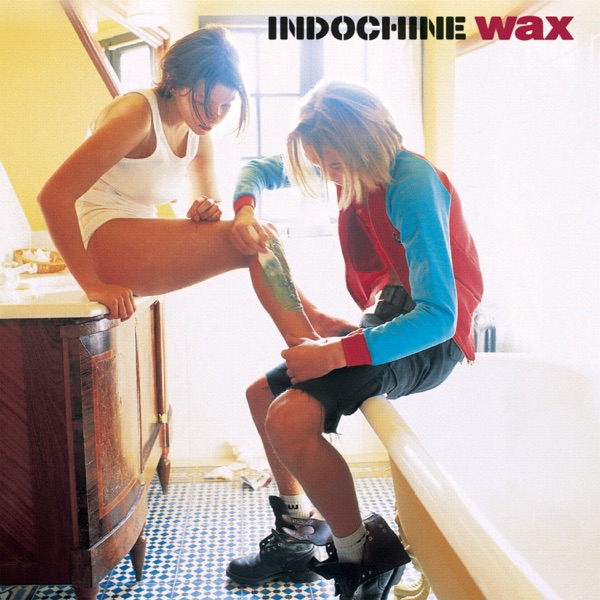
- 1996 Wax
- 1999 Dancetaria
- 2002 Paradize
- 2005 Alice & June
- 2009 La République des Meteors
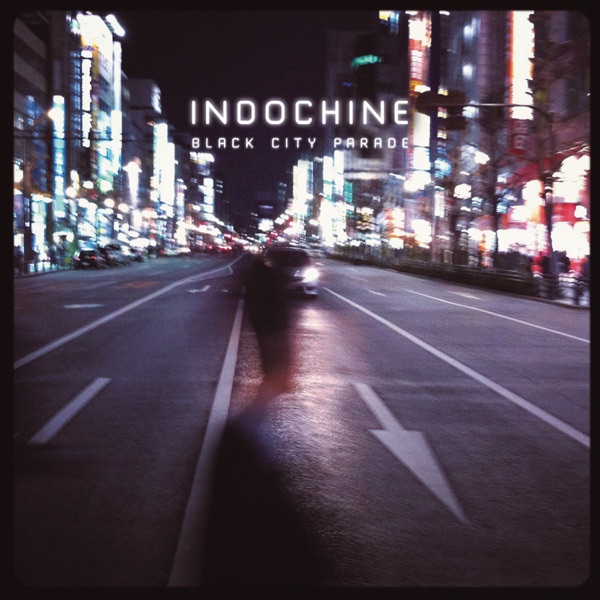
- 2013 Black City Parade
- 2017 13
- 2024 Babel Babel
Source: MusicBrainz
Deep Dive
Overview
Indochine stands as France’s most durable and commercially successful rock band, a position they have held since their formation in Paris in 1981. Emerging during the peak years of European new wave, they synthesized the electronic pulse and visual drama of that movement with the energy and songwriting sensibilities of rock, creating a sound that resonated across the Francophone world and beyond. With sales exceeding 10 million albums and singles worldwide, Indochine transcends the role of domestic fixture; they are a foundational force in French popular music and a bridge between Anglo-American new wave and European rock identity.
Formation Story
Indochine coalesced in Paris in 1981 around a core duo: Nicola Sirkis, who provided vocals and songwriting, and his brother Stéphane Sirkis, who joined in 1982. The founding ensemble included Dimitri Bodiansky, who remained with the group through the 1980s, along with Dominique Nicolas during the band’s crucial early years. The Paris new wave scene of the early 1980s was fertile ground for experimentation; the city had produced post-punk acts and electronic pioneers, and Indochine arrived with a distinct sensibility that married synth-driven arrangements to accessible pop-rock hooks and French-language vocals. This combination of accessibility and artistic ambition would define their trajectory across the next four decades.
Breakthrough Moment
Indochine’s debut album, L’Aventurier (1982), immediately signaled their commercial potential and introduced the title track, which became a defining hit. The single “L’Aventurier” and album established the band’s signature sound across French radio and into the broader European consciousness. A follow-up, Le Péril jaune (1983), consolidated their early success, proving that the debut was not a one-off phenomenon but evidence of sustained songwriting and recording prowess. Throughout the 1980s, albums including 3 (1985) and 7000 danses (1987) cemented their status as leaders of the French rock establishment, with consistent airplay and sold-out touring throughout Francophone territories and across Europe.
Peak Era
The 1980s and early 1990s constituted Indochine’s peak commercial and cultural moment. Albums released throughout this decade—L’Aventurier, Le Péril jaune, 3, 7000 danses, and Le Baiser (1990)—dominated French and European charts, and the band’s visual presentation, rooted in new wave aesthetics and theatrical staging, made them fixtures on music television. However, the mid-1990s presented a creative and commercial plateau; Un jour dans notre vie (1993) and Wax (1996) marked a period when the band’s commercial momentum slowed significantly. These years of diminished commercial success tested the band’s resilience but also proved foundational to their eventual renaissance.
Musical Style
Indochine’s sound is anchored in electronic and synthesizer-driven new wave, layered over rock-solid rhythmic foundations and melodic pop sensibilities. Vocals are characteristically French—direct, sung in the band’s native language—and often function as a unifying element that prioritizes intelligibility and emotional clarity over technical display. The production approach across their early albums emphasized bright, punchy synthesizer textures and crisp drum machines, hallmarks of early 1980s new wave production, while still maintaining enough bass weight and guitar presence to qualify as rock rather than pure electronic pop. Over time, particularly during their resurgence in the 2000s, the band incorporated live instrumentation more prominently, though the synth-pop DNA remained audible. Their songwriting gravitates toward concise, hook-laden structures that reward repeated listening and radio play—a trait that made them perfectly suited to the commercial landscape of their formation era and helps explain their longevity in an increasingly fragmented music market.
Major Albums
L’Aventurier (1982)
The debut and the album that established Indochine’s core identity: a tight blend of new wave synth work and rock-rooted song construction, anchored by the hit single that would define the band’s early profile across Europe and the Francophone world.
Le Péril jaune (1983)
A successful follow-up that proved the debut was not a fluke, refining the band’s palette and demonstrating their capacity to craft multiple radio-friendly singles without sacrificing cohesion.
7000 danses (1987)
One of the band’s most commercially successful albums of the 1980s, showcasing a band at the height of their powers during new wave’s waning influence on mainstream radio, yet still commanding significant audiences across Europe.
Paradize (2002)
A critical and commercial turning point after years of relative obscurity in the 1990s, Paradize reintroduced Indochine to contemporary audiences and initiated a second major phase of touring and album sales that would extend into the following two decades.
Alice & June (2005)
Released during the band’s sustained resurgence, this album consolidated their comeback trajectory and featured core members Nicola Sirkis alongside Marc Éliard, who joined in 1992 and remained central to the group’s sound.
Signature Songs
- L’Aventurier — The band’s breakthrough single and most enduring anthem, instantly recognizable for its propulsive synth riff and French-language vocals; remains a staple of radio and streaming across Europe.
- Canary Bay — Another major 1980s hit that showcased the band’s ability to craft melodic, immersive new wave compositions with international appeal.
- 3 — The title track from their 1985 album of the same name, exemplifying their mature synth-pop approach and songwriting precision.
Influence on Rock
Indochine’s role in French rock history is foundational. They proved that new wave aesthetics and synth-driven pop could thrive on a national scale while written and performed entirely in French, demonstrating that linguistic identity and commercial success were not mutually exclusive. Their sustained presence across four decades—from new wave’s 1980s apex through multiple subsequent eras of pop and rock evolution—established a template for French rock bands seeking both artistic credibility and mass audiences. They influenced subsequent Francophone rock and pop acts by example, showing that intelligent production, strong hooks, and consistent touring could sustain a career across changing market conditions. In the broader European context, Indochine situated French rock alongside concurrent movements in Germany, Italy, and the UK, and contributed to a vision of new wave and rock that transcended Anglo-American origins.
Legacy
Indochine remains France’s most commercially successful and consistently active rock band. Their presence on contemporary streaming platforms and in European touring circuits—they released 13 in 2017 and Babel Babel in 2024, confirming their unbroken continuity—underscores their role as cultural fixtures rather than period pieces. The band’s evolution from 1980s new wave darlings through a difficult 1990s interregnum and into a sustained second act beginning in 2002 offers a study in artistic longevity and audience loyalty. Their sales of over 10 million units worldwide place them among France’s most commercially successful musical exports, a status achieved through consistent album releases, extensive touring, and an unwavering commitment to French-language songwriting. In an era of streaming dominance and fractured attention spans, Indochine’s continued recording and touring activity, supported by a multigenerational fanbase, confirms their position as a cornerstone of rock music in the Francophone world.
Fun Facts
- The band’s name, Indochine, derives from French Indochina, the colonial administration that governed Vietnam, Cambodia, and Laos; the choice reflects the band’s fascination with exoticism and geographical romance, common touchstones in 1980s new wave culture.
- Marc Éliard, who joined the band in 1992 and remained central to their sound, was present throughout their difficult 1990s period and their triumphant 2000s resurgence, making him a crucial stabilizing force during the band’s transformation.
- Paradize, the 2002 album that sparked their comeback, arrived more than a decade after commercial relevance seemed possible and successfully repositioned the band to contemporary audiences, a feat few bands accomplish.
- The band’s visual aesthetic, rooted in new wave theatricality and 1980s design sensibilities, remained visually consistent across their careers; album artwork and performance staging often emphasized the geometric and futuristic aesthetics that defined their origin era.
Discography & Previews
Click any album to expand its track list. Each track plays a 30-second preview streamed from Apple Music. Tap the link icon next to a track to open it in Apple Music for full playback.


- 1 Le baiser ↗ 4:10
- 2 Des fleurs pour Salinger ↗ 3:14
- 3 More ↗ 7:02
- 4 Alertez Managua ↗ 3:55
- 5 Les années bazar ↗ 3:52
- 6 Punishment Park ↗ 3:50
- 7 Soudain l'eté dernier je suppose ↗ 3:52
- 8 Les plus mauvaises nuits ↗ 3:47
- 9 Persanne Thème ↗ 2:29
- 10 Tant de poussière ↗ 4:35
- 11 La colline des roses ↗ 3:59

- 1 Savoure le rouge ↗ 4:23
- 2 Sur les toits du monde ↗ 5:07
- 3 Un jour dans notre víe ↗ 4:01
- 4 Anne et moi ↗ 3:14
- 5 La main sur vous ↗ 4:55
- 6 Some Days ↗ 3:41
- 7 Bienvenue chez les nus ↗ 4:07
- 8 D'ici mon amour ↗ 4:44
- 9 Candy prend son fusil ↗ 3:16
- 10 Ultra S. ↗ 4:25
- 11 Víetnam Glam ↗ 4:05
- 12 Crystal Song Telegram ↗ 2:35


- 1 Paradize ↗ 4:50
- 2 Electrastar ↗ 5:30
- 3 Punker ↗ 2:50
- 4 Mao Boy ↗ 5:42
- 5 J'ai demandé à la lune ↗ 3:29
- 6 Dunkerque ↗ 5:48
- 7 Like a Monster ↗ 3:56
- 8 Le grand secret ↗ 5:50
- 9 La nuit des fées ↗ 4:58
- 10 Marilyn ↗ 5:55
- 11 Le manoír ↗ 5:05
- 12 Popstitute ↗ 4:00
- 13 Dark ↗ 4:37
- 14 Comateen ↗ 6:07
- 15 Un singe en hiver ↗ 3:46


- 1 Republika Meteor Ouverture ↗ 0:57
- 2 Go Rimbaud Go ! ↗ 4:09
- 3 Junior Song ↗ 3:10
- 4 Little Dolls ↗ 4:38
- 5 Le grand soir ↗ 3:43
- 6 Un ange à ma table ↗ 4:20
- 7 La lettre de métal ↗ 3:42
- 8 Le lac ↗ 3:30
- 9 Republika ↗ 4:16
- 10 Play Boy ↗ 2:50
- 11 L World ↗ 3:54
- 12 Je t'aime tant (with Gwen B & Suzanne Combo) ↗ 3:05
- 13 Bye Bye Valentine ↗ 4:41
- 14 Les aubes sont mortes ↗ 4:07
- 15 Union War ↗ 3:17
- 16 Le dernier jour (Inclus morceau caché) ↗ 7:33
- 17 We Are the Young ↗ 3:50
- 18 Mexicâne Syndiçate ↗ 3:53
- 19 You Spin Me Round (Like a Record) [Au profit de RSF] ↗ 3:11
- 1 Black City Parade (Parade Mix by Nicola Sirkis) ↗ 9:34
- 2 Black City Parade (True Shed and Jones by Shane Stoneback) ↗ 4:50
- 3 Black City Parade (True Shed and Jones by Shane Stoneback Instrumental Version) ↗ 4:40
- 4 Black City Parade (Black Disco Mix by Oli dE SaT) ↗ 9:50
- 5 Black City Parade (Klink Clock Remix) ↗ 3:39
- 6 Black City Parade ↗ 5:39

- 1 Black Sky ↗ 6:26
- 2 2033 ↗ 4:07
- 3 Station 13 ↗ 6:19
- 4 Henry Darger ↗ 5:29
- 5 La vie est belle ↗ 5:28
- 6 Kimono dans l'ambulance ↗ 5:52
- 7 Karma Girls ↗ 6:33
- 8 Suffragettes BB ↗ 5:56
- 9 Un été français ↗ 5:26
- 10 TomBoy 1 (feat. Kiddy Smile) ↗ 6:15
- 11 Song for a Dream ↗ 5:33
- 12 Cartagène ↗ 6:33
- 13 Gloria (feat. Asia Argento) ↗ 7:10
- 14 Trump le monde ↗ 6:08
- 15 La 13ème vague ↗ 4:59
- 16 Station 13 (Version longue) ↗ 8:07
- 17 Tomboy 2 ↗ 6:04
- 18 Henry Darger (John Digweed & Nick Muir Remix) ↗ 5:24
- 19 Un été français (Joachim Garraud Remix) ↗ 5:11
- 20 Station 13 (Vitalic Remix) ↗ 6:14
- 21 Station 13 (Talisco Remix) ↗ 4:41

- 1 Showtime (feat. Ana Perrote) ↗ 5:33
- 1 Babel Babel ↗ 8:07
- 2 L'amour fou ↗ 4:47
- 2 En route vers le futur ↗ 5:39
- 3 Ma vie est à toi ↗ 4:39
- 3 Girlfriend (feat. Marion Brunetto) ↗ 4:16
- 4 Victoria ↗ 4:36
- 4 Les nouveaux soleils ↗ 5:06
- 5 Sanna sur la croix ↗ 4:49
- 5 Tokyo Boy ↗ 6:42
- 6 La belle et la bête ↗ 4:04
- 6 No Name ↗ 4:24
- 7 Le chant des cygnes ↗ 5:39
- 7 Annabelle Lee ↗ 5:43
- 8 La vie est à nous ↗ 4:42
- 8 Seul au paradis ↗ 3:52
- 9 Le garçon qui rêve ↗ 4:54