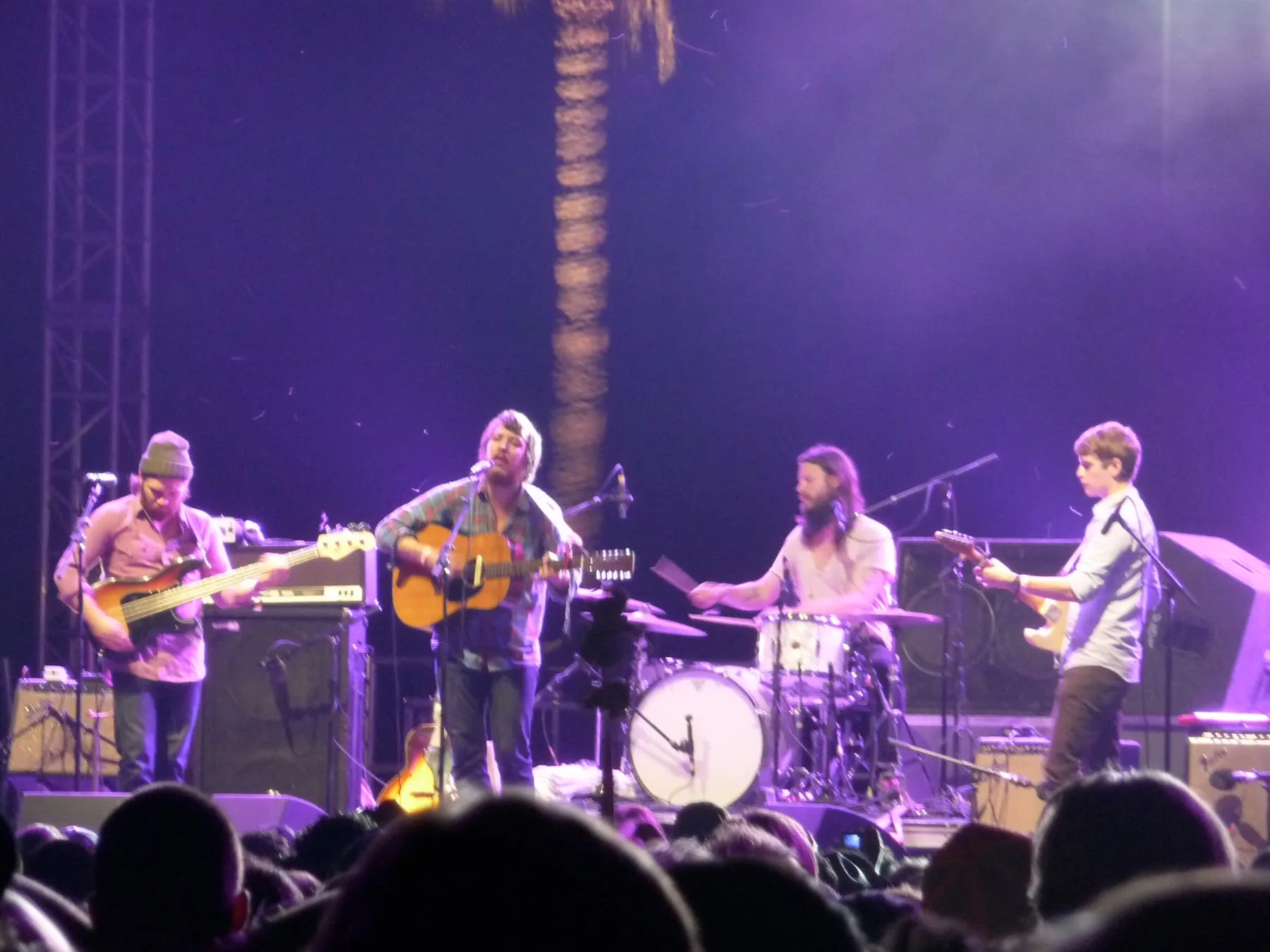
Photo by Fred von Lohmann , licensed under CC BY 2.0 · Wikimedia Commons
Rank #391
Fleet Foxes
Seattle indie-folk band of choral harmonies and pastoral textures.
From Wikipedia
Fleet Foxes are an American indie folk and folk rock band formed in Seattle, Washington, in 2006. The band currently consists of Robin Pecknold, Skyler Skjelset, Casey Wescott, Christian Wargo, and Morgan Henderson. Founding members Pecknold and Skjelset have been the only constants through the group's history, with the former serving as leader and principal songwriter.
Members
- Robin Pecknold
Studio Albums
- 2008 Fleet Foxes
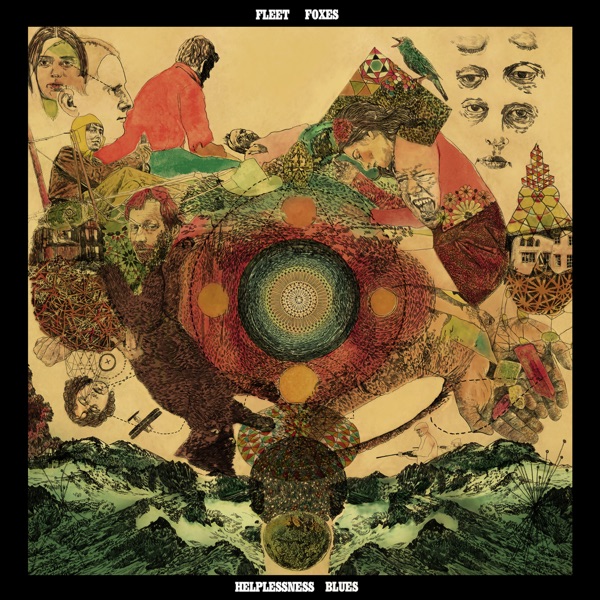
- 2011 Helplessness Blues
- 2017 Crack‐Up
- 2020 Shore
Source: MusicBrainz
Deep Dive
Overview
Fleet Foxes are an American indie folk and folk rock band formed in Seattle, Washington, in 2006. Built around the compositional vision and vocals of Robin Pecknold, the band became one of the defining acts of the 2010s indie-folk movement, distinguished by intricate multi-part vocal harmonies, acoustic instrumentation, and a production style that evokes both contemporary art-rock and traditional folk. Operating under the Sub Pop label, Fleet Foxes carved out a distinctive space in the broader landscape of 2010s indie rock by prioritizing texture, arrangement, and melodic sophistication over genre convention.
Formation Story
Fleet Foxes emerged from Seattle’s musical landscape in 2006, with Robin Pecknold establishing the project as its creative center and principal songwriter. Skyler Skjelset joined as a founding member, and together they formed the nucleus of the band that would persist through its entire history. The Seattle origin positioned the band within a city already associated with sonic innovation and a commitment to craftsmanship over commercial calculation. Though the band would grow to include Casey Wescott, Christian Wargo, and Morgan Henderson in its live and recording configurations, Pecknold and Skjelset remained the only members to appear throughout the group’s tenure, with Pecknold’s leadership and songwriting remaining the primary architectural force.
Breakthrough Moment
Fleet Foxes’ debut self-titled album, released in 2008, established their aesthetic identity and earned critical recognition within indie and folk-adjacent circles. The album’s success positioned the band for a broader breakthrough on their 2011 second album, Helplessness Blues. Released three years after their debut, Helplessness Blues represented both artistic refinement and commercial acceleration, solidifying their status as major figures in contemporary folk rock and introducing their approach to wider audiences. The album’s title track and overall sonic architecture—dense with layered vocals and organic instrumentation—became synonymous with the band’s identity and marked their transition from promising independent act to recognized force in 2010s indie rock.
Peak Era
The decade from 2008 to 2017 constituted Fleet Foxes’ most consistently acclaimed period. Following the success of Helplessness Blues, the band released Crack-Up in 2017, an album that showcased increased harmonic and structural complexity. Across these three releases, Fleet Foxes demonstrated sustained artistic ambition without sacrificing accessibility, building a discography that appealed to both critical and listener communities. The band’s collaborative approach to arrangement—with multiple members contributing instrumental and vocal parts—became increasingly sophisticated in this era, while maintaining the pastoral, nature-inflected aesthetic that defined their early work. By the time of Crack-Up, Fleet Foxes had established themselves as leading interpreters of folk-influenced indie rock, with a body of work that balanced experimental impulses against melodic coherence.
Musical Style
Fleet Foxes’ signature sound centers on multi-part vocal harmonies layered over acoustic and electric instrumentation. Their approach draws from traditional folk music while integrating contemporary recording techniques and art-rock structural principles. The band typically constructs songs around Pecknold’s lead vocals, supported by intricate harmonies from ensemble members, creating a choral richness that extends beyond conventional indie rock instrumentation. The use of acoustic guitar, strings, and carefully balanced production creates a texture that feels both intimate and expansive. Their harmonic sophistication—employing complex chord progressions and unexpected vocal arrangements—reflects both folk tradition and modernist sensibilities. The pastoral, sometimes melancholic emotional tenor of their work, combined with attention to lyrical detail and natural imagery, distinguishes Fleet Foxes from contemporaries in the indie-rock mainstream.
Major Albums
Fleet Foxes (2008)
The band’s debut established their core aesthetic: intricate vocal arrangements, acoustic instrumentation, and a commitment to melodic sophistication that set them apart from most contemporary indie rock.
Helplessness Blues (2011)
Their second album refined and expanded the formula, with Helplessness Blues becoming their most commercially successful work and introducing their orchestral approach to a wider audience through increased accessibility without sacrificing compositional depth.
Crack-Up (2017)
Released after a six-year gap, Crack-Up demonstrated increased harmonic and structural ambition, with the band pursuing greater experimental freedom while maintaining the vocal-centered aesthetic of their earlier work.
Shore (2020)
Fleet Foxes returned with Shore, marking their continued evolution and demonstrating sustained creative engagement with their folk-influenced indie rock foundation.
Signature Songs
- “White Winter Hymnal” — A choral showcase featuring interlocking vocal harmonies that became the band’s most recognizable and widely adopted song across streaming and contemporary playlists.
- “Mykonos” — An early track demonstrating the intimate, natural-imagery-driven songwriting that characterizes Pecknold’s composition style.
- “Helplessness Blues” — The title track from their 2011 album, featuring the band’s signature vocal richness and melancholic introspection.
- “Sim Sala Bim” — A compositional showcase for the band’s harmonic sophistication and instrumental arrangement approach.
Influence on Rock
Fleet Foxes’ success in the 2010s helped establish folk-influenced indie rock as a central strain within contemporary alternative music, demonstrating commercial viability for music prioritizing vocal harmony and acoustic instrumentation over conventional rock tropes. Their approach influenced subsequent generations of indie and folk-adjacent artists working with vocal harmonies and pastoral aesthetics. The band’s commitment to orchestral arrangement within indie rock—treating the ensemble as instrumental and vocal architects—provided a model for collaboration and ensemble-based composition that extended beyond their immediate scene. Their integration of folk tradition with contemporary recording techniques helped legitimize folk influences within indie rock discourse at a moment when such synthesis was not automatic.
Legacy
Fleet Foxes’ position in 2010s rock history remains secure based on the consistent critical acclaim and listener engagement across their four studio albums. The band’s sustained activity through 2020 and beyond, including their return after the six-year gap before Crack-Up, demonstrated durability beyond the typical indie-rock cycle. Their work has maintained significant streaming presence and continued cultural relevance within indie and folk communities. The band’s approach to vocal arrangement and their integration of folk sensibilities within contemporary indie rock contributed to broader musical conversations about the relationship between tradition and modernism in rock music. As a Seattle-based act operating through the Sub Pop label, they represent a distinct lineage within the city’s musical legacy.
Fun Facts
- The band’s founding lineup included Robin Pecknold and Skyler Skjelset, making them the only two members present throughout the entire history of the group.
- Fleet Foxes’ second album, Helplessness Blues, released in 2011, marked a significant commercial breakthrough following the critical reception of their 2008 debut.
- The six-year gap between Helplessness Blues and Crack-Up represented an extended creative hiatus before the band’s return to recording and active touring.
Discography & Previews
Click any album to expand its track list. Each track plays a 30-second preview streamed from Apple Music. Tap the link icon next to a track to open it in Apple Music for full playback.

- 1 Montezuma ↗ 3:37
- 2 Bedouin Dress ↗ 4:30
- 3 Sim Sala Bim ↗ 3:14
- 4 Battery Kinzie ↗ 2:49
- 5 The Plains / Bitter Dancer ↗ 5:54
- 6 Helplessness Blues ↗ 5:03
- 7 The Cascades ↗ 2:08
- 8 Lorelai ↗ 4:25
- 9 Someone You'd Admire ↗ 2:29
- 10 The Shrine / An Argument ↗ 8:07
- 11 Blue Spotted Tail ↗ 3:05
- 12 Grown Ocean ↗ 4:36

- 1 I Am All That I Need / Arroyo Seco / Thumbprint Scar ↗ 6:25
- 2 Cassius, - ↗ 4:50
- 3 - Naiads, Cassadies ↗ 3:11
- 4 Kept Woman ↗ 3:55
- 5 Third of May / Ōdaigahara ↗ 8:45
- 6 If You Need to, Keep Time on Me ↗ 3:31
- 7 Mearcstapa ↗ 4:10
- 8 On Another Ocean (January / June) ↗ 4:23
- 9 Fool's Errand ↗ 4:48
- 10 I Should See Memphis ↗ 4:44
- 11 Crack-Up ↗ 6:24

- 1 Wading In Waist-High Water ↗ 2:15
- 2 Sunblind ↗ 4:14
- 3 Can I Believe You ↗ 4:04
- 4 Jara ↗ 4:09
- 5 Featherweight ↗ 3:51
- 6 A Long Way Past The Past ↗ 4:00
- 7 For A Week Or Two ↗ 2:12
- 8 Maestranza ↗ 3:03
- 9 Young Man's Game ↗ 3:12
- 10 I'm Not My Season ↗ 3:11
- 11 Quiet Air / Gioia ↗ 4:28
- 12 Going-to-the-Sun Road ↗ 3:59
- 13 Thymia ↗ 2:23
- 14 Cradling Mother, Cradling Woman ↗ 5:10
- 15 Shore ↗ 4:20