
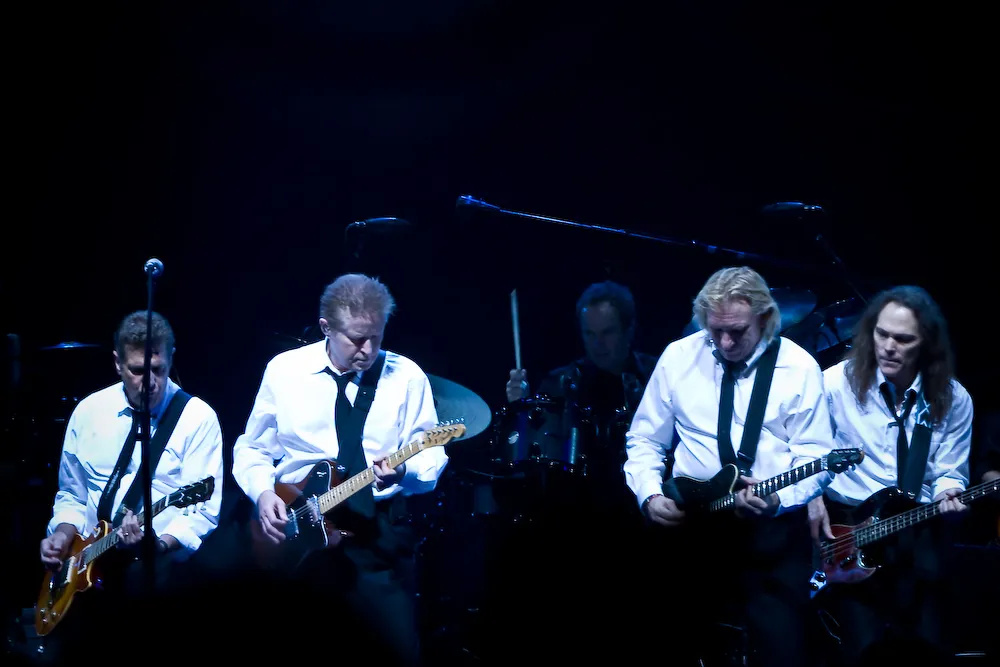
Photo by Steve Alexander , licensed under CC BY-SA 2.0 · Wikimedia Commons
Rank #22
Eagles
California country-rock harmonizers behind some of the best-selling albums ever.
From Wikipedia
The Eagles are an American rock band formed in Los Angeles in 1971. With five number-one singles, six number-one albums, six Grammy Awards and five American Music Awards, the Eagles were one of the most successful musical acts of the 1970s in North America. In addition, they are one of the world's best-selling music artists, having sold more than 200 million records worldwide, including 100 million sold in the US alone. They were inducted into the Rock and Roll Hall of Fame in 1998 and were ranked number 75 on Rolling Stone's 2010 list of the "100 Greatest Artists of All Time".
Members
- Don Henley · voice (1971–present)
- Glenn Frey · voice (1971–2016)
- Don Felder · voice (1974–2001)
- Joe Walsh · voice (1975–present)
- Timothy B. Schmit · voice (1977–present)
- Bernie Leadon
- Randy Meisner
Studio Albums
- 1972 Eagles
- 1973 Desperado
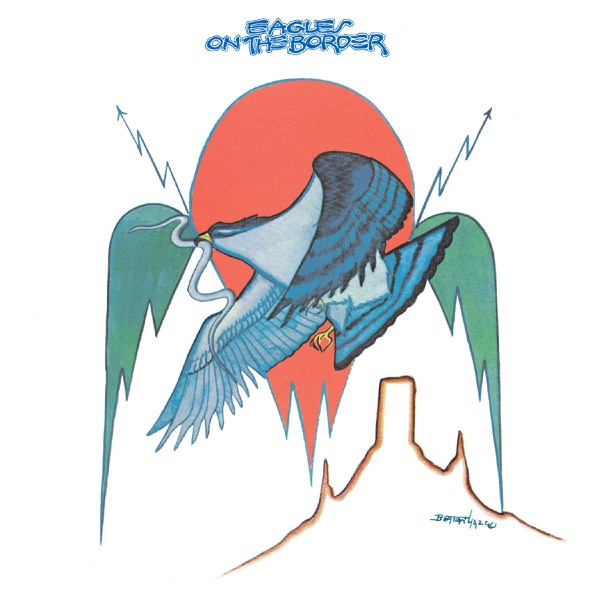
- 1974 On the Border
- 1975 One of These Nights
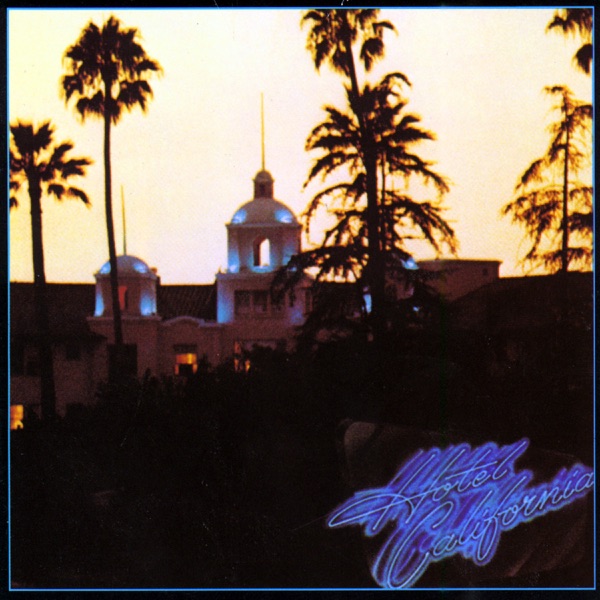
- 1976 Hotel California
- 1979 The Long Run
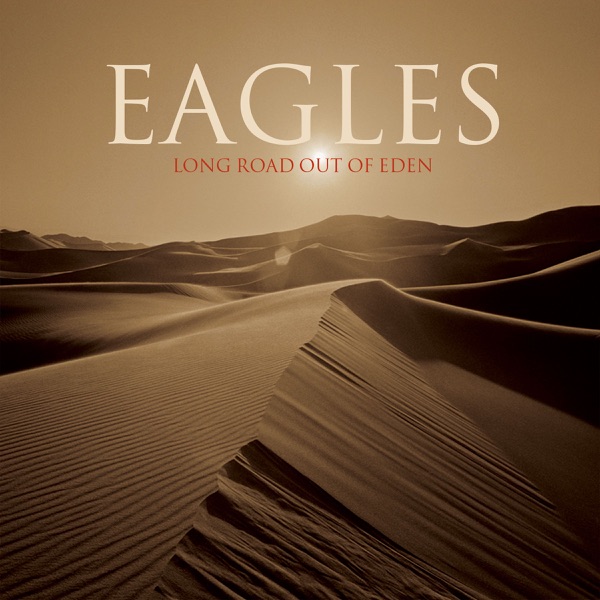
- 2007 Long Road Out of Eden
- 2017 The Kings of Hollywood: California Broadcast 1980
Source: MusicBrainz
Deep Dive
Overview
The Eagles are an American rock band formed in Los Angeles in 1971, and became one of the most successful musical acts of the 1970s in North America. Built on intricate vocal harmonies, country-rock instrumentation, and sharply crafted songwriting, the band achieved unprecedented commercial success with five number-one singles, six number-one albums, and sales exceeding 200 million records worldwide, including 100 million in the United States alone. Their influence on the sound of 1970s popular music was substantial and enduring, establishing a template for arena rock that balanced country and folk influences with professional studio production and vocal precision.
Formation Story
The Eagles emerged from Los Angeles in 1971, bringing together musicians from established California country-rock circles. The founding members were Don Henley on vocals, Glenn Frey on vocals and guitar, Bernie Leadon, and Randy Meisner. The band’s assembly reflected the era’s musical climate: a convergence of rock ambition with country and folk sensibilities that had flourished on the California coast. Los Angeles in the early 1970s was a fertile ground for this hybrid sound, with established record labels, a robust touring infrastructure, and an audience receptive to both radio-friendly melodies and instrumental sophistication.
Breakthrough Moment
The Eagles’ debut album, released in 1972, established the band’s commercial viability and sonic identity. However, it was their second album, Desperado (1973), that deepened their artistic reach and began to signal the scope of their ambition. The band’s breakthrough toward massive mainstream success arrived with On the Border (1974), which demonstrated their capacity to blend country storytelling with rock production values. This trajectory culminated in One of These Nights (1975), an album that secured their position as major commercial players and showcased the vocal interplay and instrumental polish that would define their peak.
Peak Era
The Eagles’ greatest period of commercial and creative dominance arrived with Hotel California (1976), one of the best-selling albums of the 1970s and a defining record of the decade. The album consolidated all elements of their sound—elaborate vocal harmonies, country-inflected rock structures, and meticulously layered studio production—into a cohesive statement that appealed across genre boundaries and demographic lines. By this point, the lineup included Don Felder (who joined in 1974) and Joe Walsh (who joined in 1975), expanding the band’s instrumental and vocal palette. The band continued this commercial momentum with The Long Run (1979), their final studio album before a lengthy breakup, during which members pursued solo careers and other projects. The 1970s represented the band’s era of maximum cultural penetration and sales, with their records dominating radio airplay and concert venues across North America.
Musical Style
The Eagles crafted a distinctive sound that drew from country music, folk traditions, and rock architecture. Their trademark approach centered on intricate four and five-part vocal harmonies, delivered by Henley, Frey, Meisner, and later Walsh and Felder, layered over electric guitar work that combined country fingerstyle techniques with rock power chords. Lyrically, they favored narrative storytelling rooted in American themes—journeys, relationships, moral complexity, and the darker currents of California life—delivered with clarity and emotional directness. The band’s studio production reflected the era’s advancing recording technology: each track was meticulously arranged, with overdubbed guitars, keyboard textures, and percussion designed to create density without sacrificing melody. The country-rock classification proved accurate but incomplete; their sound encompassed folk influences, pop sensibilities, and rock ambition in roughly equal measure, making them difficult to confine to any single genre box.
Major Albums
Eagles (1972)
The debut introduced the band’s harmonic approach and established the country-rock template they would refine over subsequent releases, creating immediate commercial traction and radio presence.
Desperado (1973)
A concept-adjacent album exploring outlaw narratives and Americana themes, deepening the band’s artistic ambitions beyond straightforward rock-and-roll delivery.
One of These Nights (1975)
This album cemented their transition to superstardom, with increasingly sophisticated production and songwriting that showcased their mastery of radio-friendly yet substantive rock composition.
Hotel California (1976)
Perhaps the defining album of their career, this record achieved unprecedented commercial saturation while maintaining musical credibility, selling millions of copies and becoming a cultural touchstone of the 1970s.
The Long Run (1979)
Their final collaborative album before an extended breakup, demonstrating that their commercial appeal remained intact even as their creative unity began to fragment.
Long Road Out of Eden (2007)
A studio album released after decades away from recording together, marking their return to the recording studio and demonstrating the band’s continued relevance.
Signature Songs
- “Take It Easy” — A country-rock manifesto and one of their defining early hits, establishing the band’s laid-back yet ambitious aesthetic.
- “Tequila Sunrise” — A mid-tempo showcase for their vocal harmonies and intricate guitar work.
- “Desperado” — The centerpiece of their second album, a character study delivered with dramatic emotional weight.
- “One of These Nights” — A confident, radio-dominating track that exemplified their commercial peak.
- “Hotel California” — Their most enduring song, a complex composition that became a cultural landmark and remains ubiquitous in popular consciousness.
- “Life in the Fast Lane” — A rock-oriented track featuring driving guitar work and commentary on excess and modern life.
- “The Long Run” — The title track of their final 1970s album, showcasing their ability to build extended compositional narratives.
Influence on Rock
The Eagles’ success established country-rock as a commercially viable major-label genre and demonstrated that intricate vocal harmony and sophisticated production could coexist with rock credibility. They influenced the trajectory of 1970s arena rock, showing that bands could achieve massive sales without sacrificing instrumental or compositional substance. Their approach to studio recording—treating each album as a complete sonic statement with meticulous layering and arrangement—set standards that would influence rock production practices across subsequent decades. The band’s emphasis on vocal precision and harmonic complexity influenced both their contemporaries and later acts working in the rock and country-rock idioms, establishing a lineage that extended well beyond the 1970s.
Legacy
The Eagles were inducted into the Rock and Roll Hall of Fame in 1998, cementing their status as canonical figures in American rock history. They were ranked number 75 on Rolling Stone’s 2010 list of the “100 Greatest Artists of All Time,” a placement reflecting their sustained cultural impact and commercial achievement. Their records remain among the best-selling albums worldwide, with sales continuing to accumulate through physical formats, digital downloads, and streaming platforms decades after their initial release. The band remained active through touring and occasional studio work, with the lineup adjusting over time. Their 2007 return to studio recording with Long Road Out of Eden demonstrated that their audience and commercial viability persisted, even as the music industry underwent fundamental transformation. The Eagles’ catalog continues to represent the 1970s at its commercial and artistic apex, with their records serving as reference points for understanding that era’s popular music landscape.
Fun Facts
- The Eagles’ formation in Los Angeles coincided with the explosion of country-rock as a dominant commercial force, positioning them at the exact intersection of musical trends and audience demand.
- Glenn Frey (1971–2016) remained a core member from the band’s formation through his death, making him a constant presence across the entire span of their canonical 1970s output and their subsequent reunions.
- Joe Walsh, who joined in 1975, brought significant guitar prowess and songwriting contributions that expanded the band’s textural possibilities during their peak commercial period.
- Timothy B. Schmit joined as a voice member in 1977, arriving during the The Long Run era and continuing as an active member through to the present day.
Discography & Previews
Click any album to expand its track list. Each track plays a 30-second preview streamed from Apple Music. Tap the link icon next to a track to open it in Apple Music for full playback.




- 1 No More Walks In the Wood ↗ 2:01
- 1 Long Road Out of Eden ↗ 10:17
- 2 How Long ↗ 3:16
- 2 I Dreamed There Was No War ↗ 1:38
- 3 Busy Being Fabulous ↗ 4:21
- 3 Somebody ↗ 4:09
- 4 What Do I Do With My Heart ↗ 3:54
- 4 Frail Grasp On the Big Picture ↗ 5:46
- 5 Guilty of the Crime ↗ 3:44
- 5 Last Good Time In Town ↗ 7:07
- 6 I Don't Want To Hear Any More ↗ 4:21
- 6 I Love To Watch a Woman Dance ↗ 3:16
- 7 Waiting In the Weeds ↗ 7:46
- 7 Business As Usual ↗ 5:31
- 8 No More Cloudy Days ↗ 4:03
- 8 Center of the Universe ↗ 3:42
- 9 Fast Company ↗ 4:01
- 9 It's Your World Now ↗ 4:22
- 10 Do Something ↗ 5:12
- 11 You Are Not Alone ↗ 2:24