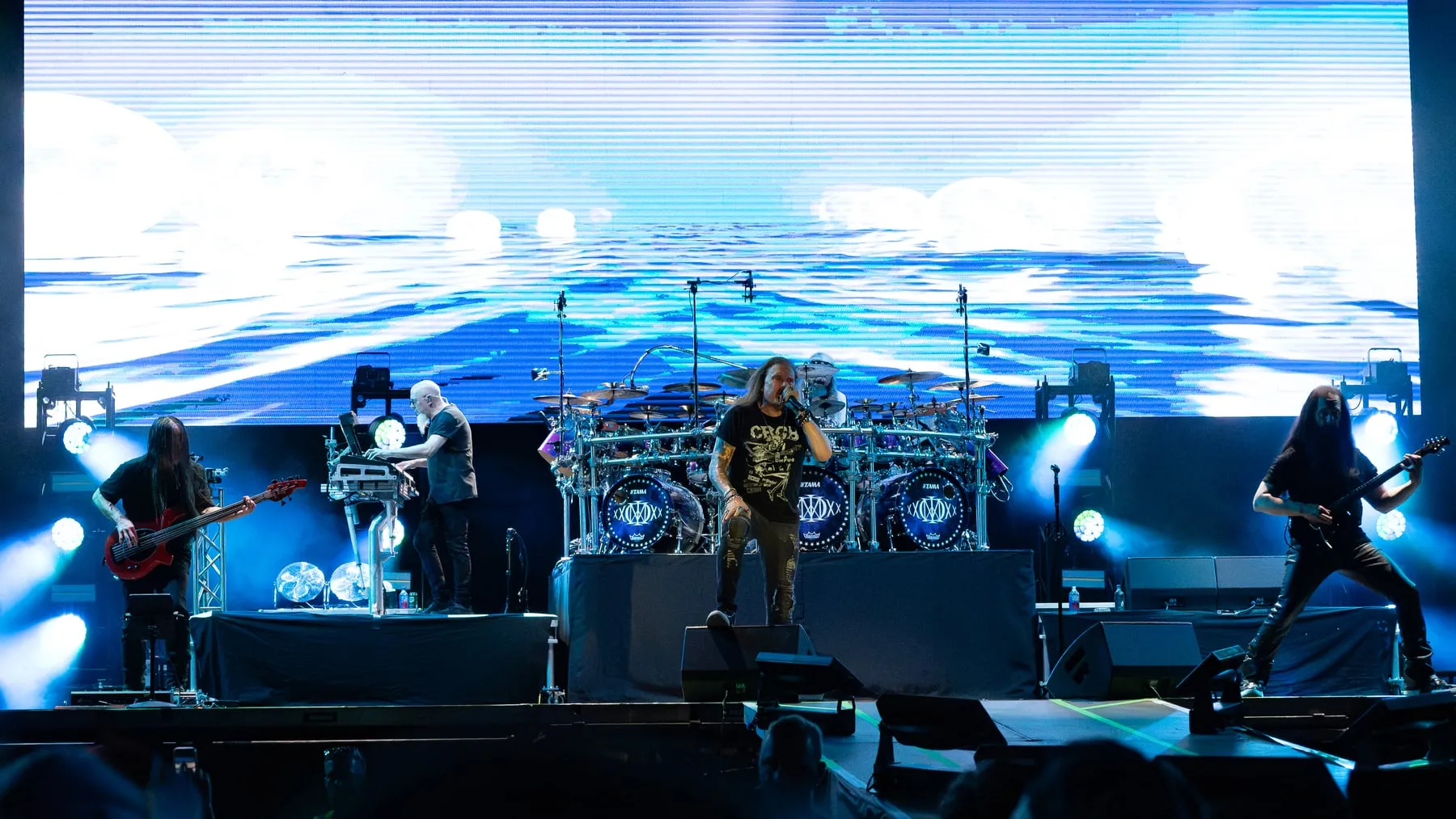
Photo by Dario De Marco , licensed under Public domain · Wikimedia Commons
Rank #291
Dream Theater
Long Island progressive-metal flagship of arena-scale shred.
From Wikipedia
Dream Theater is an American progressive metal band formed in 1985 in Boston, Massachusetts. The band comprises John Petrucci (guitar), John Myung (bass), Mike Portnoy (drums), James LaBrie (vocals), and Jordan Rudess (keyboards).
Members
- Chris Collins (1985–1985)
- John Myung (1985–present)
- John Petrucci (1985–present)
- Kevin Moore (1985–1994)
- Charlie Dominici (1988–1989)
- James LaBrie (1991–present)
- Derek Sherinian (1994–1999)
- Jordan Rudess (1999–present)
- Mike Mangini (2010–2023)
- Mike Portnoy (2023–present)
Deep Dive
Overview
Dream Theater is an American progressive metal band that emerged from the Boston area in 1985 and became one of the defining acts of 1990s progressive rock and metal fusion. Centered on the technical prowess of guitarist John Petrucci and keyboardist Jordan Rudess, the band constructed sprawling compositions that fused complex time signatures, virtuosic instrumental passages, and arena-rock ambitions. With a lineup anchored by bassist John Myung and vocalist James LaBrie, Dream Theater created a template for modern progressive metal that emphasized technical precision and ambitious song structures.
Formation Story
Dream Theater crystallized in 1985 when John Petrucci and John Myung, both committed to pushing the boundaries of rock musicianship, began collaborating with Chris Collins on guitar. The band’s earliest incarnation worked to establish itself on the Boston-area rock circuit, though significant lineup changes followed almost immediately. Drummer Mike Portnoy joined the group in the late 1980s, bringing a percussive approach marked by rapid-fire polyrhythmic fills and a progressive sensibility that would become central to the band’s identity. Keyboardist Kevin Moore provided the instrumental texture during the band’s formative years, while vocalist Charlie Dominici occupied the microphone only briefly, from 1988 to 1989. James LaBrie, who took over vocal duties in 1991, would become the band’s permanent frontman and the voice that carried Dream Theater through its mainstream breakthrough.
Breakthrough Moment
Dream Theater’s leap to widespread recognition came with the 1992 release of Images and Words, their second studio album, which established the band as a dominant force in progressive metal. The record showcased a fully mature songwriting approach: extended compositions that built from quieter, keyboard-driven passages into explosive guitar-and-drum showcases, all while maintaining harmonic complexity and structural ambition. The album’s commercial and critical success positioned the band as standard-bearers for a progressive metal movement that was gaining traction among audiences hungry for musicians who could play their instruments with exceptional technical skill. Subsequent albums like Awake (1994) and Metropolis, Pt. 2: Scenes From a Memory (1999) solidified Dream Theater’s status as arena-headliners and festival stalwarts.
Peak Era
The decade spanning the mid-1990s through the early 2000s represented Dream Theater’s creative and commercial zenith. Metropolis, Pt. 2: Scenes From a Memory in 1999 marked an artistic high point, showcasing the band’s ability to construct an elaborate narrative across a double album’s worth of material, with instrumental sections that displayed technical mastery without sacrificing melodic sensibility. Albums including Six Degrees of Inner Turbulence (2002) and Train of Thought (2003) sustained that momentum, each stretching the boundaries of what could be achieved within progressive metal’s framework. During this stretch, keyboardist Jordan Rudess, who joined in 1999, became an essential voice in the band’s sonic palette, his classical training and synthesizer command adding orchestral depth to Petrucci’s guitar work. The early 2000s cemented Dream Theater’s position as one of rock’s most technically proficient and structurally ambitious acts, capable of filling large venues across North America and Europe.
Musical Style
Dream Theater’s sound synthesizes classical music theory, heavy metal aggression, and progressive rock’s architectural ambition. Petrucci’s guitar playing ranges from rapid arpeggiated passages and sweep-picked solos to clean, jazz-inflected fingerstyle work; his tone emphasizes clarity and articulation even at extreme tempos. Rudess’s keyboard contributions span from grand-piano voicings and atmospheric synthesizer sweeps to distorted electronic textures and rapid note runs that match or rival Petrucci’s instrumental velocity. Myung’s bass playing operates in multiple registers simultaneously, often providing harmonic foundation while also engaging in countermelodic dialogue with the guitars. Portnoy’s drumming is characterized by intricate kick-drum patterns, sudden meter changes, and fills that integrate ideas from jazz and classical music rather than adhering strictly to rock conventions. LaBrie’s vocals sit atop these instrumental complexities, his range and power carrying melody through compositions that can shift fundamentally from section to section. The band’s production tends toward clarity and separation, allowing each instrument to be heard distinctly even in passages of maximum density.
Major Albums
Images and Words (1992)
The album that announced Dream Theater as a major force, combining technical proficiency with strong songwriting and establishing the template for modern progressive metal. The record achieved platinum certification and remains the band’s most commercially successful effort.
Awake (1994)
A conceptual deepening that saw the band exploring longer composition lengths and more abstract harmonic territory while maintaining accessibility. Awake reinforced Dream Theater’s status as progressive metal leaders.
Metropolis, Pt. 2: Scenes From a Memory (1999)
A double album and narrative rock opera that stands as the band’s most ambitious artistic statement, combining elaborate storytelling with instrumental virtuosity and demonstrating that progressive metal could sustain listener engagement across extended playtime.
Six Degrees of Inner Turbulence (2002)
A sprawling effort that further expanded the band’s dynamic range and compositional scope, featuring both intricate instrumental passages and more emotionally direct vocal moments.
Train of Thought (2003)
A tightly constructed album that balanced technical display with memorable melodies, showcasing the full maturity of Rudess’s contributions and the band’s collective command of their craft.
Distance Over Time (2019)
A recent album that illustrated Dream Theater’s sustained ability to craft sophisticated progressive metal decades into their existence, maintaining technical standards while remaining engaged with contemporary production values.
Signature Songs
- “Pull Me Under” — The breakthrough single from Images and Words, combining complexity with an accessible pop-rock sensibility that brought the band’s first real radio exposure.
- “Take the Time” — A showcase for the band’s instrumental interplay and dynamic range, building from quiet introspection to explosive crescendos.
- “Metropolis—Part 1” — The opening track of Metropolis, Pt. 2, establishing the album’s conceptual framework with dramatic musical storytelling.
- “Six Degrees of Separation” — An extended composition that highlights the band’s ability to sustain complex ideas across double-digit minute counts.
- “Panic Attack” — A song whose rhythmic complexity and lyrical intensity exemplify Dream Theater’s technical ambition even in relatively concise song forms.
Influence on Rock
Dream Theater established a blueprint for progressive metal that influenced subsequent generations of musicians who sought to combine heavy guitar tones with jazz-informed harmony and classical-music complexity. The band’s technical standard—the expectation that rock musicians should master their instruments to near-virtuosic levels—rippled through metal and hard rock communities. Bands emerging after Images and Words often measured themselves against Dream Theater’s instrumental proficiency, while the group’s album-oriented approach and resistance to verse-chorus-verse simplicity provided an alternative model to grunge and alternative rock’s dominant aesthetic of the 1990s. The band demonstrated that audiences existed for music that demanded active, engaged listening rather than passive consumption, helping legitimize progressive metal as a sustainable commercial category.
Legacy
Dream Theater’s influence on 21st-century rock and metal remains substantial. The band continues to record and tour extensively, maintaining a devoted international fanbase that values their uncompromising approach to composition and performance. Their extensive discography—spanning from 1989 to the present—provides a working archive of progressive metal’s evolution across multiple decades, with recent albums like A View From the Top of the World (2021) and Parasomnia (2025) demonstrating that the band continues to develop musically rather than repeating past templates. Streaming platforms have made Dream Theater’s complete catalog accessible to younger listeners, introducing the band to audiences who might not have encountered progressive metal through traditional radio or MTV exposure. The group’s sustained activity and continued artistic output ensure their position as one of the handful of bands that defined late 20th-century progressive rock and extended that legacy credibly into contemporary contexts.
Fun Facts
- Dream Theater has released sixteen studio albums across a career spanning forty years, with drummer Mike Portnoy returning to the band in 2023 after several years away, rejoining founding bassist John Myung and guitarist John Petrucci.
- Keyboardist Jordan Rudess trained classically as a piano virtuoso before joining Dream Theater in 1999, bringing a formal musical education that shaped the band’s orchestral approach to composition.
- The band’s 1999 album Metropolis, Pt. 2: Scenes From a Memory operated as a narrative concept album, with the album’s track sequence unfolding a complex story across multiple movements.
- John Petrucci and John Myung have remained with the band continuously since its 1985 formation, making them the longest-tenured members and primary creative constants throughout Dream Theater’s evolution.