
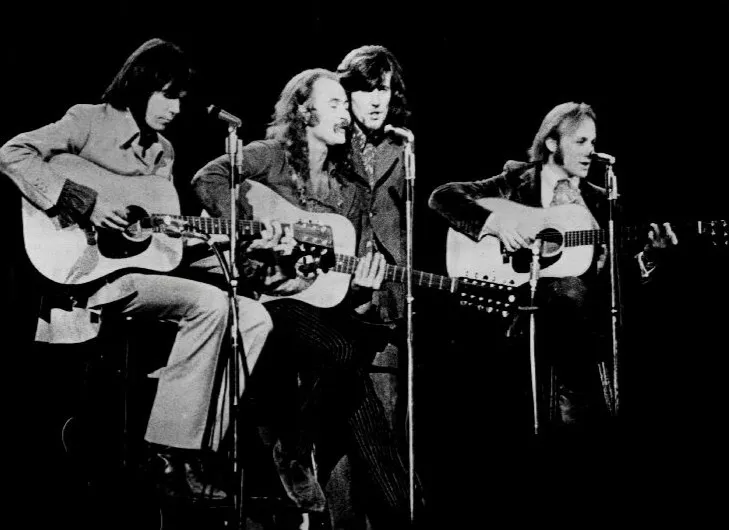
Photo by CMA-Creative Management Associates/Atlantic Records , licensed under Public domain · Wikimedia Commons
Rank #82
Crosby, Stills, Nash & Young
Harmony-rich supergroup whose softer rock defined a folkier strand of the era.
From Wikipedia
Crosby, Stills & Nash (CSN) was a folk rock supergroup composed of the American singer-songwriters David Crosby and Stephen Stills and the English-American singer-songwriter Graham Nash. When joined by the Canadian singer-songwriter Neil Young, they were known as Crosby, Stills, Nash & Young (CSNY). They are noted for their intricate vocal harmonies and lasting influence on American music and culture, their political activism and their tumultuous relationships.
Members
- David Crosby
- Graham Nash
- Neil Young
- Stephen Stills
Studio Albums
- 1970 Déjà vu
- 1988 American Dream
- 1999 Looking Forward
Source: MusicBrainz
Deep Dive
Overview
Crosby, Stills & Nash emerged in 1968 as a folk rock supergroup built on the foundation of three accomplished singer-songwriters: American David Crosby and Stephen Stills, alongside English-American Graham Nash. When Canadian Neil Young joined the lineup, the group became Crosby, Stills, Nash & Young (CSNY), a collective whose intricate vocal harmonies and politically charged songwriting came to define a softer, more acoustic strand of American rock during the early 1970s. Their formation represented a convergence of talent from earlier influential groups—Crosby from The Byrds, Stills from Buffalo Springfield, and Nash from The Hollies—making CSNY less a new band than a merger of established artists at the height of their creative powers.
Formation Story
The group came together in Los Angeles in 1968, when Crosby, Stills, and Nash united to pool their songwriting and vocal abilities. Each member brought years of professional experience and a reputation for melodic sophistication. When Neil Young, whose work in Buffalo Springfield had established him as a distinctive guitarist and songwriter, joined the lineup, the ensemble achieved a four-part harmony and instrumental depth that became its trademark. The Los Angeles scene of the late 1960s provided both the cultural context and the recording infrastructure that allowed these four musicians to craft their sound with precision.
Breakthrough Moment
The supergroup’s debut album, released in 1969, quickly established their commercial and critical presence, but the 1970 release of Déjà vu marked their definitive breakthrough. That album showcased the group’s tightened arrangements, fuller production, and expanded songwriting palette. Déjà vu became a landmark achievement in folk rock, demonstrating that acoustic-based songwriting and complex harmonies could command mainstream audiences without sacrificing artistic ambition. The album’s success confirmed that CSNY was not a novelty supergroup but a lasting creative force capable of sustained output and evolution.
Peak Era
The period surrounding Déjà vu represented the group’s commercial and creative peak. The album’s reception established CSNY as central figures in 1970s rock, their influence extending well beyond folk rock into the broader landscape of soft rock and country rock. Their harmonies became a benchmark against which many subsequent groups would be measured. The internal tensions and occasional periods of dissolution that would come to characterize the group were not yet dominant; instead, the four members functioned as a cohesive unit, each contributing equally to the creative vision. This period underscored their lasting influence on American music and culture, a position cemented by their political activism and willingness to address contemporary social issues through their songwriting.
Musical Style
Crosby, Stills, Nash & Young built their sound on close vocal harmonies layered over acoustic and electric guitar arrangements. Each member’s vocal tone contributed distinctly to the blend—Crosby’s warm, somewhat languid phrasing; Stills’s more aggressive delivery; Nash’s clear, soaring tenor; and Young’s often raw, piercing voice. The instrumentation typically centered on acoustic guitars, supplemented by electric guitars, bass, and drums in varying proportions depending on the song’s demands. Their approach drew from folk music’s emphasis on lyrical content and melodic clarity while incorporating the fuller production values of contemporary rock. The sound evolved across their work, moving from the relatively sparse arrangements of their early recordings toward the more elaborate orchestrations evident on Déjà vu, yet always maintaining the harmonic sophistication and acoustic foundation that defined their core identity.
Major Albums
Déjà Vu (1970)
The group’s landmark second album, Déjà vu solidified their position as one of rock’s premier harmony ensembles and demonstrated their ability to balance commercial accessibility with artistic complexity. The album’s success established the template for their sound across the decade.
American Dream (1988)
Released after years of separation and internal conflict, American Dream reunited all four members and marked a return to collaborative recording. The album signified the group’s ability to reconvene and produce work together despite their famously tumultuous relationships.
Looking Forward (1999)
This later reunion album showcased the group’s continued songwriting capabilities and their willingness to engage with contemporary production techniques while maintaining their signature harmonic approach.
Signature Songs
- “Suite: Judy Blue Eyes” — Stills’s extended composition featuring one of rock’s most recognizable vocal arrangements and showcasing the group’s harmonic precision.
- “Helplessly Hoping” — A three-part harmony showcase that became emblematic of CSNY’s vocal interplay and intimate songwriting.
- “Our House” — Nash’s domestic meditation, rendered as a warm, accessible pop-rock number that demonstrated the group’s range beyond extended acoustic arrangements.
- “Déjà Vu” — The title track, a Crosby composition that exemplified the group’s sophisticated harmonic layering and production ambition.
Influence on Rock
Crosby, Stills, Nash & Young’s impact extended across multiple dimensions of 1970s rock and beyond. Their demonstration that supergroups could function as more than celebrity exercises—that assembling established artists could yield creatively cohesive and commercially successful work—influenced the formation of numerous subsequent collaborations. Their approach to vocal harmony informed soft rock and country rock traditions throughout the 1970s and beyond. The group’s willingness to engage with political themes in their songwriting established a template for socially conscious rock music. Their intricate production techniques and emphasis on studio craftsmanship influenced how rock musicians approached the recording process, demonstrating that folk-based material could benefit from sophisticated arrangement and production without losing its essential character. The harmonic vocabulary they developed became foundational for generations of singer-songwriters and rock bands seeking to balance accessibility with musical sophistication.
Legacy
Crosby, Stills, Nash & Young’s legacy resides in their fundamental contribution to defining one strand of 1970s rock—the acoustic-based, harmony-rich alternative to the louder, blues-rooted hard rock dominating the same period. Their willingness to reunite multiple times across decades, despite the personal conflicts that frequently divided the group, underscored both the power of their musical chemistry and the difficulty of maintaining such collaborations. The group’s work remained central to rock radio and streaming platforms, ensuring that their influence extended continuously from their peak era through subsequent generations. The members’ continued individual careers as solo artists and their periodic reunions kept CSNY’s catalog and concept alive in the popular consciousness, while their early records remained touchstones for understanding how folk and rock traditions could intersect with mass-market success.
Fun Facts
- The group’s formation brought together musicians from three previously established bands: David Crosby (The Byrds), Stephen Stills and Neil Young (Buffalo Springfield), and Graham Nash (The Hollies).
- Graham Nash was English-American, making CSNY genuinely international in composition despite forming in Los Angeles.
- The group’s internal conflicts and periodic dissolutions became nearly as famous as their music, with multiple reunions and breakups spanning decades.
- Atlantic Records served as the group’s primary label throughout their recording history.
Discography & Previews
Click any album to expand its track list. Each track plays a 30-second preview streamed from Apple Music. Tap the link icon next to a track to open it in Apple Music for full playback.

- 1 Carry On ↗ 4:26
- 2 Teach Your Children ↗ 2:53
- 3 Almost Cut My Hair ↗ 4:29
- 4 Helpless ↗ 3:37
- 5 Woodstock ↗ 3:54
- 6 Déjà Vu ↗ 4:12
- 7 Our House ↗ 3:00
- 8 4 + 20 ↗ 2:07
- 9 Country Girl: A. Whiskey Boot Hill / B. Down, Down, Down / C. "Country Girl" (I Think You're Pretty) ↗ 5:12
- 10 Everybody I Love You ↗ 2:22

- 1 American Dream ↗ 3:18
- 2 Got It Made ↗ 4:56
- 3 Name of Love ↗ 4:13
- 4 Don't Say Goodbye ↗ 3:23
- 5 This Old House ↗ 4:50
- 6 Nighttime for the Generals ↗ 4:10
- 7 Shadowland ↗ 4:47
- 8 Drivin' Thunder ↗ 3:16
- 9 Clear Blue Skies ↗ 3:07
- 10 That Girl ↗ 3:31
- 11 Compass ↗ 5:28
- 12 Soldiers of Peace ↗ 3:47
- 13 Feel Your Love ↗ 4:14
- 14 Night Song ↗ 4:13
