
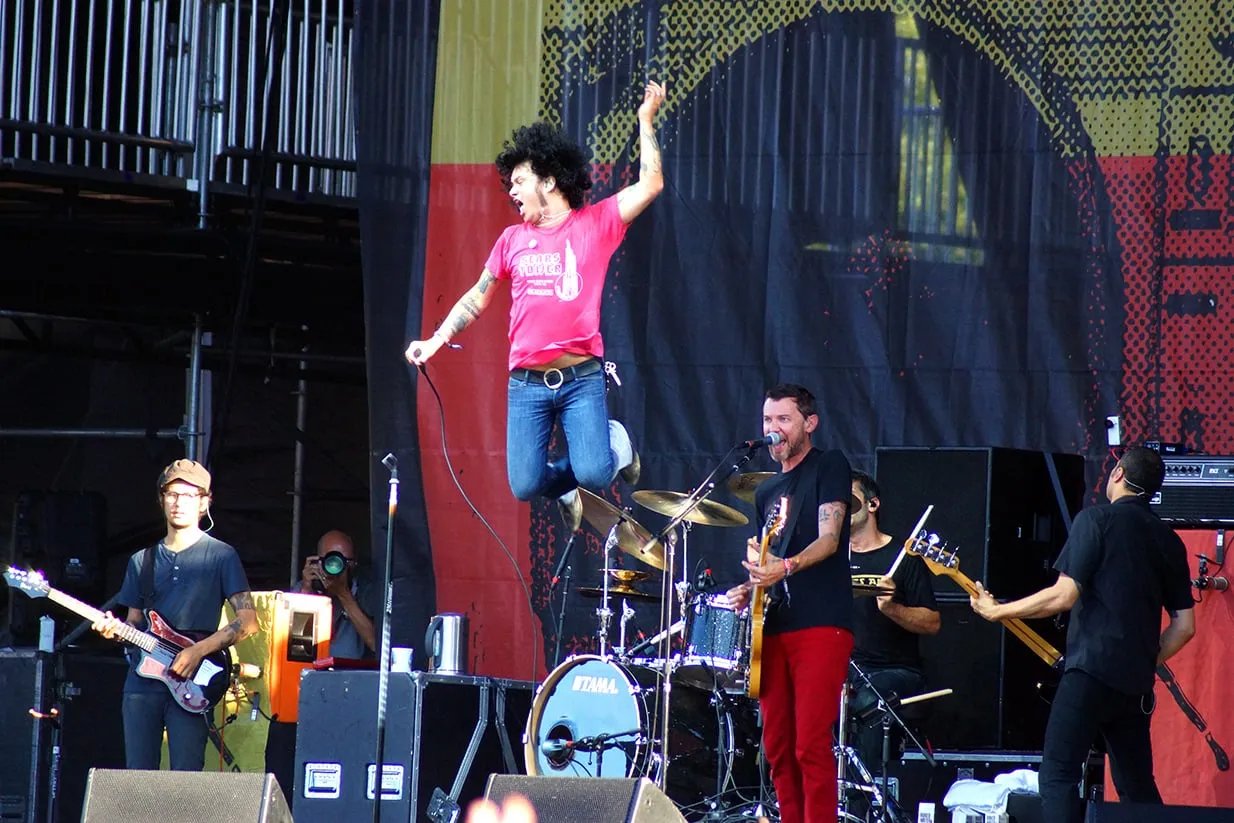
Photo by Shane Hirschman from Hollywood, CA , licensed under CC BY-SA 2.0 · Wikimedia Commons
Rank #146
At the Drive-In
El Paso post-hardcore band whose 'Relationship of Command' is a touchstone.
From Wikipedia
At the Drive-In was an American post-hardcore band from El Paso, Texas, formed in 1994. The band's most recent line-up consisted of Cedric Bixler-Zavala (vocals), Omar Rodríguez-López, Paul Hinojos (bass), Tony Hajjar (drums) and Keeley Davis. After several early line-up changes, the band solidified into a five-piece, consisting of Bixler-Zavala, Rodríguez-López, Jim Ward, Hinojos and Hajjar.
Members
- Cedric Bixler-Zavala
- Jim Ward
- Omar Rodríguez-López
- Paul Hinojos
- Tony Hajjar
Studio Albums
- 1996 Acrobatic Tenement
- 1998 In/Casino/Out
- 2000 Relationship of Command
- 2017 in·ter a·li·a
Source: MusicBrainz
Deep Dive
Overview
At the Drive-In was an American post-hardcore band from El Paso, Texas, formed in 1993. Operating across two distinct eras separated by a decade-long hiatus, the band became synonymous with the post-hardcore resurgence of the early 2000s through their landmark third album, Relationship of Command, which stands as a touchstone of the genre. The band’s jagged, high-velocity approach to post-hardcore—combining fractured guitar work, rapid-fire drumming, and urgent vocal delivery—positioned them as intellectual provocateurs within a scene often reduced to teenage angst, proving that punk aggression and structural complexity were not mutually exclusive.
Formation Story
At the Drive-In coalesced in El Paso during 1993, drawing from the city’s underexplored punk and post-punk heritage. After several early lineup fluctuations, the band stabilized around Cedric Bixler-Zavala on vocals, Omar Rodríguez-López on guitar, Jim Ward on guitar, Paul Hinojos on bass, and Tony Hajjar on drums. This five-piece crystallized the band’s sonic identity: a propulsive, technically demanding style grounded in post-hardcore but filtered through a punk ethos of immediacy and confrontation. The lineup’s chemistry forged during El Paso’s insular but creatively fertile underground scene became the foundation for everything that followed.
Breakthrough Moment
At the Drive-In’s initial recordings—Acrobatic Tenement in 1996 and In/Casino/Out in 1998—established them as skilled craftspeople within post-hardcore’s rising tide. However, their watershed moment arrived with Relationship of Command in 2000. Released when the post-hardcore underground was reaching critical mass, the album galvanized the band’s reputation beyond regional cult status into the broader alternative rock consciousness. The record’s combination of architectural precision and emotional volatility caught critics and fans mid-career: here was a band that refused easy categorization, whose music sounded simultaneously aggressive and cerebral, urgent and composed. Relationship of Command became the gateway through which the wider rock audience discovered At the Drive-In.
Peak Era
The years following Relationship of Command’s release marked At the Drive-In’s apex of cultural resonance and creative momentum. The band toured extensively, their live performances becoming legendary for their intensity and unpredictability—a characteristic that would define their reputation in real time. This period solidified their standing as a cornerstone band of early-2000s post-hardcore, a genre increasingly populated by disciples of their template. The band’s output during this window established the sonic vocabulary that would influence scores of bands across the following decade, from their contemporaries in post-hardcore to musicians working in adjacent underground scenes.
Musical Style
At the Drive-In’s music existed in the productive tension between control and chaos. Rodríguez-López and Ward constructed guitar parts that favored dissonance, sharp angles, and sudden shifts in texture over traditional rock melody, while Hajjar’s drumming delivered kinetic propulsion through intricate, polyrhythmic patterns that avoided straight 4/4 predictability. Hinojos’s bass provided a third melodic voice rather than simple rhythmic underpinning, weaving through the guitars’ fractured landscape. Bixler-Zavala’s vocals, pitched somewhere between singing and shouting, delivered lyrics with percussive urgency, treating his voice as another rhythmic instrument capable of sudden tonal swings. The overall effect was post-hardcore in lineage but executed with a punk sensibility: the songs breathed, they surged, they fractured, but they never became overindulgent or precious. Production-wise, the band’s records favored clarity over mud, ensuring that every instrumental layer remained distinct even as the song structure resisted conventional verse-chorus logic.
Major Albums
Acrobatic Tenement (1996)
The band’s debut established their core approach: jagged post-hardcore built on complex arrangements and Bixler-Zavala’s convulsive vocal style, introducing the formal precision that would become their hallmark.
In/Casino/Out (1998)
A refinement of their debut’s template, this record deepened the band’s compositional ambitions while maintaining their rawness, positioning them as serious contenders in the expanding post-hardcore underground.
Relationship of Command (2000)
The band’s defining statement and the album that transcended underground cult status, Relationship of Command remains the most immediately recognizable At the Drive-In record and a cornerstone of 21st-century post-hardcore.
in·ter a·li·a (2017)
Released 17 years after Relationship of Command, this reunion album demonstrated the band’s continued relevance and their ability to expand on previous sonic templates without simply imitating their most celebrated period.
Signature Songs
- “One Armed Scissor” — The closest At the Drive-In came to a radio-friendly single, this song distilled their fractured energy into a relatively concise package while maintaining structural ambition.
- “Rolodex Propaganda” — A showcase for the band’s ability to deploy controlled chaos and sudden dynamics shifts, building from whisper to crescendo across its runtime.
- “Give It a Name” — Demonstrates Bixler-Zavala’s vocal versatility and the band’s skill at constructing tension through minimal, economical instrumentation before explosive release.
- “Winter Month Novel” — One of their most architecturally ambitious compositions, proving post-hardcore could encompass genuine compositional depth.
Influence on Rock
At the Drive-In’s impact on post-2000 rock music extended far beyond their underground origins. They became a template for bands seeking to balance intellectual rigor with punk immediacy, demonstrating that post-hardcore need not choose between accessibility and complexity. The band’s success inspired countless musicians to view post-hardcore not as a dead-end subgenre but as a living tradition capable of generating new variations. Their emphasis on rhythm as a melodic element and their structural adventurousness rippled through alternative rock, influencing bands across multiple genres who sought to apply post-hardcore’s fractured sensibility to their own work. The band’s reunion in 2016 and subsequent output signaled the genre’s longevity in the streaming era, proving that early-2000s post-hardcore held enduring appeal for audiences discovering it for the first time and those returning to it with historical perspective.
Legacy
At the Drive-In’s position within rock history solidified around Relationship of Command, an album that remains in heavy rotation within alternative rock discourse and streaming catalogs. The band’s departure from the scene after their initial run left a vacuum that drove considerable retrospective mythologizing; their return in 2017 with in·ter a·li·a confirmed that their influence had only deepened in their absence. The band stands as one of the few post-hardcore acts to maintain genuine cultural resonance across multiple decades, their music neither dated by period aesthetics nor rendered obsolete by genre evolution. Their live presence continues to draw both longtime adherents and newer listeners discovering the band through algorithmic pathways, ensuring that their catalog remains vital rather than merely historical.
Fun Facts
- At the Drive-In hailed from El Paso, Texas, a city far removed from traditional post-hardcore strongholds like New York, California, or the Pacific Northwest, yet produced one of the genre’s most influential acts.
- The band’s hiatus lasted over a decade before reuniting, during which members pursued various side projects that expanded their sonic and creative possibilities.
- Omar Rodríguez-López and Cedric Bixler-Zavala later collaborated in The Mars Volta, bringing the fractured, complex aesthetic they pioneered at At the Drive-In into progressive-leaning alternative rock.
Discography & Previews
Click any album to expand its track list. Each track plays a 30-second preview streamed from Apple Music. Tap the link icon next to a track to open it in Apple Music for full playback.


- 1 Arcarsenal ↗ 2:55
- 2 Pattern Against User ↗ 3:18
- 3 One Armed Scissor ↗ 4:20
- 4 Sleepwalk Capsules ↗ 3:27
- 5 Invalid Litter Dept. ↗ 6:05
- 6 Mannequin Republic ↗ 3:03
- 7 Enfilade ↗ 5:01
- 8 Rolodex Propaganda ↗ 2:55
- 9 Quarantined ↗ 5:25
- 10 Cosmonaut ↗ 3:23
- 11 Non-Zero Possibility ↗ 5:34
- 12 Extracurricular ↗ 4:00
- 13 Catacombs ↗ 4:14

- 1 No Wolf Like the Present ↗ 3:39
- 2 Continuum ↗ 4:02
- 3 Tilting At the Univendor ↗ 3:27
- 4 Governed By Contagions ↗ 3:27
- 5 Pendulum In a Peasant Dress ↗ 3:41
- 6 Incurably Innocent ↗ 3:27
- 7 Call Broken Arrow ↗ 4:11
- 8 Holtzclaw ↗ 3:50
- 9 Torrentially Cutshaw ↗ 3:12
- 10 Ghost-Tape No. 9 ↗ 4:16
- 11 Hostage Stamps ↗ 3:53