
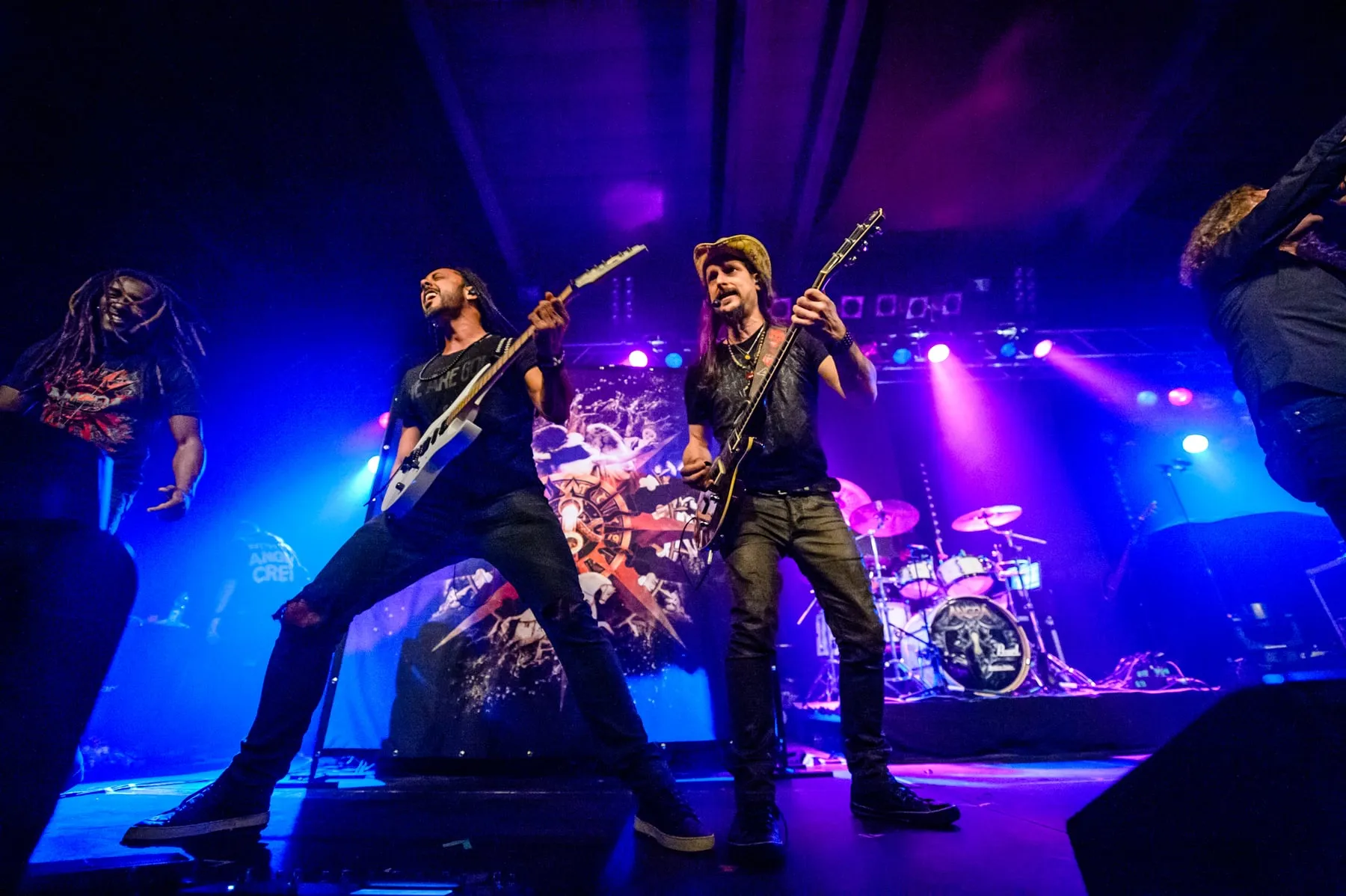
Photo by © Markus Felix | PushingPixels ( contact me ) , licensed under CC BY-SA 3.0 · Wikimedia Commons
Rank #262
Angra
São Paulo power-metal band of operatic and Brazilian flavor.
From Wikipedia
Angra is a Brazilian power metal band formed in 1991. They have released ten regular studio albums, six EPs, and seven live CD/DVDs to date. Led by Rafael Bittencourt, the band has gained a degree of popularity in Japan and Europe.
Members
- Andre Matos (1991–2000)
- Luís Mariutti (1991–2000)
- Rafael Bittencourt (1991–present)
- Kiko Loureiro (1992–2015)
- Edu Falaschi (2000–2012)
- Aquiles Priester (2001–2008)
- Felipe Andreoli (2001–present)
- Fabio Lione (2013–present)
- Bruno Valverde (2014–present)
- Marcelo Barbosa (2015–present)
- André Hernandes
- Ricardo Confessori (?–2014)
Studio Albums
- 1993 Angels Cry
- 1996 Holy Land
- 1998 Fireworks
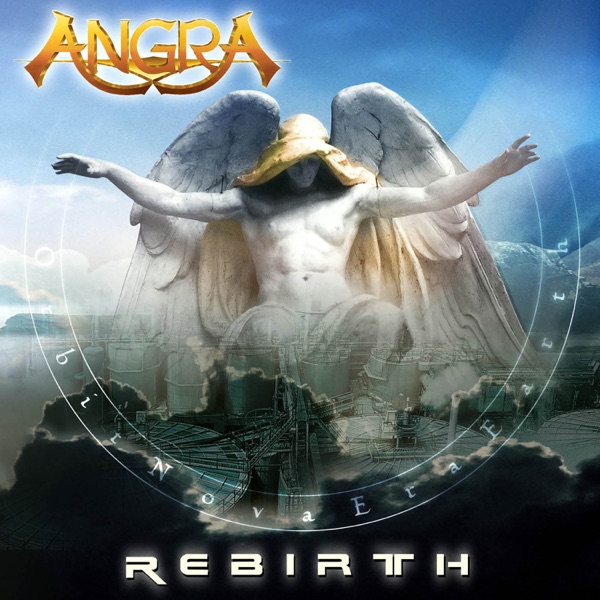
- 2001 Rebirth
- 2004 Temple of Shadows
- 2006 Aurora Consurgens
- 2010 Aqua
- 2014 Secret Garden
- 2018 ØMNI
- 2023 Cycles of Pain
Source: MusicBrainz
Deep Dive
Overview
Angra is a Brazilian power metal band formed in São Paulo in 1991, operating continuously for over three decades. The group occupies a singular niche in the global metal landscape: a power metal outfit that synthesizes European symphonic metal traditions with Brazilian harmonic and rhythmic sensibilities, anchored by operatic vocal performances and progressive metal instrumentation. While Brazilian metal as a whole remained marginal in Western markets until the late 2000s, Angra developed a dedicated following in Japan and Europe, establishing themselves as one of the few non-European acts to achieve sustained recognition in the power metal and symphonic metal subgenres.
Formation Story
Angra was founded in 1991 in São Paulo by Rafael Bittencourt, whose guitar work and compositional direction would remain the band’s backbone throughout their existence. The initial lineup included vocalist Andre Matos, bassist Luís Mariutti, and other founding members who grounded the project in the burgeoning metal scene of São Paulo. The band emerged in the early 1990s at a moment when power metal and progressive metal were consolidating their identity in Europe—particularly in Germany, Scandinavia, and Italy—but Angra’s formation in Brazil positioned them as geographic outsiders, a status that would inform their distinctive artistic voice. The decision to incorporate symphonic elements and operatic vocal styles reflected both European influence and a deliberate artistic choice to distinguish themselves in an increasingly crowded subgenre.
Breakthrough Moment
Angra’s debut album, Angels Cry (1993), introduced their signature blend of operatic vocals, symphonic arrangements, and technical metal instrumentation to a wider audience. Released early in their career, the album established the template that would define their approach: multilayered songwriting, virtuosic guitar and keyboard work, and the use of operatic tenor vocals as a primary melodic instrument. Holy Land (1996) followed three years later, solidifying their reputation and expanding their fanbase within European and Japanese metal communities. These early records positioned Angra as innovators within the power metal field, drawing comparisons to European symphonic metal acts while maintaining a distinctly Brazilian identity in their harmonic approach and compositional DNA.
Peak Era
The period spanning 2001 to 2010—encompassing the albums Rebirth (2001), Temple of Shadows (2004), Aurora Consurgens (2006), and Aqua (2010)—marked Angra’s most creatively ambitious and commercially successful phase. The 2001 arrival of drummer Aquiles Priester and bassist Felipe Andreoli strengthened the rhythm section, while vocalist Edu Falaschi, who joined in 2000, brought a different vocal timbre and range to the band’s operatic approach, replacing founding member Andre Matos. This lineup oversaw a series of albums that deepened Angra’s symphonic textures while maintaining the technical complexity that had become their trademark. Temple of Shadows in particular refined their compositional approach, and Aqua demonstrated their ability to evolve beyond their initial formula without losing their foundational identity. During this decade, the band’s popularity in Japan solidified, and European festival appearances became regular fixtures.
Musical Style
Angra’s sound is fundamentally rooted in power metal—marked by fast tempos, distorted electric guitars, and emphatic rhythmic drive—but inflected heavily with symphonic metal elements that distinguish them from traditional European power metal acts. The band employs keyboard arrangements that recall classical composition, particularly in their use of orchestral swells and layered harmonic textures, alongside six-string electric guitar work that balances speed and melody. Rafael Bittencourt’s compositions favor intricate song structures, often incorporating time signature shifts and dynamic range that ally the band with progressive metal traditions. Vocally, Angra has always emphasized operatic tenor delivery—whether through Andre Matos in their early years or Edu Falaschi in the 2000s and beyond, and later Fabio Lione from 2013 onward—treating the voice as another instrument within the symphonic architecture rather than a vehicle for conventional verse-chorus-verse song structure. Brazilian harmonic language and rhythmic inflection, subtle but consistent, thread through their arrangements, grounding their European-influenced aesthetic in a distinctly South American musical identity.
Major Albums
Angels Cry (1993)
Angra’s debut established their core identity: operatic vocals, technical guitar work, symphonic keyboards, and progressive song structures that rejected verse-chorus-verse convention in favor of compositional ambition.
Holy Land (1996)
The follow-up deepened the symphonic elements while refining the band’s balance between melody and technical virtuosity, expanding their reputation within European and Asian metal communities.
Temple of Shadows (2004)
Released during the Edu Falaschi era, this album represented a creative peak, synthesizing symphonic metal arrangements with mature songwriting and production clarity that showcased the band’s range across multiple vocal and instrumental textures.
Aurora Consurgens (2006)
Continuing their evolution, Aurora Consurgens demonstrated Angra’s ability to refine their symphonic approach while maintaining the technical foundations that had always defined them.
Aqua (2010)
This album showcased the band’s comfort with their established sound while exploring new territory in arrangement and production, cementing their status as elder statesmen of the power metal tradition.
Signature Songs
- Angels Cry — The title track from their debut, an operatic power metal showcase that announced Angra’s arrival and established their signature fusion of symphonic and technical metal elements.
- Holy Land — The defining track from their second album, combining progressive composition with operatic vocal delivery and symphonic orchestration.
- Lisbon — A complex progressive metal composition demonstrating the band’s facility with dynamic arrangement and technical instrumentation across extended song structures.
- Wuthering Heights — Angra’s reimagining of the Kate Bush classic, serving as a flagship demonstration of their operatic vocal approach and symphonic metal sensibilities.
Influence on Rock
Angra’s sustained presence in the power metal and symphonic metal subgenres influenced how subsequent metal acts outside Europe approached the symphonic tradition. Their Brazilian origin and relentless technical approach proved that power metal could flourish outside the European strongholds of Germany, Scandinavia, and Italy, opening artistic and commercial pathways for metal musicians from non-traditional metal nations. The band’s consistent emphasis on operatic vocals and symphonic arrangement—particularly their rejection of aggressive harsh vocals in favor of trained tenor delivery—reinforced a distinct branch of power metal that prioritized melody and orchestration alongside speed and technical precision. Through their discography and consistent touring presence in Japan, Angra contributed to the globalization of power metal audiences and the recognition of metal as a legitimate international phenomenon beyond Europe and North America.
Legacy
Over three decades of continuous activity, Angra has released ten studio albums and numerous live recordings and EPs, establishing a body of work that remains a touchstone for symphonic power metal. Their role in establishing Brazil as a source of significant metal innovation—rather than merely a market for European and American acts—has historical importance within heavy metal historiography. The band’s longevity reflects the deep global infrastructure of metal fandom, particularly in Japan and Europe, where touring and album sales sustained their career even as mainstream Western rock radio ignored them. Subsequent Brazilian metal bands emerged in part because Angra had already demonstrated commercial viability and international credibility. Angra’s place in metal history is neither as influential as the foundational power metal acts of the 1980s and early 1990s, nor as commercially omnipresent as mainstream metal acts, but rather as consistent innovators who proved that regional identity and non-English-language or accent-marked vocal delivery need not limit metal’s commercial reach and artistic legitimacy.
Fun Facts
- The band’s consistent lineup changes, particularly the arrival of drummer Aquiles Priester in 2001 and the 2013 transition to vocalist Fabio Lione, demonstrate how Angra prioritized musical direction and composition over static personnel, allowing Rafael Bittencourt’s vision to evolve across multiple vocalist eras.
- Angra’s early popularity in Japan during the 1990s and 2000s—a market that embraced symphonic and power metal while Western mainstream rock shifted toward alternative styles—proved crucial to their sustained recording and touring career.
- The band’s operatic vocal approach predated and ran counter to the increasingly growl-and-scream-dominated aesthetic of extreme metal that dominated the late 1990s and 2000s, positioning them as traditionalists within a progressive metal context.
Discography & Previews
Click any album to expand its track list. Each track plays a 30-second preview streamed from Apple Music. Tap the link icon next to a track to open it in Apple Music for full playback.



- 1 Deus Le Volt! ↗ 0:52
- 2 Spread Your Fire ↗ 4:25
- 3 Angels and Demons ↗ 4:11
- 4 Waiting Silence ↗ 4:55
- 5 Wishing Well ↗ 4:00
- 6 The Temple of Hate ↗ 5:13
- 7 The Shadow Hunter ↗ 8:06
- 8 No Pain for the Dead ↗ 5:05
- 9 Winds of Destination ↗ 6:56
- 10 Sprouts of Time ↗ 5:09
- 11 Morning Star ↗ 7:39
- 12 Late Redemption ↗ 4:55
- 13 Gate XIII ↗ 5:06


- 1 Cyclus Doloris ↗ 0:48
- 2 Ride into the Storm ↗ 6:12
- 3 Dead Man on Display ↗ 6:07
- 4 Tide of Changes (Pt. I) ↗ 1:15
- 5 Tide of Changes (feat. Vanessa Moreno) [Pt. II] ↗ 5:38
- 6 Vida Seca ↗ 5:11
- 7 Gods of the World ↗ 4:44
- 8 Cycles of Pain ↗ 5:14
- 9 Faithless Sanctuary ↗ 6:39
- 10 Here in the Now ↗ 5:54
- 11 Generation Warriors ↗ 5:09
- 12 Tears of Blood ↗ 5:36